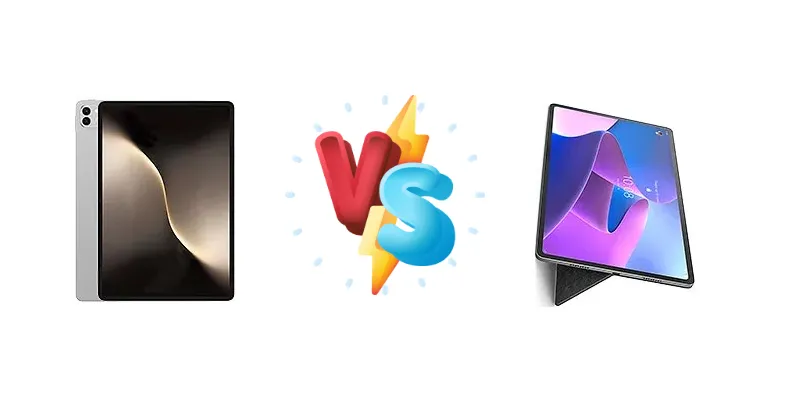
The Android tablet market is heating up, with the Honor MagicPad 3 entering the fray with Qualcomm’s flagship Snapdragon 8 Gen 3. This puts it directly against established players like the Lenovo Tab P12 Pro, powered by the still-capable Snapdragon 870. This comparison dissects the key differences to help you determine which tablet best suits your needs.
🏆 Quick Verdict
For users prioritizing raw performance and future-proofing, the Honor MagicPad 3 is the clear winner thanks to its Snapdragon 8 Gen 3. However, the Lenovo Tab P12 Pro remains a compelling option for those seeking a balanced experience with a proven track record and potentially lower price point.
| Network |
|---|
| 2G bands | N/A | GSM 850 / 900 / 1800 / 1900 |
| 3G bands | N/A | HSDPA 850 / 900 / 1900 / 2100 |
| 4G bands | N/A | 1, 2, 3, 4, 5, 7, 8, 19, 20, 26, 28, 34, 38, 39, 40, 41 |
| 5G bands | - | 1, 3, 7, 8, 20, 28, 38, 41, 77, 78 SA/NSA/Sub6 |
| EDGE | No | - |
| GPRS | No | - |
| Speed | - | HSPA, LTE, 5G - cellular model only |
| Technology | No cellular connectivity | GSM / HSPA / LTE / 5G |
| Launch |
|---|
| Announced | 2025, July 02 | 2021, September 08 |
| Status | Available. Released 2025, July 02 | Available. Released 2021, November 19 |
| Body |
|---|
| Dimensions | 293.9 x 201.4 x 5.8 mm (11.57 x 7.93 x 0.23 in) | 285.6 x 184.5 x 5.6 mm (11.24 x 7.26 x 0.22 in) |
| SIM | No | Nano-SIM (cellular model only) |
| Weight | 595 g (1.31 lb) | 565 g (1.25 lb) |
| | - | Stylus support |
| Display |
|---|
| Resolution | 2136 x 3200 pixels, 3:2 ratio (~289 ppi density) | 1600 x 2560 pixels, 16:10 ratio (~240 ppi density) |
| Size | 13.3 inches, 527.0 cm2 (~89.0% screen-to-body ratio) | 12.6 inches, 460.3 cm2 (~87.4% screen-to-body ratio) |
| Type | IPS LCD, 1B colors, 165Hz, HDR Vivid, 1000 nits (peak) | AMOLED, 120Hz, HDR10+, Dolby Vision, 600 nits (HBM) |
| Platform |
|---|
| CPU | Octa-core (1x3.3 GHz Cortex-X4 & 3x3.2 GHz Cortex-A720 & 2x3.0 GHz Cortex-A720 & 2x2.3 GHz Cortex-A520) | Octa-core (1x3.2 GHz Kryo 585 & 3x2.42 GHz Kryo 585 & 4x1.80 GHz Kryo 585) |
| Chipset | Qualcomm SM8650-AC Snapdragon 8 Gen 3 (4 nm) | Qualcomm SM8250-AC Snapdragon 870 5G (7 nm) |
| GPU | Adreno 750 (1 GHz) | Adreno 650 |
| OS | Android 15, MagicOS 9 | Android 11 |
| Memory |
|---|
| Card slot | No | microSDXC (dedicated slot) |
| Internal | 256GB 8GB RAM, 256GB 12GB RAM, 512GB 16GB RAM, 1TB 16GB RAM | 128GB 6GB RAM, 256GB 8GB RAM |
| Main Camera |
|---|
| Dual | 13 MP, f/2.0, AF
2 MP (macro) | 13 MP, (wide), AF
5 MP, (ultrawide) |
| Features | LED flash | - |
| Video | 4K@30fps, 1080p@30fps | 4K@30fps, 1080p@30fps |
| Selfie camera |
|---|
| Single | 9 MP, f/2.2 | 8 MP, (wide)
8 MP, IR TOF 3D, (biometrics sensor only) |
| Video | 4K@30fps, 1080p@30fps | 1080p@30fps |
| Sound |
|---|
| 3.5mm jack | - | No |
| 35mm jack | No | No |
| Loudspeaker | Yes, with stereo speakers (8 speakers) | Yes, with stereo speakers (4 speakers) |
| | - | JBL speakers |
| Comms |
|---|
| Bluetooth | 5.4, A2DP, LE, aptX HD, aptX Adaptive, ASHA | 5.2, A2DP, LE |
| NFC | No | Yes (wireless charging and data transfer only) |
| Positioning | No | GPS, GLONASS, BDS - cellular model only |
| Radio | No | Unspecified |
| USB | USB Type-C 3.2, Display Port 1.2, OTG, accessory connector pins | USB Type-C 3.1 |
| WLAN | Wi-Fi 802.11 a/b/g/n/ac/6/7, dual-band | Wi-Fi 802.11 a/b/g/n/ac/6, dual-band, Wi-Fi Direct |
| Features |
|---|
| Sensors | Accelerometer, proximity (accessories only), gyro | Fingerprint (side-mounted), accelerometer, gyro, proximity |
| Battery |
|---|
| Charging | 66W wired
5W reverse wired | 45W wired, QC4 |
| Type | Si/C Li-Ion 12450 mAh | Li-Po 10200 mAh |
| Misc |
|---|
| Colors | Gray, White, Gold | Storm Grey |
| Models | CGA-W00 | TB-Q706Z, TB-Q706F |
| Price | About 360 EUR | About 520 EUR |
Honor MagicPad 3
- Significantly faster Snapdragon 8 Gen 3 processor
- 66W fast charging for quicker top-ups
- 5W reverse wired charging for accessories
- Potential for higher price point
- Battery capacity unknown – could be smaller than P12 Pro
Lenovo Tab P12 Pro
- Proven Snapdragon 870 performance
- Potentially more affordable price
- Well-established reputation for build quality
- Slower 45W charging
- Older chipset – less future-proof
Display Comparison
While display specifications are missing for both devices, the Lenovo Tab P12 Pro is known for its high-quality 12.6-inch 2K display. The Honor MagicPad 3, being a newer device, likely features a similar or improved panel. However, the Snapdragon 8 Gen 3’s display engine may offer more advanced features like variable refresh rate support for smoother visuals. The 4nm process of the 8 Gen 3 also allows for more efficient display power consumption. Without specific nit brightness or color gamut data, it’s difficult to definitively declare a winner, but the MagicPad 3 has the potential for a more advanced display experience.
Camera Comparison
Camera details are absent for both tablets. However, given the tablet form factor, camera quality is typically less of a priority than on smartphones. It’s reasonable to assume the Honor MagicPad 3, being a newer model, may incorporate a more advanced camera system, potentially with larger sensors and improved image processing capabilities leveraging the ISP within the Snapdragon 8 Gen 3. The 8 Gen 3’s ISP offers enhanced features like 8K video recording and improved low-light performance, which the 870 lacks.
Performance
The core difference lies in the chipsets. The Honor MagicPad 3’s Snapdragon 8 Gen 3 (4nm) represents a significant leap over the Lenovo Tab P12 Pro’s Snapdragon 870 (7nm). The 8 Gen 3 features a new CPU architecture – Cortex-X4, A720, and A520 – offering substantial gains in both single-core and multi-core performance compared to the 870’s Kryo 585 cores. The 4nm fabrication process also translates to improved thermal efficiency, meaning the MagicPad 3 is less likely to throttle under sustained load. This benefits gamers and users running resource-intensive applications. The 870 is still a capable chip, but the 8 Gen 3 provides a noticeable performance advantage.
Battery Life
Battery capacity is not specified for either device. However, the Honor MagicPad 3’s 66W wired charging is a significant advantage over the Lenovo Tab P12 Pro’s 45W charging with QC4. This faster charging speed will allow the MagicPad 3 to replenish its battery much quicker, minimizing downtime. While a larger battery capacity on the P12 Pro could offset this, the 66W charging is a tangible benefit for users who value convenience. The MagicPad 3 also offers 5W reverse wired charging, a feature absent on the P12 Pro, allowing it to charge smaller accessories.
Buying Guide
Buy the Honor MagicPad 3 if you demand the absolute best performance for demanding tasks like gaming, video editing, or running multiple applications simultaneously. Its newer chipset and faster charging will appeal to power users. Buy the Lenovo Tab P12 Pro if you prioritize a refined, well-rounded tablet experience with excellent build quality and a proven chipset that handles everyday tasks and moderate gaming with ease, potentially at a more attractive price.
Frequently Asked Questions
❓ Will the Snapdragon 8 Gen 3 in the Honor MagicPad 3 handle demanding games like Genshin Impact at max settings?
Yes, the Snapdragon 8 Gen 3 is a flagship-level chipset designed to handle even the most demanding mobile games at maximum settings with consistently high frame rates. Its advanced thermal management should also prevent significant throttling during extended gaming sessions.
❓ Is the Snapdragon 870 in the Lenovo Tab P12 Pro still capable of running modern Android apps smoothly?
Absolutely. The Snapdragon 870 remains a very capable processor for everyday tasks, multitasking, and even moderate gaming. While it won't match the raw performance of the 8 Gen 3, it provides a smooth and responsive experience for most users.
❓ Does the 66W charging on the Honor MagicPad 3 generate a lot of heat during charging?
While 66W charging is fast, the Snapdragon 8 Gen 3’s power management features and the tablet’s thermal design should mitigate excessive heat buildup. Honor likely incorporates safeguards to regulate temperature during charging, ensuring safe and efficient power delivery.