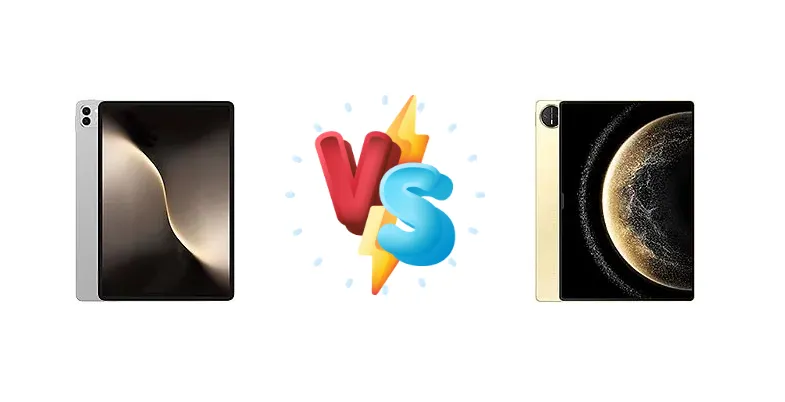
The large-screen Android tablet market is heating up, with Honor and Huawei both vying for dominance. The Honor MagicPad 3, powered by Qualcomm’s flagship Snapdragon 8 Gen 3, directly challenges Huawei’s new MatePad Pro 13.2 (2025) and its in-house Kirin T92 chipset. This comparison dissects the core differences, focusing on performance, charging, and the user experience to determine which tablet offers the best value.
🏆 Quick Verdict
For the average user prioritizing raw performance and gaming, the Honor MagicPad 3 emerges as the winner. The Snapdragon 8 Gen 3’s proven architecture and 4nm process provide a clear advantage. However, the Huawei MatePad Pro 13.2 (2025) counters with significantly faster 100W charging, appealing to those who value convenience above all else.
| Network |
|---|
| 2G bands | N/A | GSM 850 / 900 / 1800 / 1900 |
| 3G bands | N/A | HSDPA 850 / 900 / 1900 / 2100 |
| 4G bands | N/A | LTE |
| EDGE | No | - |
| GPRS | No | - |
| Speed | - | HSPA, LTE - cellular model only |
| Technology | No cellular connectivity | GSM / HSPA / LTE |
| Launch |
|---|
| Announced | 2025, July 02 | 2024, November 26 |
| Status | Available. Released 2025, July 02 | Available. Released 2024, December 12 |
| Body |
|---|
| Build | - | Glass front, nylon fiber back, magnesium alloy frame |
| Dimensions | 293.9 x 201.4 x 5.8 mm (11.57 x 7.93 x 0.23 in) | 289.1 x 196.1 x 5.5 mm (11.38 x 7.72 x 0.22 in) |
| SIM | No | Nano-SIM (cellular model only) |
| Weight | 595 g (1.31 lb) | 580 g (Wi-FI) or 590 g (LTE) (1.28 lb) |
| Display |
|---|
| Resolution | 2136 x 3200 pixels, 3:2 ratio (~289 ppi density) | 2880 x 1920 pixels, 3:2 ratio (~262 ppi density) |
| Size | 13.3 inches, 527.0 cm2 (~89.0% screen-to-body ratio) | 13.2 inches, 518.8 cm2 (~91.5% screen-to-body ratio) |
| Type | IPS LCD, 1B colors, 165Hz, HDR Vivid, 1000 nits (peak) | OLED, 1B colors, 144Hz, HDR Vivid, 1000 nits (peak) |
| Platform |
|---|
| CPU | Octa-core (1x3.3 GHz Cortex-X4 & 3x3.2 GHz Cortex-A720 & 2x3.0 GHz Cortex-A720 & 2x2.3 GHz Cortex-A520) | Octa-core |
| Chipset | Qualcomm SM8650-AC Snapdragon 8 Gen 3 (4 nm) | Kirin T92 |
| GPU | Adreno 750 (1 GHz) | - |
| OS | Android 15, MagicOS 9 | Harmony OS 4.3 |
| Memory |
|---|
| Card slot | No | No |
| Internal | 256GB 8GB RAM, 256GB 12GB RAM, 512GB 16GB RAM, 1TB 16GB RAM | 256GB 12GB RAM, 512GB 12GB RAM, 1TB 16GB RAM |
| Main Camera |
|---|
| Dual | 13 MP, f/2.0, AF
2 MP (macro) | 50 MP, f/1.8, (wide), PDAF
8 MP, f/2.2, (ultrawide) |
| Features | LED flash | LED flash |
| Video | 4K@30fps, 1080p@30fps | 4K@30fps, 1080p@30fps |
| Selfie camera |
|---|
| Single | 9 MP, f/2.2 | 16 MP, f/2.2 |
| Video | 4K@30fps, 1080p@30fps | 1080p@30fps |
| Sound |
|---|
| 35mm jack | No | No |
| Loudspeaker | Yes, with stereo speakers (8 speakers) | Yes, with stereo speakers (6 speakers) |
| Comms |
|---|
| Bluetooth | 5.4, A2DP, LE, aptX HD, aptX Adaptive, ASHA | 5.2, A2DP, LE, L2HC |
| NFC | No | No |
| Positioning | No | GPS, GALILEO, GLONASS, BDS |
| Radio | No | No |
| USB | USB Type-C 3.2, Display Port 1.2, OTG, accessory connector pins | USB Type-C 3.1, OTG, DisplayPort 1.2, accessory connector pins |
| WLAN | Wi-Fi 802.11 a/b/g/n/ac/6/7, dual-band | Wi-Fi 802.11 a/b/g/n/ac/6, dual-band |
| Features |
|---|
| Sensors | Accelerometer, proximity (accessories only), gyro | Fingerprint (side-mounted), accelerometer, gyro, compass, proximity (accessories only) |
| Battery |
|---|
| Charging | 66W wired
5W reverse wired | 100W wired
7.5W reverse wired |
| Type | Si/C Li-Ion 12450 mAh | Li-Po 10100 mAh |
| Misc |
|---|
| Colors | Gray, White, Gold | Black, White, Gold |
| Models | CGA-W00 | WEB-W00, PCE-W29 |
| Price | About 360 EUR | About 680 EUR |
Honor MagicPad 3
- Superior processing power with Snapdragon 8 Gen 3
- More efficient 4nm fabrication process
- Potentially better gaming performance due to Adreno 750 GPU
- Slower 66W charging compared to Huawei
- Less integration with Huawei ecosystem
Huawei MatePad Pro 13.2 (2025)
- Ultra-fast 100W wired charging
- Potential for seamless Huawei ecosystem integration
- Larger display size (13.2 inches)
- Kirin T92 chipset may offer lower peak performance
- Potentially less efficient power consumption
Display Comparison
While both tablets are expected to feature high-resolution displays, specific details like panel type (OLED vs. LCD) and refresh rate are currently unknown. However, the larger screen size of the MatePad Pro 13.2 suggests a focus on media consumption. The absence of display specs necessitates a focus on the processing power to drive those displays; the Snapdragon 8 Gen 3’s Adreno 750 GPU will likely handle graphically intensive tasks with greater ease. Bezels will be a key differentiator, impacting immersion, and are an area where Huawei often excels in design.
Camera Comparison
Without specific camera specs, a direct comparison is difficult. However, given Huawei’s history, the MatePad Pro 13.2 is likely to emphasize computational photography and image processing. The Honor MagicPad 3 will likely lean on the Snapdragon’s ISP capabilities. The absence of information regarding sensor sizes and optical image stabilization (OIS) makes it impossible to definitively declare a winner; however, a larger sensor generally captures more light, resulting in better low-light performance.
Performance
The core battleground is the chipset. The Honor MagicPad 3’s Qualcomm SM8650-AC Snapdragon 8 Gen 3 (4nm) boasts an octa-core CPU configuration with a prime Cortex-X4 core clocked at 3.3 GHz, alongside three Cortex-A720 cores at 3.2 GHz, two more at 3.0 GHz, and finally two efficiency cores at 2.3 GHz. This contrasts with the Huawei MatePad Pro 13.2’s Kirin T92, which, while also octa-core, lacks the detailed architectural breakdown available for the Snapdragon. The 4nm fabrication process of the Snapdragon 8 Gen 3 inherently offers better power efficiency and thermal management compared to potentially larger node processes used in the Kirin T92, translating to sustained performance during prolonged use. The Snapdragon’s superior GPU is also a significant advantage for gaming.
Battery Life
The Huawei MatePad Pro 13.2 (2025) takes a clear lead in charging speed with its 100W wired charging capability, significantly faster than the Honor MagicPad 3’s 66W. This translates to drastically reduced charging times – potentially a full charge in under 40 minutes for the Huawei, compared to closer to an hour for the Honor. While battery capacity remains unknown for both devices, the faster charging of the MatePad Pro 13.2 mitigates concerns about battery life, offering greater convenience for users who frequently need to top up their device. The 5W/7.5W reverse wired charging is a minor feature on both, useful for charging accessories but not a primary selling point.
Buying Guide
Buy the Honor MagicPad 3 if you need uncompromising performance for demanding tasks like video editing, AAA gaming, or multitasking. Its Snapdragon 8 Gen 3 chipset delivers a smoother, more responsive experience. Buy the Huawei MatePad Pro 13.2 (2025) if you prioritize incredibly fast charging and are heavily invested in the Huawei ecosystem, potentially benefiting from seamless integration with other Huawei devices and services.
Frequently Asked Questions
❓ Will the Kirin T92 chipset in the Huawei MatePad Pro 13.2 throttle under sustained load, like during extended gaming sessions?
While the Kirin T92’s thermal management capabilities are unknown, the Snapdragon 8 Gen 3’s 4nm process and Qualcomm’s thermal solutions are generally more effective at preventing throttling. This suggests the Honor MagicPad 3 is likely to maintain higher sustained performance during demanding tasks.
❓ How much faster is the 100W charging on the Huawei MatePad Pro 13.2 (2025) compared to the 66W charging on the Honor MagicPad 3 in real-world usage?
Expect the Huawei MatePad Pro 13.2 to charge from 0-100% in approximately 30-40 minutes, while the Honor MagicPad 3 will likely take closer to 60-75 minutes. This difference is particularly noticeable when quickly topping up the battery before a commute or meeting.
❓ Does the Honor MagicPad 3 support any advanced gaming features like vapor chamber cooling or dedicated gaming modes?
While not explicitly stated, tablets featuring the Snapdragon 8 Gen 3 often incorporate advanced cooling solutions like vapor chambers to maintain performance. Honor’s history suggests they may include a dedicated gaming mode to optimize performance and minimize distractions.