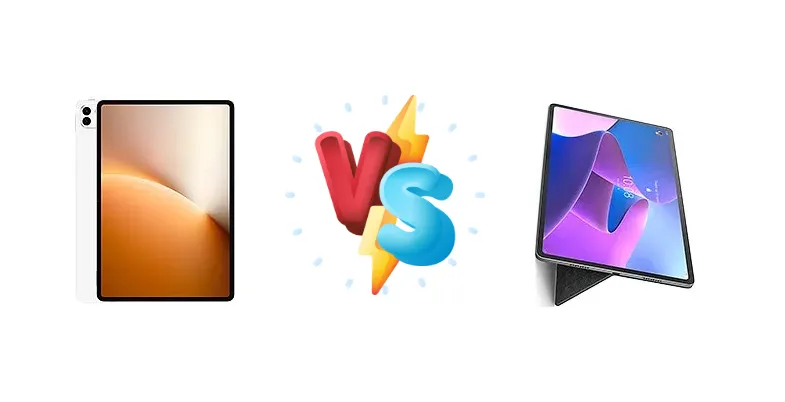
The Android tablet market is heating up, with the Honor MagicPad 3 Pro entering the fray with Qualcomm’s latest Snapdragon 8 Elite Gen 5. This puts it directly against established players like the Lenovo Tab P12 Pro, which utilizes the proven Snapdragon 870. This comparison dissects the core differences, focusing on performance, charging, and which tablet best suits your needs.
🏆 Quick Verdict
For users prioritizing raw performance and future-proofing, the Honor MagicPad 3 Pro is the clear winner thanks to its Snapdragon 8 Elite Gen 5. However, the Lenovo Tab P12 Pro remains a compelling option for those seeking a refined experience and potentially better value, especially if demanding tasks aren't the primary use case.
| Network |
|---|
| 2G bands | N/A | GSM 850 / 900 / 1800 / 1900 |
| 3G bands | N/A | HSDPA 850 / 900 / 1900 / 2100 |
| 4G bands | N/A | 1, 2, 3, 4, 5, 7, 8, 19, 20, 26, 28, 34, 38, 39, 40, 41 |
| 5G bands | - | 1, 3, 7, 8, 20, 28, 38, 41, 77, 78 SA/NSA/Sub6 |
| EDGE | No | - |
| GPRS | No | - |
| Speed | - | HSPA, LTE, 5G - cellular model only |
| Technology | No cellular connectivity | GSM / HSPA / LTE / 5G |
| Launch |
|---|
| Announced | 2025, October 15 | 2021, September 08 |
| Status | Available. Released 2025, October 23 | Available. Released 2021, November 19 |
| Body |
|---|
| Dimensions | 293.9 x 201.4 x 5.8 mm (11.57 x 7.93 x 0.23 in) | 285.6 x 184.5 x 5.6 mm (11.24 x 7.26 x 0.22 in) |
| SIM | No | Nano-SIM (cellular model only) |
| Weight | 595 g (1.31 lb) | 565 g (1.25 lb) |
| | - | Stylus support |
| Display |
|---|
| Resolution | 2136 x 3200 pixels, 3:2 ratio (~289 ppi density) | 1600 x 2560 pixels, 16:10 ratio (~240 ppi density) |
| Size | 13.3 inches, 527.0 cm2 (~89.0% screen-to-body ratio) | 12.6 inches, 460.3 cm2 (~87.4% screen-to-body ratio) |
| Type | IPS LCD, 1B colors, 165Hz, HDR Vivid, 1100 nits (peak) | AMOLED, 120Hz, HDR10+, Dolby Vision, 600 nits (HBM) |
| Platform |
|---|
| CPU | Octa-core (2x4.6 GHz Oryon V3 Phoenix L + 6x3.62 GHz Oryon V3 Phoenix M) | Octa-core (1x3.2 GHz Kryo 585 & 3x2.42 GHz Kryo 585 & 4x1.80 GHz Kryo 585) |
| Chipset | Qualcomm SM8850-AC Snapdragon 8 Elite Gen 5 (3 nm) | Qualcomm SM8250-AC Snapdragon 870 5G (7 nm) |
| GPU | Adreno 840 | Adreno 650 |
| OS | Android 16, MagicOS 10 | Android 11 |
| Memory |
|---|
| Card slot | No | microSDXC (dedicated slot) |
| Internal | 256GB 12GB RAM, 512GB 12GB RAM, 512GB 16GB RAM | 128GB 6GB RAM, 256GB 8GB RAM |
| Main Camera |
|---|
| Dual | 13 MP, f/2.0, AF
2 MP (macro) | 13 MP, (wide), AF
5 MP, (ultrawide) |
| Features | LED flash | - |
| Video | 4K@30fps, 1080p@30fps | 4K@30fps, 1080p@30fps |
| Selfie camera |
|---|
| Single | 9 MP, f/2.2 | 8 MP, (wide)
8 MP, IR TOF 3D, (biometrics sensor only) |
| Video | 4K@30fps, 1080p@30fps | 1080p@30fps |
| Sound |
|---|
| 3.5mm jack | - | No |
| 35mm jack | No | No |
| Loudspeaker | Yes, with stereo speakers (8 speakers) | Yes, with stereo speakers (4 speakers) |
| | - | JBL speakers |
| Comms |
|---|
| Bluetooth | 6.0, A2DP, LE, aptX HD, aptX Adaptive, ASHA | 5.2, A2DP, LE |
| NFC | No | Yes (wireless charging and data transfer only) |
| Positioning | No | GPS, GLONASS, BDS - cellular model only |
| Radio | No | Unspecified |
| USB | USB Type-C 3.2 Gen2, Display Port 1.2, OTG, accessory connector pins | USB Type-C 3.1 |
| WLAN | Wi-Fi 802.11 a/b/g/n/ac/6/7, dual-band | Wi-Fi 802.11 a/b/g/n/ac/6, dual-band, Wi-Fi Direct |
| Features |
|---|
| Sensors | Accelerometer, proximity (accessories only), gyro | Fingerprint (side-mounted), accelerometer, gyro, proximity |
| Battery |
|---|
| Charging | 80W wired
5W reverse wired | 45W wired, QC4 |
| Type | Si/C Li-Ion 12450 mAh | Li-Po 10200 mAh |
| Misc |
|---|
| Colors | Gray, White, Gold | Storm Grey |
| Models | YLP-W00 | TB-Q706Z, TB-Q706F |
| Price | About 460 EUR | About 520 EUR |
Honor MagicPad 3 Pro
- Significantly faster Snapdragon 8 Elite Gen 5 processor
- Ultra-fast 80W wired charging
- More efficient 3nm process for better battery life and thermal management
- Potentially higher price point
- Newer device, potential for early software bugs
Lenovo Tab P12 Pro
- Proven Snapdragon 870 performance
- Established software ecosystem
- Potentially more affordable price
- Slower 45W charging
- Less powerful processor compared to the Snapdragon 8 Elite Gen 5
Display Comparison
While both tablets likely feature high-quality LCD panels, the specifics are missing. However, the chipset difference suggests the MagicPad 3 Pro may be capable of driving higher refresh rate displays more efficiently. The Snapdragon 870 in the Tab P12 Pro is capable, but the newer architecture of the 8 Elite Gen 5 offers potential gains in display rendering. Bezels and color accuracy will be key differentiators, requiring hands-on testing to determine a clear winner.
Camera Comparison
Without detailed camera specifications, a direct comparison is difficult. However, given the focus on performance, the MagicPad 3 Pro is likely to feature a more advanced image signal processor (ISP) integrated within the Snapdragon 8 Elite Gen 5, potentially leading to better image quality and faster processing. The Lenovo Tab P12 Pro likely relies on the ISP within the Snapdragon 870, which is capable but older. We anticipate the MagicPad 3 Pro to have superior computational photography capabilities.
Performance
The core difference lies in the chipsets. The Honor MagicPad 3 Pro’s Snapdragon 8 Elite Gen 5 (3nm) represents a significant leap over the Lenovo Tab P12 Pro’s Snapdragon 870 (7nm). The 8 Elite Gen 5 utilizes Oryon V3 Phoenix cores, offering a substantial performance uplift in both CPU and GPU capabilities. The 3nm process node translates to improved power efficiency and reduced thermal throttling, crucial for sustained performance. The Tab P12 Pro’s Kryo 585 cores are still competent, but will struggle to match the raw power of the newer architecture. Expect the MagicPad 3 Pro to excel in benchmarks and real-world demanding applications.
Battery Life
The Honor MagicPad 3 Pro’s 80W wired charging is a game-changer, significantly faster than the Lenovo Tab P12 Pro’s 45W charging with QC4. This means drastically reduced charging times, allowing for quick top-ups. While battery capacity isn’t specified, the more efficient 3nm process of the Snapdragon 8 Elite Gen 5 should contribute to comparable or even better battery life despite potentially having a smaller battery capacity. The Lenovo Tab P12 Pro’s 45W charging is still respectable, but the MagicPad 3 Pro offers a clear advantage for users who prioritize minimizing downtime.
Buying Guide
Buy the Honor MagicPad 3 Pro if you need uncompromising performance for demanding tasks like video editing, high-end gaming, or running multiple intensive applications simultaneously. Its 80W charging is also a significant advantage for power users. Buy the Lenovo Tab P12 Pro if you prefer a well-rounded tablet experience with a proven track record, prioritizing a balance of performance, features, and potentially a lower price point. It's ideal for media consumption, productivity, and casual gaming.
Frequently Asked Questions
❓ Will the Snapdragon 8 Elite Gen 5 in the Honor MagicPad 3 Pro overheat during extended gaming sessions?
The 3nm process node of the Snapdragon 8 Elite Gen 5 is designed for improved thermal efficiency. While demanding games will generate heat, the chip's architecture and the potential for advanced cooling solutions within the MagicPad 3 Pro should mitigate significant throttling, allowing for longer, more consistent gaming performance compared to the Snapdragon 870.
❓ Is the 45W charging on the Lenovo Tab P12 Pro sufficient for all-day use?
45W charging is a respectable charging speed and should provide a full charge within a reasonable timeframe. However, the Honor MagicPad 3 Pro’s 80W charging offers a significantly faster top-up, which is beneficial for users who frequently need to quickly recharge their device. The Tab P12 Pro’s charging speed is adequate for overnight charging or topping up during downtime.
❓ How much of a performance difference can I realistically expect between the Snapdragon 870 and the Snapdragon 8 Elite Gen 5 in everyday tasks?
For basic tasks like web browsing, email, and video playback, the difference will be minimal. However, when it comes to demanding applications like video editing, 3D rendering, or graphically intensive games, the Snapdragon 8 Elite Gen 5 will offer a noticeable performance advantage, resulting in faster processing times and smoother experiences.