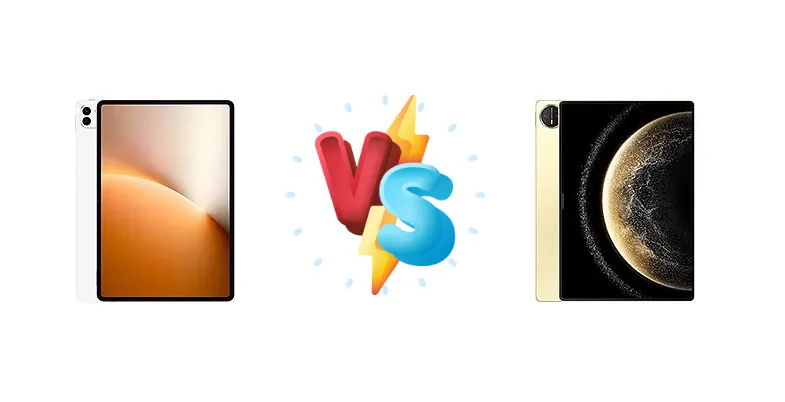
The high-end Android tablet space is heating up, with Honor and Huawei both vying for dominance. The Honor MagicPad 3 Pro, powered by Qualcomm’s latest Snapdragon 8 Elite Gen 5, directly challenges Huawei’s MatePad Pro 13.2 (2025) and its in-house Kirin T92 chipset. This comparison dissects the key differences, focusing on performance, charging, and ultimately, which tablet delivers the best experience for your needs.
🏆 Quick Verdict
For users prioritizing raw performance and gaming, the Honor MagicPad 3 Pro emerges as the winner. The Snapdragon 8 Elite Gen 5, built on a 3nm process, offers a significant architectural advantage over the Kirin T92. However, the Huawei MatePad Pro 13.2 (2025) counters with faster 100W charging, making it a strong contender for power users.
| Network |
|---|
| 2G bands | N/A | GSM 850 / 900 / 1800 / 1900 |
| 3G bands | N/A | HSDPA 850 / 900 / 1900 / 2100 |
| 4G bands | N/A | LTE |
| EDGE | No | - |
| GPRS | No | - |
| Speed | - | HSPA, LTE - cellular model only |
| Technology | No cellular connectivity | GSM / HSPA / LTE |
| Launch |
|---|
| Announced | 2025, October 15 | 2024, November 26 |
| Status | Available. Released 2025, October 23 | Available. Released 2024, December 12 |
| Body |
|---|
| Build | - | Glass front, nylon fiber back, magnesium alloy frame |
| Dimensions | 293.9 x 201.4 x 5.8 mm (11.57 x 7.93 x 0.23 in) | 289.1 x 196.1 x 5.5 mm (11.38 x 7.72 x 0.22 in) |
| SIM | No | Nano-SIM (cellular model only) |
| Weight | 595 g (1.31 lb) | 580 g (Wi-FI) or 590 g (LTE) (1.28 lb) |
| Display |
|---|
| Resolution | 2136 x 3200 pixels, 3:2 ratio (~289 ppi density) | 2880 x 1920 pixels, 3:2 ratio (~262 ppi density) |
| Size | 13.3 inches, 527.0 cm2 (~89.0% screen-to-body ratio) | 13.2 inches, 518.8 cm2 (~91.5% screen-to-body ratio) |
| Type | IPS LCD, 1B colors, 165Hz, HDR Vivid, 1100 nits (peak) | OLED, 1B colors, 144Hz, HDR Vivid, 1000 nits (peak) |
| Platform |
|---|
| CPU | Octa-core (2x4.6 GHz Oryon V3 Phoenix L + 6x3.62 GHz Oryon V3 Phoenix M) | Octa-core |
| Chipset | Qualcomm SM8850-AC Snapdragon 8 Elite Gen 5 (3 nm) | Kirin T92 |
| GPU | Adreno 840 | - |
| OS | Android 16, MagicOS 10 | Harmony OS 4.3 |
| Memory |
|---|
| Card slot | No | No |
| Internal | 256GB 12GB RAM, 512GB 12GB RAM, 512GB 16GB RAM | 256GB 12GB RAM, 512GB 12GB RAM, 1TB 16GB RAM |
| Main Camera |
|---|
| Dual | 13 MP, f/2.0, AF
2 MP (macro) | 50 MP, f/1.8, (wide), PDAF
8 MP, f/2.2, (ultrawide) |
| Features | LED flash | LED flash |
| Video | 4K@30fps, 1080p@30fps | 4K@30fps, 1080p@30fps |
| Selfie camera |
|---|
| Single | 9 MP, f/2.2 | 16 MP, f/2.2 |
| Video | 4K@30fps, 1080p@30fps | 1080p@30fps |
| Sound |
|---|
| 35mm jack | No | No |
| Loudspeaker | Yes, with stereo speakers (8 speakers) | Yes, with stereo speakers (6 speakers) |
| Comms |
|---|
| Bluetooth | 6.0, A2DP, LE, aptX HD, aptX Adaptive, ASHA | 5.2, A2DP, LE, L2HC |
| NFC | No | No |
| Positioning | No | GPS, GALILEO, GLONASS, BDS |
| Radio | No | No |
| USB | USB Type-C 3.2 Gen2, Display Port 1.2, OTG, accessory connector pins | USB Type-C 3.1, OTG, DisplayPort 1.2, accessory connector pins |
| WLAN | Wi-Fi 802.11 a/b/g/n/ac/6/7, dual-band | Wi-Fi 802.11 a/b/g/n/ac/6, dual-band |
| Features |
|---|
| Sensors | Accelerometer, proximity (accessories only), gyro | Fingerprint (side-mounted), accelerometer, gyro, compass, proximity (accessories only) |
| Battery |
|---|
| Charging | 80W wired
5W reverse wired | 100W wired
7.5W reverse wired |
| Type | Si/C Li-Ion 12450 mAh | Li-Po 10100 mAh |
| Misc |
|---|
| Colors | Gray, White, Gold | Black, White, Gold |
| Models | YLP-W00 | WEB-W00, PCE-W29 |
| Price | About 460 EUR | About 680 EUR |
Honor MagicPad 3 Pro
- Superior CPU performance with Snapdragon 8 Elite Gen 5
- More efficient 3nm fabrication process
- Potentially better gaming performance due to Adreno GPU
- Slower 80W charging compared to Huawei
- Reverse charging is limited to 5W
Huawei MatePad Pro 13.2 (2025)
- Faster 100W wired charging
- Potentially stronger image processing capabilities
- Slightly more powerful reverse charging at 7.5W
- Kirin T92 likely offers lower peak performance
- May have less efficient thermal management
Display Comparison
While both tablets are expected to feature high-resolution displays, specific details like peak brightness and panel technology (LTPO) are currently unavailable for the MatePad Pro 13.2 (2025). However, given Huawei’s history, we anticipate a vibrant OLED panel with excellent color accuracy. The Honor MagicPad 3 Pro’s display quality will be crucial, as the Snapdragon 8 Elite Gen 5 has the power to drive high refresh rates and demanding visuals. Bezels will be a key differentiator, impacting immersion and overall aesthetics.
Camera Comparison
Without specific camera specs for either device, it’s difficult to make a definitive judgment. However, given the focus on performance, we can expect both tablets to prioritize image processing capabilities. Huawei has historically excelled in computational photography, so the MatePad Pro 13.2 (2025) may offer more refined image processing algorithms. The Honor MagicPad 3 Pro will likely leverage the Snapdragon 8 Elite Gen 5’s ISP for fast and accurate image capture. The presence of OIS (Optical Image Stabilization) will be a crucial factor for video recording and low-light photography.
Performance
The core of this comparison lies in the chipsets. The Honor MagicPad 3 Pro’s Qualcomm SM8850-AC Snapdragon 8 Elite Gen 5 (3nm) boasts an octa-core CPU configuration with Oryon V3 Phoenix cores – 2x4.6 GHz (L) and 6x3.62 GHz (M). This architecture, combined with the 3nm fabrication process, promises superior performance and efficiency compared to the Kirin T92 in the Huawei MatePad Pro 13.2 (2025). While the Kirin T92 is an octa-core processor, the lack of detailed architectural information makes a direct comparison difficult. The Snapdragon 8 Elite Gen 5’s advanced CPU and GPU will translate to smoother multitasking, faster app loading times, and a more responsive user experience, particularly in graphically intensive applications. The Snapdragon’s Adreno GPU will likely outperform the Kirin’s integrated graphics.
Battery Life
The Huawei MatePad Pro 13.2 (2025) takes the lead in charging speed with its 100W wired charging capability, significantly faster than the Honor MagicPad 3 Pro’s 80W. This translates to quicker top-ups, minimizing downtime. While the Honor MagicPad 3 Pro offers 5W reverse wired charging, the Huawei device provides 7.5W, offering slightly more utility for charging accessories. The actual battery life will depend on the capacity of each tablet’s battery (currently unknown), but the faster charging of the Huawei device provides a tangible benefit for users who frequently need to recharge.
Buying Guide
Buy the Honor MagicPad 3 Pro if you need uncompromising performance for demanding tasks like video editing, AAA gaming, or running multiple applications simultaneously. Its Snapdragon 8 Elite Gen 5 provides a clear edge in processing power. Buy the Huawei MatePad Pro 13.2 (2025) if you prioritize rapid charging and potentially tighter software integration within the Huawei ecosystem, and are less concerned with achieving the absolute highest benchmark scores.
Frequently Asked Questions
❓ Will the Snapdragon 8 Elite Gen 5 in the Honor MagicPad 3 Pro experience thermal throttling during extended gaming sessions?
The Snapdragon 8 Elite Gen 5’s 3nm process and Qualcomm’s thermal management technologies are designed to mitigate throttling. However, sustained peak performance will inevitably generate heat. The Honor MagicPad 3 Pro’s cooling solution (likely a vapor chamber) will be critical in maintaining stable performance during prolonged gaming. Independent testing will be needed to assess the extent of any throttling.
❓ Does the Kirin T92 in the Huawei MatePad Pro 13.2 (2025) support Huawei’s SuperHub feature for seamless multi-device collaboration?
Given Huawei’s emphasis on ecosystem integration, it’s highly probable that the MatePad Pro 13.2 (2025) will support SuperHub. This feature allows for seamless file sharing, screen mirroring, and cross-device collaboration with other Huawei devices. This is a key advantage for users already invested in the Huawei ecosystem.
❓ What type of display technology is expected on the Huawei MatePad Pro 13.2 (2025)?
Based on Huawei’s previous tablet releases, the MatePad Pro 13.2 (2025) is expected to feature an OLED display. OLED technology offers superior contrast ratios, vibrant colors, and excellent viewing angles. The inclusion of LTPO (Low-Temperature Polycrystalline Oxide) technology would enable variable refresh rates, further enhancing power efficiency.