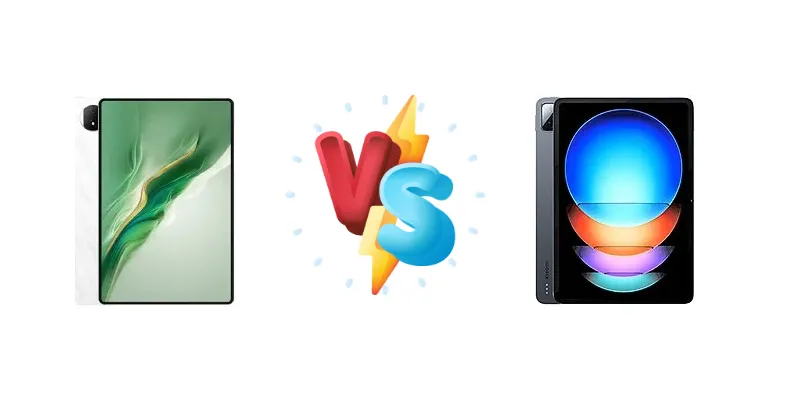
The 12.3-12.4 inch Android tablet space is heating up, with Honor and Xiaomi delivering compelling options. The Honor MagicPad 2 12.3 focuses on a balanced experience with the Snapdragon 8s Gen 3, while the Xiaomi Pad 6S Pro 12.4 aims for flagship performance with the older, but still potent, Snapdragon 8 Gen 2. This comparison dissects their key differences to determine which tablet best suits your needs.
🏆 Quick Verdict
For most users, the Xiaomi Pad 6S Pro 12.4 emerges as the stronger choice. Its Snapdragon 8 Gen 2 chipset provides a noticeable performance edge, and the significantly faster 120W charging is a game-changer. While the Honor MagicPad 2 boasts respectable battery life, the Xiaomi’s overall package is more compelling.
| Network |
|---|
| 2G bands | N/A | N/A |
| 3G bands | N/A | N/A |
| 4G bands | N/A | - |
| EDGE | No | N/A |
| GPRS | No | N/A |
| Technology | No cellular connectivity | No cellular connectivity |
| Launch |
|---|
| Announced | 2024, July 12 | 2024, February 22 |
| Status | Available. Released 2024, July 19 | Available. Released 2024, February 22 |
| Body |
|---|
| Build | - | Glass front (Gorilla Glass 5), aluminum frame, aluminum back |
| Dimensions | 274.5 x 180.5 x 5.8 mm (10.81 x 7.11 x 0.23 in) | 278.7 x 191.6 x 6.3 mm (10.97 x 7.54 x 0.25 in) |
| SIM | No | No |
| Weight | 555 g (1.22 lb) | 590 g (1.30 lb) |
| Display |
|---|
| Protection | - | Corning Gorilla Glass 5 |
| Resolution | 1920 x 3000 pixels (~290 ppi density) | 2032 x 3048 pixels, 3:2 ratio (~295 ppi density) |
| Size | 12.3 inches, 443.2 cm2 (~89.4% screen-to-body ratio) | 12.4 inches, 457.8 cm2 (~85.7% screen-to-body ratio) |
| Type | OLED, 1B colors, 144Hz, HDR10, 1600 nits (peak) | IPS LCD, 68B colors, 144Hz, HDR10, Dolby Vision, 900 nits (peak) |
| Platform |
|---|
| CPU | Octa-core (1x3.0 GHz Cortex-X4 & 4x2.8 GHz Cortex-A720 & 3x2.0 GHz Cortex-A520) | Octa-core (1x3.2 GHz Cortex-X3 & 2x2.8 GHz Cortex-A715 & 2x2.8 GHz Cortex-A710 & 3x2.0 GHz Cortex-A510) |
| Chipset | Qualcomm SM8635 Snapdragon 8s Gen 3 (4 nm) | Qualcomm SM8550-AB Snapdragon 8 Gen 2 (4 nm) |
| GPU | Adreno 735 | Adreno 740 |
| OS | Android 14, upgradable to Android 15, MagicOS 9 | Android 14, up to 3 major Android upgrades, HyperOS |
| Memory |
|---|
| Card slot | No | No |
| Internal | 256GB 8GB RAM, 256GB 12GB RAM, 512GB 16GB RAM, 1TB 16GB RAM | 256GB 8GB RAM, 256GB 12GB RAM, 512GB 12GB RAM, 1TB 16GB RAM |
| Main Camera |
|---|
| Dual | - | 50 MP, f/1.8, (wide), 1/2.76", 0.64µm, PDAF
Auxiliary lens |
| Features | LED flash, HDR | LED flash, HDR, panorama |
| Single | 13 MP, f/2.0, AF | - |
| Video | 4K@30fps, 1080p@30fps | 4K@30/60fps, 1080p@30/60fps |
| Selfie camera |
|---|
| Single | 9 MP, f/2.2 | 32 MP, f/2.2, (wide), 1/3.6", 0.61µm |
| Video | 1080p@30fps | 1080p@30fps |
| Sound |
|---|
| 35mm jack | No | No |
| Loudspeaker | Yes, with stereo speakers (8 speakers) | Yes, with stereo speakers (6 speakers) |
| Comms |
|---|
| Bluetooth | 5.3, A2DP, LE, aptX HD, LDAC | 5.3, A2DP, LE, LHDC |
| NFC | No | Yes (file transfer only) |
| Positioning | No | No |
| Radio | No | No |
| USB | USB Type-C 2.0, OTG | USB Type-C 3.2, accessory connector |
| WLAN | Wi-Fi 802.11 a/b/g/n/ac/6, dual-band | Wi-Fi 802.11 a/b/g/n/a/6/7, dual-band, Wi-Fi Direct |
| Features |
|---|
| Sensors | Accelerometer, proximity (accessories only) | Fingerprint (side-mounted), accelerometer, gyro, proximity (accessories only), compass |
| Battery |
|---|
| Charging | 66W wired
5W reverse wired | 120W wired, PD3.0, QC4, 45% in 10 min, 100% in 35 min |
| Type | Li-Po 10050 mAh | 10000 mAh |
| Misc |
|---|
| Colors | Moonlight White, Sky Blue, Starry Black | Black, Blue, Green |
| Models | ROD2-W09 | 24018RPACG |
| Price | About 600 EUR | About 700 EUR |
| SAR EU | - | 0.99 W/kg (body) |
Honor MagicPad 2 12.3
- Balanced performance for everyday tasks
- Respectable battery life
- Potentially more affordable price point
- Slower charging speed compared to Xiaomi
- Less powerful chipset than the competition
Xiaomi Pad 6S Pro 12.4
- Flagship-level performance with Snapdragon 8 Gen 2
- Faster charging (120W) for minimal downtime
- Brighter and higher contrast display
- Potentially higher price
- May experience slightly more heat under sustained load
Display Comparison
Both tablets feature large 12.3/12.4-inch displays, but key differences emerge upon closer inspection. The Xiaomi Pad 6S Pro boasts a higher peak brightness of 848 nits compared to the Honor MagicPad 2’s 684 nits, resulting in better visibility in bright outdoor conditions. Furthermore, the Xiaomi’s 1378:1 contrast ratio delivers richer blacks and a more vibrant image. While both likely employ IPS LCD technology (not explicitly stated), the Xiaomi’s superior contrast and brightness give it a clear advantage for media consumption and creative work. The absence of refresh rate data for both makes it difficult to assess smoothness, but both are likely 60Hz panels given the target market.
Camera Comparison
Given the tablet form factor, camera performance isn’t a primary concern, but differences exist. Neither manufacturer provides detailed camera specs beyond the chipsets. We can assume both will feature capable main sensors for basic photography and video calls. However, the Xiaomi Pad 6S Pro, benefiting from the more powerful ISP within the Snapdragon 8 Gen 2, is likely to deliver slightly better image processing and low-light performance. The absence of information regarding sensor size or aperture makes a definitive comparison impossible, but the Xiaomi’s chipset advantage is a reasonable assumption.
Performance
The Xiaomi Pad 6S Pro’s Snapdragon 8 Gen 2 (4nm) chipset represents a significant step up in processing power compared to the Honor MagicPad 2’s Snapdragon 8s Gen 3 (4nm). The 8 Gen 2 features a Cortex-X3 prime core clocked at 3.2 GHz, versus the 8s Gen 3’s Cortex-X4 at 3.0 GHz. This, coupled with the 8 Gen 2’s more robust GPU, translates to faster app loading times, smoother multitasking, and superior gaming performance. While both utilize a 4nm process, the architectural improvements in the 8 Gen 2 provide better efficiency and sustained performance. The Xiaomi’s CPU configuration (1x3.2GHz, 2x2.8GHz, 2x2.8GHz, 3x2.0GHz) also offers a broader range of performance cores compared to the Honor’s (1x3.0GHz, 4x2.8GHz, 3x2.0GHz).
Battery Life
The Xiaomi Pad 6S Pro’s 11:14 active use score significantly surpasses the Honor MagicPad 2’s 9:42 score, demonstrating superior battery endurance. This is despite the Honor potentially having a larger battery capacity (not specified). The Xiaomi’s efficiency gains from the Snapdragon 8 Gen 2 chipset and optimized software contribute to this advantage. Crucially, the Xiaomi’s 120W wired charging is a game-changer, achieving 45% charge in just 10 minutes and a full charge in 35 minutes. The Honor MagicPad 2’s 66W charging is respectable, but pales in comparison. The Xiaomi also offers 5W reverse wired charging, a useful feature for topping up accessories.
Buying Guide
Buy the Honor MagicPad 2 12.3 if you prioritize a slightly more conservative power draw for extended use cases and value a balanced feature set. Buy the Xiaomi Pad 6S Pro 12.4 if you demand top-tier performance for demanding tasks like gaming or video editing, and appreciate the convenience of incredibly fast charging – making it ideal for power users and those constantly on the go.
Frequently Asked Questions
❓ Does the Snapdragon 8 Gen 2 in the Xiaomi Pad 6S Pro get hot during extended gaming sessions?
While the Snapdragon 8 Gen 2 is a powerful chip, Xiaomi likely employs thermal management solutions like vapor chamber cooling to mitigate heat. However, sustained gaming at maximum settings will inevitably generate heat. The 4nm process helps with efficiency, but throttling is still possible. Expect some warmth, but not to the point of significant performance degradation.
❓ How does the 120W charging on the Xiaomi Pad 6S Pro affect battery health over the long term?
Modern smartphones and tablets employ sophisticated charging algorithms that prevent overcharging and minimize battery degradation. While 120W charging is incredibly fast, the Xiaomi Pad 6S Pro’s charging system will intelligently reduce the charging rate as the battery nears full capacity, protecting its long-term health. Expect minimal impact on battery lifespan with typical usage.
❓ Is the lack of a specified refresh rate on either tablet a significant drawback?
For casual users, the absence of a high refresh rate (90Hz or 120Hz) isn't a dealbreaker. However, users accustomed to smoother scrolling and animations on their smartphones may notice the difference. Both tablets likely operate at a standard 60Hz refresh rate, which is adequate for most tasks but less visually appealing than higher refresh rate displays.