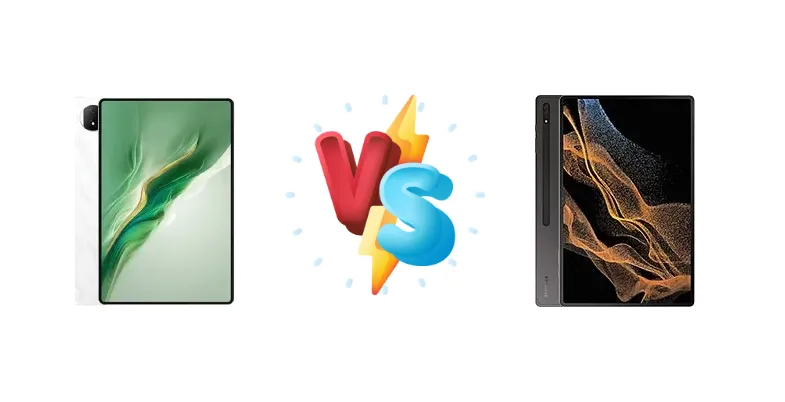
The large-screen Android tablet market is heating up. The Honor MagicPad 2 12.3 arrives as a compelling alternative to established players like Samsung’s Galaxy Tab S8 Ultra, offering a newer chipset and aggressive pricing. This comparison dives deep into the specifications and real-world implications of each device to determine which tablet best suits your needs.
🏆 Quick Verdict
For most users prioritizing sustained performance and all-day battery life, the Honor MagicPad 2 12.3 emerges as the winner. Its Snapdragon 8s Gen 3 and impressive 9:42 active use battery score provide a smoother, longer-lasting experience than the Samsung Galaxy Tab S8 Ultra, despite the latter’s more established brand recognition.
| Network |
|---|
| 2G bands | N/A | GSM 850 / 900 / 1800 / 1900 |
| 3G bands | N/A | HSDPA 850 / 900 / 1700(AWS) / 1900 / 2100 |
| 4G bands | N/A | LTE |
| 5G bands | - | SA/NSA |
| EDGE | No | - |
| GPRS | No | - |
| Speed | - | HSPA, LTE, 5G - cellular model only |
| Technology | No cellular connectivity | GSM / HSPA / LTE / 5G |
| Launch |
|---|
| Announced | 2024, July 12 | 2022, February 09 |
| Status | Available. Released 2024, July 19 | Available. Released 2022, April 30 |
| Body |
|---|
| Dimensions | 274.5 x 180.5 x 5.8 mm (10.81 x 7.11 x 0.23 in) | 326.4 x 208.6 x 5.5 mm (12.85 x 8.21 x 0.22 in) |
| SIM | No | Nano-SIM (cellular model only) |
| Weight | 555 g (1.22 lb) | 726 g (Wi-Fi), 728 g (5G) (1.60 lb) |
| | - | Stylus, 2.8ms latency (Bluetooth integration, accelerometer, gyro) |
| Display |
|---|
| Protection | - | Corning Gorilla Glass 5 |
| Resolution | 1920 x 3000 pixels (~290 ppi density) | 1848 x 2960 pixels, 16:10 ratio (~240 ppi density) |
| Size | 12.3 inches, 443.2 cm2 (~89.4% screen-to-body ratio) | 14.6 inches, 612.6 cm2 (~90.0% screen-to-body ratio) |
| Type | OLED, 1B colors, 144Hz, HDR10, 1600 nits (peak) | Super AMOLED, 120Hz, HDR10+ |
| Platform |
|---|
| CPU | Octa-core (1x3.0 GHz Cortex-X4 & 4x2.8 GHz Cortex-A720 & 3x2.0 GHz Cortex-A520) | Octa-core (1x3.00 GHz Cortex-X2 & 3x2.50 GHz Cortex-A710 & 4x1.80 GHz Cortex-A510) |
| Chipset | Qualcomm SM8635 Snapdragon 8s Gen 3 (4 nm) | Qualcomm SM8450 Snapdragon 8 Gen 1 (4 nm) |
| GPU | Adreno 735 | Adreno 730 |
| OS | Android 14, upgradable to Android 15, MagicOS 9 | Android 12, up to 4 major Android upgrades, One UI 6.1.1 |
| Memory |
|---|
| Card slot | No | microSDXC (dedicated slot) |
| Internal | 256GB 8GB RAM, 256GB 12GB RAM, 512GB 16GB RAM, 1TB 16GB RAM | 128GB 8GB RAM, 256GB 8GB RAM, 256GB 12GB RAM, 256GB 16GB RAM, 512GB 12GB RAM, 512GB 16GB RAM |
| | - | UFS |
| Main Camera |
|---|
| Dual | - | 13 MP, f/2.0, 26mm (wide), 1/3.4", 1.0µm, AF
6 MP, f/2.2, (ultrawide) |
| Features | LED flash, HDR | LED flash, HDR, panorama |
| Single | 13 MP, f/2.0, AF | - |
| Video | 4K@30fps, 1080p@30fps | 4K@30/60fps, 1080p@30fps |
| Selfie camera |
|---|
| Dual | - | 12 MP, f/2.2, 26mm (wide)
12 MP, f/2.4, 120˚ (ultrawide) |
| Features | - | HDR |
| Single | 9 MP, f/2.2 | - |
| Video | 1080p@30fps | 4K@30/60fps, 1080p@30fps |
| Sound |
|---|
| 3.5mm jack | - | No |
| 35mm jack | No | No |
| Loudspeaker | Yes, with stereo speakers (8 speakers) | Yes, with stereo speakers (4 speakers) |
| | - | Tuned by AKG |
| Comms |
|---|
| Bluetooth | 5.3, A2DP, LE, aptX HD, LDAC | 5.2, A2DP, LE |
| NFC | No | No |
| Positioning | No | GPS, GLONASS, BDS, GALILEO - cellular model only |
| Radio | No | No |
| USB | USB Type-C 2.0, OTG | USB Type-C 3.2, magnetic connector |
| WLAN | Wi-Fi 802.11 a/b/g/n/ac/6, dual-band | Wi-Fi 802.11 a/b/g/n/ac/6e, dual-band, Wi-Fi Direct |
| Features |
|---|
| Sensors | Accelerometer, proximity (accessories only) | Fingerprint (under display, optical), accelerometer, gyro, proximity, compass |
| | - | Wireless Samsung DeX |
| Battery |
|---|
| Charging | 66W wired
5W reverse wired | 45W wired, 100% in 82 min |
| Type | Li-Po 10050 mAh | Li-Po 11200 mAh |
| Misc |
|---|
| Colors | Moonlight White, Sky Blue, Starry Black | Graphite |
| Models | ROD2-W09 | SM-X900, SM-X906, SM-X906B, SM-X906U, SM-X906N |
| Price | About 600 EUR | About 1150 EUR |
| SAR EU | - | 0.69 W/kg (body) |
Honor MagicPad 2 12.3
- Superior battery life (9:42h active use)
- Faster 66W charging
- More modern Snapdragon 8s Gen 3 chipset
- Less established brand recognition
- Software ecosystem may not be as mature as Samsung's
Samsung Galaxy Tab S8 Ultra
- Mature software ecosystem with Samsung DeX
- Potentially wider accessory availability
- Strong brand reputation
- Slower 45W charging
- Older Snapdragon 8 Gen 1 chipset
- Likely shorter battery life
Display Comparison
The Samsung Galaxy Tab S8 Ultra boasts a larger display, but the Honor MagicPad 2 12.3 holds its own with a measured peak brightness of 684 nits. While Samsung’s display likely features LTPO technology for variable refresh rates (a common feature in their Ultra line, though not explicitly stated in the provided data), the Honor’s brightness is sufficient for comfortable outdoor viewing. The absence of detailed color accuracy data makes a direct comparison difficult, but both tablets are expected to deliver vibrant visuals suitable for media consumption. Bezels are likely comparable, given both devices target a premium aesthetic.
Camera Comparison
Neither tablet is positioned as a photography powerhouse, but the camera systems are worth noting. Without specific sensor details, it’s difficult to make a definitive judgment. However, the focus should be on video conferencing capabilities rather than still photography. Both tablets likely feature adequate front-facing cameras for video calls, and rear cameras suitable for document scanning. The absence of detailed camera specs suggests neither device prioritizes this feature.
Performance
The core of the performance difference lies in the chipsets. The Honor MagicPad 2 12.3 utilizes the Qualcomm SM8635 Snapdragon 8s Gen 3 (4nm), while the Samsung Galaxy Tab S8 Ultra features the older SM8450 Snapdragon 8 Gen 1 (4nm). Although both are 4nm chips, the Snapdragon 8s Gen 3’s architecture – featuring a Cortex-X4 prime core versus the Tab S8 Ultra’s Cortex-X2 – offers a performance edge in sustained workloads. The Tab S8 Ultra’s CPU configuration (1x3.00 GHz Cortex-X2, 3x2.50 GHz Cortex-A710, 4x1.80 GHz Cortex-A510) is slightly clocked higher on the A710 cores, but the 8s Gen 3’s newer core design and efficiency improvements are more impactful. The impact of RAM speed (likely LPDDR5x on both) is less significant than the CPU architecture.
Battery Life
The Honor MagicPad 2 12.3 truly shines in battery life, achieving an impressive 9:42 hours of active use. The Samsung Galaxy Tab S8 Ultra’s battery capacity isn’t provided, but its 45W charging (taking 82 minutes for a full charge) is slower than the Honor’s 66W wired charging. This faster charging speed, combined with the superior battery endurance, gives the Honor a significant advantage for users who need all-day power without being tethered to an outlet. The 5W reverse wired charging on the Honor is a niche feature, useful for topping up smaller accessories.
Buying Guide
Buy the Honor MagicPad 2 12.3 if you need a tablet focused on maximizing battery life for extended productivity or media consumption, and value a more recent chipset for sustained performance. Buy the Samsung Galaxy Tab S8 Ultra if you prioritize a more mature software ecosystem with features like DeX, and are willing to trade some battery life for a potentially wider range of accessories and brand support.
Frequently Asked Questions
❓ Does the Snapdragon 8s Gen 3 in the Honor MagicPad 2 12.3 throttle under sustained load, and how does it compare to the Snapdragon 8 Gen 1 in the Tab S8 Ultra?
The Snapdragon 8s Gen 3 is designed for improved thermal efficiency compared to the 8 Gen 1. While throttling is inevitable with any high-performance chipset, the 8s Gen 3’s architecture and 4nm process should result in less aggressive throttling during extended gaming or video editing sessions, providing more consistent performance than the Tab S8 Ultra.
❓ How does the 66W charging on the Honor MagicPad 2 12.3 translate to real-world charging times compared to the Samsung Galaxy Tab S8 Ultra’s 45W charging?
The Honor MagicPad 2 12.3’s 66W charging is significantly faster. While a precise 0-100% time isn’t provided, the Tab S8 Ultra takes 82 minutes to fully charge. The Honor is expected to achieve a full charge in considerably less time, potentially around 60-70 minutes, offering a substantial convenience advantage.
❓ Is the lack of S Pen support on the Honor MagicPad 2 12.3 a significant drawback for note-taking and creative tasks?
If you heavily rely on stylus input, the lack of native S Pen support on the Honor MagicPad 2 12.3 is a notable omission. The Samsung Galaxy Tab S8 Ultra includes the S Pen, offering a seamless experience for note-taking, sketching, and navigating the interface. However, third-party stylus options are available for the Honor, though compatibility and features may vary.