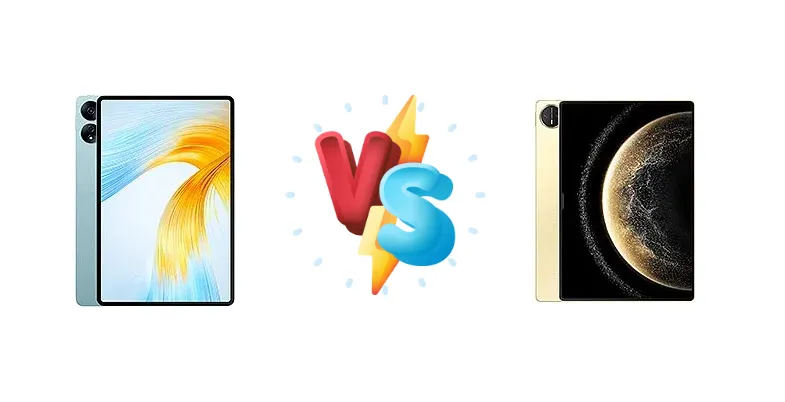
The tablet market is heating up, with Honor and Huawei both vying for dominance. The Honor MagicPad 13, leveraging the Snapdragon 888 5G, represents a mature platform with established performance. The Huawei MatePad Pro 13.2 (2025), powered by the in-house Kirin T92, aims to deliver a new level of integration and efficiency. This comparison dissects the key differences to help you choose the right tablet for your needs.
🏆 Quick Verdict
For the average user prioritizing fast charging and potentially optimized software integration, the Huawei MatePad Pro 13.2 (2025) is the better choice. Its 100W charging significantly outperforms the Honor MagicPad 13’s 66W, and the Kirin T92 promises a refined user experience, though raw performance benchmarks remain to be seen. However, the MagicPad 13 offers a known quantity with the Snapdragon 888.
| Network |
|---|
| 2G bands | N/A | GSM 850 / 900 / 1800 / 1900 |
| 3G bands | N/A | HSDPA 850 / 900 / 1900 / 2100 |
| 4G bands | N/A | LTE |
| EDGE | No | - |
| GPRS | No | - |
| Speed | - | HSPA, LTE - cellular model only |
| Technology | No cellular connectivity | GSM / HSPA / LTE |
| Launch |
|---|
| Announced | 2023, July 12 | 2024, November 26 |
| Status | Available. Released 2023, July 20 | Available. Released 2024, December 12 |
| Body |
|---|
| Build | - | Glass front, nylon fiber back, magnesium alloy frame |
| Dimensions | 291.7 x 191.1 x 6.5 mm or 6.8 mm | 289.1 x 196.1 x 5.5 mm (11.38 x 7.72 x 0.22 in) |
| SIM | No | Nano-SIM (cellular model only) |
| Weight | 660 g or 673 g (1.09 lb) | 580 g (Wi-FI) or 590 g (LTE) (1.28 lb) |
| Display |
|---|
| Resolution | 1840 x 2880 pixels (~263 ppi density) | 2880 x 1920 pixels, 3:2 ratio (~262 ppi density) |
| Size | 13.0 inches, 494.7 cm2 (~88.7% screen-to-body ratio) | 13.2 inches, 518.8 cm2 (~91.5% screen-to-body ratio) |
| Type | TFT LCD, 1B colors, 144Hz, HDR10, 700 nits (HBM) | OLED, 1B colors, 144Hz, HDR Vivid, 1000 nits (peak) |
| Platform |
|---|
| CPU | Octa-core (1x2.84 GHz Cortex-X1 & 3x2.42 GHz Cortex-A78 & 4x1.80 GHz Cortex-A55) | Octa-core |
| Chipset | Qualcomm SM8350 Snapdragon 888 5G (5 nm) | Kirin T92 |
| GPU | Adreno 660 | - |
| OS | Android 13, MagicOS 7.2 | Harmony OS 4.3 |
| Memory |
|---|
| Card slot | No | No |
| Internal | 256GB 8GB RAM, 256GB 12GB RAM, 512GB 16GB RAM | 256GB 12GB RAM, 512GB 12GB RAM, 1TB 16GB RAM |
| Main Camera |
|---|
| Dual | - | 50 MP, f/1.8, (wide), PDAF
8 MP, f/2.2, (ultrawide) |
| Features | LED flash, HDR | LED flash |
| Single | 13 MP, f/2.0, AF | - |
| Video | 4K@30fps, 1080p@30fps | 4K@30fps, 1080p@30fps |
| Selfie camera |
|---|
| Single | 9 MP, f/2.2 | 16 MP, f/2.2 |
| Video | 1080p@30fps | 1080p@30fps |
| Sound |
|---|
| 35mm jack | No | No |
| Loudspeaker | Yes, with stereo speakers (8 speakers) | Yes, with stereo speakers (6 speakers) |
| Comms |
|---|
| Bluetooth | 5.2, A2DP, LE | 5.2, A2DP, LE, L2HC |
| NFC | No | No |
| Positioning | No | GPS, GALILEO, GLONASS, BDS |
| Radio | No | No |
| USB | USB Type-C 3.2, DisplayPort, OTG, magnetic connector pins | USB Type-C 3.1, OTG, DisplayPort 1.2, accessory connector pins |
| WLAN | Wi-Fi 802.11 a/b/g/n/ac/6, dual-band | Wi-Fi 802.11 a/b/g/n/ac/6, dual-band |
| Features |
|---|
| Sensors | Accelerometer, proximity (accessories only) | Fingerprint (side-mounted), accelerometer, gyro, compass, proximity (accessories only) |
| Battery |
|---|
| Charging | 66W wired
5W reverse wired | 100W wired
7.5W reverse wired |
| Type | Li-Po 10050 mAh | Li-Po 10100 mAh |
| Misc |
|---|
| Colors | Gray, Blue, Gold | Black, White, Gold |
| Models | GDI-W09 | WEB-W00, PCE-W29 |
| Price | About 360 EUR | About 680 EUR |
Honor MagicPad 13
- Proven Snapdragon 888 performance
- Established Android ecosystem
- Good value proposition (potentially)
- Slower 66W charging
- Older chipset architecture
Huawei MatePad Pro 13.2 (2025)
- Ultra-fast 100W charging
- Potentially optimized Kirin T92 performance
- Modern design and features
- Kirin T92 performance is unproven
- Huawei ecosystem limitations (potential)
Display Comparison
While specific display details are absent, both tablets likely target high-resolution experiences. The MatePad Pro 13.2’s larger screen size suggests a focus on media consumption and productivity. The Honor MagicPad 13, with its smaller form factor, may prioritize portability. Without knowing panel technology (OLED vs. LCD) or refresh rates, it’s difficult to definitively declare a winner, but the larger canvas of the MatePad Pro 13.2 will appeal to those who multitask or enjoy immersive video playback.
Camera Comparison
Given the tablet form factor, camera performance isn't a primary focus. However, the absence of detailed camera specifications suggests neither device will excel in photography. We can assume both will feature capable main sensors for casual snapshots, but advanced features like optical image stabilization (OIS) or large sensor sizes are unlikely to be present. The focus will likely be on video conferencing capabilities.
Performance
The core difference lies in the chipsets. The Honor MagicPad 13 utilizes the Qualcomm Snapdragon 888 5G (5nm), a proven performer known for its robust CPU and GPU capabilities. Its octa-core configuration, featuring a Cortex-X1 prime core, delivers strong single-core performance. The Huawei MatePad Pro 13.2 (2025) employs the Kirin T92. While the core count is the same, the manufacturing process and architectural details of the Kirin T92 are unknown. The Snapdragon 888’s 5nm process is well-established, offering a balance of performance and efficiency. The Kirin T92’s performance will depend heavily on its design and optimization. The Snapdragon 888’s Adreno 660 GPU is a known quantity, capable of handling demanding games. Without specific GPU details for the Kirin T92, it’s difficult to assess its gaming prowess.
Battery Life
The Huawei MatePad Pro 13.2 (2025) takes a clear lead in charging speed with its 100W wired charging, significantly faster than the Honor MagicPad 13’s 66W. This translates to substantially quicker top-ups, a crucial advantage for users on the go. While battery capacity isn’t specified, the faster charging of the MatePad Pro 13.2 mitigates any potential disadvantage from a smaller battery size. The 7.5W reverse wired charging on the MatePad Pro 13.2 is also slightly higher than the MagicPad 13’s 5W, offering a bit more utility for topping up accessories.
Buying Guide
Buy the Honor MagicPad 13 if you need a tablet with a well-understood chipset and a proven track record of performance in demanding applications. It’s ideal for users who frequently engage in gaming or resource-intensive tasks and value the Snapdragon ecosystem. Buy the Huawei MatePad Pro 13.2 (2025) if you prefer a potentially more efficient and integrated experience, prioritizing faster charging speeds and a modern design. This tablet caters to users who value convenience and a streamlined software experience.
Frequently Asked Questions
❓ Will the Kirin T92 chipset in the Huawei MatePad Pro 13.2 (2025) overheat during extended gaming sessions?
The thermal performance of the Kirin T92 is currently unknown. Huawei has been focusing on efficiency improvements in its chipsets, which could mitigate overheating. However, the Snapdragon 888 in the Honor MagicPad 13 is known to throttle under sustained load, so the Kirin T92’s performance will need to be evaluated in real-world testing to determine its thermal characteristics.
❓ Does the Huawei MatePad Pro 13.2 (2025) support the full range of Google Play Services?
Huawei's access to Google Play Services remains a complex issue. While the MatePad Pro 13.2 (2025) will likely run a version of Android, it may utilize Huawei Mobile Services (HMS) instead of Google Mobile Services (GMS). This means some apps may require sideloading or may not function correctly. Users should verify app compatibility before purchasing.
❓ How does the 66W charging on the Honor MagicPad 13 compare to typical tablet charging speeds?
66W charging is relatively fast for a tablet, but it's becoming increasingly common. While it's a significant improvement over standard tablet chargers, it's still noticeably slower than the 100W charging offered by the Huawei MatePad Pro 13.2 (2025). Expect a full charge to take around 60-90 minutes with the Honor MagicPad 13, compared to potentially under an hour with the Huawei.