
Honor MagicPad 13 vs Apple iPad Pro 12.9 (2022): A Clash of Chipsets and Ecosystems
| Phones Images | |||||
|---|---|---|---|---|---|
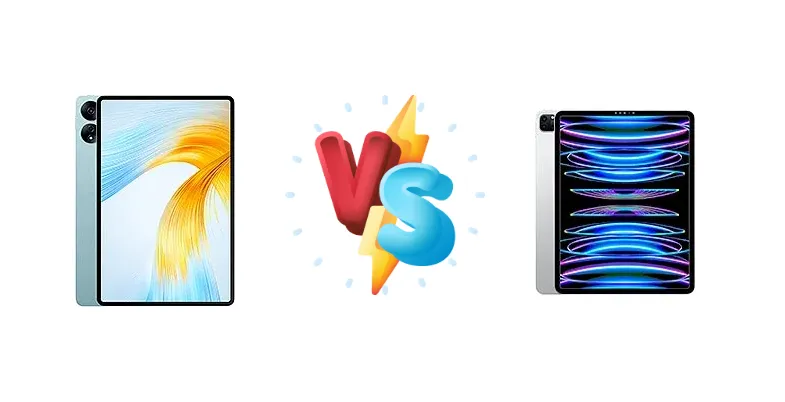
|
🏆 Quick Verdict
For the average user prioritizing raw performance and a seamless software experience, the Apple iPad Pro 12.9 (2022) is the clear winner. However, the Honor MagicPad 13 offers a compelling value proposition, delivering solid performance for everyday tasks and media consumption at a significantly lower price point.
| PHONES | ||
|---|---|---|
| Phone Names | Honor MagicPad 13 | Apple iPad Pro 12.9 (2022) |
| Network | ||
|---|---|---|
| 2G bands | N/A | GSM 850 / 900 / 1800 / 1900 |
| 3G bands | N/A | HSDPA 850 / 900 / 1700(AWS) / 1900 / 2100 |
| 4G bands | N/A | 1, 2, 3, 4, 5, 7, 8, 11, 12, 13, 14, 17, 18, 19, 20, 21, 25, 26, 28, 29, 30, 32, 34, 38, 39, 40, 41, 42, 46, 48, 66, 71 - A2764, A2437 |
| 5G bands | - | 1, 2, 3, 5, 7, 8, 12, 14, 20, 25, 26, 28, 29, 30, 38, 40, 41, 48, 66, 70, 71, 77, 78, 79, 258, 260, 261 SA/NSA/Sub6/mmWave - A2764 |
| EDGE | No | - |
| GPRS | No | - |
| Speed | - | HSPA, LTE, 5G |
| Technology | No cellular connectivity | GSM / HSPA / LTE / 5G |
| - | 1, 2, 3, 5, 7, 8, 12, 14, 20, 25, 26, 28, 29, 30, 38, 40, 41, 48, 66, 70, 71, 77, 78, 79 SA/NSA/Sub6 - A2437, A2766 | |
| Launch | ||
|---|---|---|
| Announced | 2023, July 12 | 2022, October 18 |
| Status | Available. Released 2023, July 20 | Available. Released 2022, October 26 |
| Body | ||
|---|---|---|
| Build | - | Glass front, aluminum back, aluminum frame |
| Dimensions | 291.7 x 191.1 x 6.5 mm or 6.8 mm | 280.6 x 214.9 x 6.4 mm (11.05 x 8.46 x 0.25 in) |
| SIM | No | Nano-SIM + eSIM |
| Weight | 660 g or 673 g (1.09 lb) | 682 g (Wi-Fi), 685 g (5G) (1.50 lb) |
| - | Stylus support (Bluetooth integration; magnetic) | |
| Display | ||
|---|---|---|
| Protection | - | Scratch-resistant glass, oleophobic coating |
| Resolution | 1840 x 2880 pixels (~263 ppi density) | 2048 x 2732 pixels, 4:3 ratio (~265 ppi density) |
| Size | 13.0 inches, 494.7 cm2 (~88.7% screen-to-body ratio) | 12.9 inches, 515.3 cm2 (~85.4% screen-to-body ratio) |
| Type | TFT LCD, 1B colors, 144Hz, HDR10, 700 nits (HBM) | Liquid Retina XDR mini-LED LCD, 120Hz, HDR10, Dolby Vision, 1000 nits (typ), 1600 nits (peak) |
| Platform | ||
|---|---|---|
| CPU | Octa-core (1x2.84 GHz Cortex-X1 & 3x2.42 GHz Cortex-A78 & 4x1.80 GHz Cortex-A55) | Octa-core (4x3.49 GHz performance cores, 4 efficiency cores) |
| Chipset | Qualcomm SM8350 Snapdragon 888 5G (5 nm) | Apple M2 |
| GPU | Adreno 660 | Apple GPU (10-core graphics) |
| OS | Android 13, MagicOS 7.2 | iPadOS 16.1, upgradable to iPadOS 26.1 |
| Memory | ||
|---|---|---|
| Card slot | No | No |
| Internal | 256GB 8GB RAM, 256GB 12GB RAM, 512GB 16GB RAM | 128GB 8GB RAM, 256GB 8GB RAM, 512GB 8GB RAM, 1TB 16GB RAM, 2TB 16GB RAM |
| Main Camera | ||
|---|---|---|
| Dual | - | 12 MP, f/1.8, (wide), 1/3.0", 1.22µm, dual pixel PDAF 10 MP, f/2.4, 125˚ (ultrawide) TOF 3D LiDAR scanner (depth) |
| Features | LED flash, HDR | Quad-LED dual-tone flash, HDR |
| Single | 13 MP, f/2.0, AF | 12 MP, f/2.4, 122˚ (ultrawide) |
| Video | 4K@30fps, 1080p@30fps | 4K@24/25/30/60fps, 1080p@25/30/60/120/240fps; gyro-EIS, ProRes |
| Selfie camera | ||
|---|---|---|
| Features | - | Face detection, HDR, panorama |
| Single | 9 MP, f/2.2 | 12 MP, f/2.4, 122˚ (ultrawide) |
| Video | 1080p@30fps | 1080p@25/30/60fps, gyro-EIS, HDR |
| Sound | ||
|---|---|---|
| 3.5mm jack | - | No |
| 35mm jack | No | No |
| Loudspeaker | Yes, with stereo speakers (8 speakers) | Yes, with stereo speakers (4 speakers) |
| Comms | ||
|---|---|---|
| Bluetooth | 5.2, A2DP, LE | 5.3, A2DP, LE, EDR |
| NFC | No | No |
| Positioning | No | GPS, GLONASS, GALILEO, QZSS (Wi‑Fi + Cellular model only) |
| Radio | No | No |
| USB | USB Type-C 3.2, DisplayPort, OTG, magnetic connector pins | USB Type-C 4 (Thunderbolt 3), DisplayPort, magnetic connector |
| WLAN | Wi-Fi 802.11 a/b/g/n/ac/6, dual-band | Wi-Fi 802.11 a/b/g/n/ac/6e, dual-band, hotspot |
| Features | ||
|---|---|---|
| Sensors | Accelerometer, proximity (accessories only) | Face ID, accelerometer, gyro, compass, barometer |
| Battery | ||
|---|---|---|
| Charging | 66W wired 5W reverse wired | - |
| Type | Li-Po 10050 mAh | Li-Po 10758 mAh (40.88 Wh) |
| Misc | ||
|---|---|---|
| Colors | Gray, Blue, Gold | Silver, Space Gray |
| Models | GDI-W09 | A2764, A2437, A2766, A2436, iPad14,5, iPad14,6 |
| Price | About 360 EUR | About 1450 EUR |
Honor MagicPad 13
- Faster charging with 66W support
- More affordable price point
- Android ecosystem flexibility
- Older Snapdragon 888 chipset
- Likely lower display quality
- Less refined software experience
Apple iPad Pro 12.9 (2022)
- Significantly more powerful M2 chip
- Superior display quality with mini-LED and ProMotion
- Optimized iPadOS ecosystem
- Higher price tag
- Slower 20W charging
- Less open ecosystem
Display Comparison
While specific display specs for the Honor MagicPad 13 are unavailable, the iPad Pro 12.9 (2022) boasts a Liquid Retina XDR display with mini-LED backlighting, achieving a peak brightness of 1600 nits. This significantly surpasses what is typically found in tablets at the MagicPad 13’s price point. The iPad Pro also features ProMotion technology (adaptive refresh rates up to 120Hz) for smoother scrolling and animations. The absence of LTPO in the MagicPad 13 likely means a fixed refresh rate, impacting power efficiency and visual fluidity. Bezels are also expected to be noticeably thinner on the iPad Pro, contributing to a more immersive viewing experience.
Camera Comparison
Detailed camera specifications for the Honor MagicPad 13 are lacking. However, the iPad Pro 12.9 (2022) features a 12MP Wide camera and a 10MP Ultra Wide camera, along with a LiDAR Scanner for enhanced AR experiences and low-light photography. Apple’s image signal processor (ISP) excels in computational photography, delivering consistently high-quality images and videos. While the MagicPad 13 may offer acceptable image quality for casual use, it’s unlikely to match the iPad Pro’s capabilities in terms of dynamic range, detail, and low-light performance. The LiDAR scanner on the iPad Pro is a unique feature absent on the MagicPad 13, enabling advanced AR applications.
Performance
The core of this comparison lies in the chipset battle. Apple’s M2 is a custom-designed SoC built on a 5nm process, featuring 8 CPU cores (4 performance, 4 efficiency) and a powerful GPU. This architecture delivers significantly higher single-core and multi-core performance compared to the Qualcomm Snapdragon 888 5G (5nm) in the Honor MagicPad 13. The Snapdragon 888, while still capable, is a generation behind and will struggle with sustained, demanding workloads. The M2’s unified memory architecture also provides a performance advantage, especially in tasks involving large files and complex applications. The Snapdragon 888’s Cortex-X1 prime core offers strong burst performance, but the M2’s consistent performance across all cores is a key differentiator.
Battery Life
The Honor MagicPad 13’s 66W wired charging is a significant advantage, allowing for a full charge in under an hour. The iPad Pro 12.9 (2022) supports 20W wired charging, resulting in a considerably slower charging time. However, battery life is influenced by more than just charging speed. The M2 chip’s power efficiency, combined with iPadOS optimizations, likely results in comparable or even superior real-world battery life despite the potential for a smaller battery capacity in the iPad Pro. The 5W reverse wired charging on the MagicPad 13 is a niche feature, useful for topping up smaller devices, but less impactful than the iPad Pro’s overall power management.
Buying Guide
Buy the Honor MagicPad 13 if you need a capable tablet for media consumption, light productivity, and gaming, and value affordability and the flexibility of the Android ecosystem. Buy the Apple iPad Pro 12.9 (2022) if you demand the absolute best performance for demanding tasks like video editing, graphic design, and professional workflows, and are invested in the Apple ecosystem.