
Honor Magic8 vs. Xiaomi 14 Pro: A Flagship Showdown of Snapdragon Power
| Phones Images | |||||
|---|---|---|---|---|---|
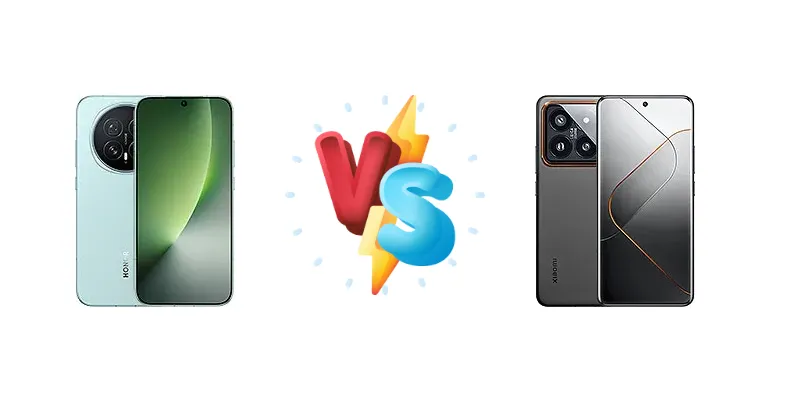
|
🏆 Quick Verdict
For users prioritizing raw CPU performance and a potentially more efficient thermal profile, the Honor Magic8 edges out the Xiaomi 14 Pro. However, the Xiaomi 14 Pro’s significantly faster 120W charging and established software ecosystem make it a compelling alternative, especially for those heavily invested in the Xiaomi ecosystem.
| PHONES | ||
|---|---|---|
| Phone Names | Honor Magic8 | Xiaomi 14 Pro |
| Network | ||
|---|---|---|
| 2G bands | GSM 850 / 900 / 1800 / 1900 | GSM 850 / 900 / 1800 / 1900 |
| 3G bands | HSDPA 800 / 850 / 900 / 1700(AWS) / 1900 / 2100 | HSDPA 800 / 850 / 900 / 1700(AWS) / 1900 / 2100 |
| 4G bands | LTE | 1, 3, 4, 5, 7, 8, 18, 19, 26, 28, 34, 38, 39, 40, 41, 42, 48, 66 |
| 5G bands | SA/NSA | 1, 3, 5, 7, 8, 28, 38, 40, 41, 48, 66, 77, 78, 79 SA/NSA |
| Speed | HSPA, LTE, 5G | HSPA, LTE, 5G |
| Technology | GSM / HSPA / LTE / 5G | GSM / CDMA / HSPA / CDMA2000 / LTE / 5G |
| Launch | ||
|---|---|---|
| Announced | 2025, October 15 | 2023, October 26 |
| Status | Available. Released 2025, October 23 | Available. Released 2023, November 01 |
| Body | ||
|---|---|---|
| Build | - | Glass front, aluminum frame or titanium frame, glass back |
| Dimensions | 157.1 x 74 x 8 mm (6.19 x 2.91 x 0.31 in) | 161.4 x 75.3 x 8.5 mm |
| SIM | Nano-SIM + Nano-SIM | Nano-SIM + Nano-SIM |
| Weight | 205 g (7.23 oz) | 223 g or 230 g (7.87 oz) |
| Display | ||
|---|---|---|
| Protection | Giant Rhino Glass | Shatterproof glass |
| Resolution | 1256 x 2760 pixels (~461 ppi density) | 1440 x 3200 pixels, 20:9 ratio (~522 ppi density) |
| Size | 6.58 inches, 105.3 cm2 (~90.6% screen-to-body ratio) | 6.73 inches, 108.9 cm2 (~89.6% screen-to-body ratio) |
| Type | LTPO OLED, 1B colors, 120Hz, 4320Hz PWM, Dolby Vision, HDR Vivid, 1800 nits (HBM), 6000 nits (peak) | LTPO AMOLED, 68B colors, 120Hz, Dolby Vision, HDR10+, 3000 nits (peak) |
| Platform | ||
|---|---|---|
| CPU | Octa-core (2x4.6 GHz Oryon V3 Phoenix L + 6x3.62 GHz Oryon V3 Phoenix M) | Octa-core (1x3.3 GHz Cortex-X4 & 3x3.2 GHz Cortex-A720 & 2x3.0 GHz Cortex-A720 & 2x2.3 GHz Cortex-A520) |
| Chipset | Qualcomm SM8850-AC Snapdragon 8 Elite Gen 5 (3 nm) | Qualcomm SM8650-AB Snapdragon 8 Gen 3 (4 nm) |
| GPU | Adreno 840 | Adreno 750 |
| OS | Android 16, up to 7 major Android upgrades, MagicOS 10 | Android 14, HyperOS |
| Memory | ||
|---|---|---|
| Card slot | No | No |
| Internal | 256GB 12GB RAM, 512GB 12GB RAM, 512GB 16GB RAM, 1TB 16GB RAM | 256GB 12GB RAM, 512GB 16GB RAM, 1TB 16GB RAM |
| Main Camera | ||
|---|---|---|
| Features | Color spectrum sensor, LED flash, HDR, panorama | Laser AF, color spectrum sensor, Leica lens, Dual-LED dual-tone flash, HDR, panorama |
| Triple | 50 MP, f/1.9, 24mm (wide), 1/1.56", 1.0µm, multi-directional PDAF, OIS 64 MP, f/2.5, (telephoto), PDAF, OIS, 3x optical zoom 50 MP, f/2.0, 12mm, 122˚ (ultrawide), 1/2.88", 0.61µm, dual pixel PDAF | 50 MP, f/1.4-f/4.0, 23mm (wide), 1/1.31", 1.2µm, dual pixel PDAF, OIS 50 MP, f/2.0, 75mm (telephoto), PDAF (10cm - ∞), OIS, 3.2x optical zoom 50 MP, f/2.2, 14mm, 115˚ (ultrawide), AF |
| Video | 4K@24/30/60fps, 1080p@24/30/60/120/240fps, gyro-EIS, OIS, HDR, 10-bit video | 8K@24fps (HDR), 4K@24/30/60fps (HDR10+, 10-bit Dolby Vision HDR, 10-bit LOG), 1080p@30/60/120/240/960fps, 720p@1920fps, gyro-EIS |
| Selfie camera | ||
|---|---|---|
| Features | - | HDR, panorama |
| Single | 50 MP, f/2.0, 21mm (wide), 1/2.93", 0.6µm | 32 MP, f/2.0, 22mm (wide), 0.7µm |
| Video | 4K@30/60fps, 1080p@30/60fps, gyro-EIS | 4K@30/60fps, 1080p@30/60fps, gyro-EIS |
| Sound | ||
|---|---|---|
| 35mm jack | No | No |
| Loudspeaker | Yes, with large amplitude stereo speakers | Yes, with stereo speakers |
| Comms | ||
|---|---|---|
| Bluetooth | 6.0, A2DP, LE, aptX HD, aptX Adaptive, aptX Lossless, LHDC 5, Auracast, ASHA | 5.4, A2DP, LE, aptX HD, aptX Adaptive |
| Infrared port | Yes | Yes |
| NFC | Yes | Yes |
| Positioning | GPS (L1+L5), BDS (B1I+B1c+B2a+B2b), GALILEO (E1+E5a+E5b), QZSS (L1+L5), NavIC (L1+L5), GLONASS | GPS (L1+L5), GLONASS (G1), BDS (B1I+B1c+B2a), GALILEO (E1+E5a), QZSS (L1+L5), NavIC (L5) |
| Radio | No | No |
| USB | USB Type-C 2.0, DisplayPort 1.2, OTG | USB Type-C 3.2 Gen 2, OTG |
| WLAN | Wi-Fi 802.11 a/b/g/n/ac/6/7, dual-band, Wi-Fi Direct | Wi-Fi 802.11 a/b/g/n/ac/6e/7, dual-band, Wi-Fi Direct |
| Features | ||
|---|---|---|
| Sensors | Fingerprint (under display, ultrasonic), accelerometer, gyro, proximity, compass | Fingerprint (under display, optical), accelerometer, proximity, gyro, compass, barometer |
| Battery | ||
|---|---|---|
| Charging | 90W wired, 90W PPS, 40W UFCS 80W wireless Reverse wireless 5W reverse wired | 120W wired, PD3.0, QC4, 100% in 18 min 50W wireless, 100% in 40 min 10W reverse wireless |
| Type | Si/C Li-Ion 7000 mAh | Li-Po 4880 mAh |
| Misc | ||
|---|---|---|
| Colors | Black, White, Gold, Mint | Black, Silver, Titanium, Green |
| Models | BKQ-AN80, BKQ-AN00 | 23116PN5BC |
| Price | About 540 EUR | About 650 EUR |
Honor Magic8
- Potentially superior CPU performance due to Oryon cores and 3nm process.
- Advanced charging standards (PPS, UFCS) offer wider compatibility.
- Reverse wired charging for convenience.
- Slower wired charging compared to Xiaomi 14 Pro.
- Software ecosystem may be less mature than Xiaomi's MIUI.
Xiaomi 14 Pro
- Ultra-fast 120W wired charging for minimal downtime.
- Established MIUI software with extensive features and customization.
- Likely to feature a large 1-inch camera sensor for excellent image quality.
- Snapdragon 8 Gen 3 (4nm) may trail the 8 Elite Gen 5 in peak CPU performance.
- Wireless charging speed is slower than the Honor Magic8.
Display Comparison
While both devices are expected to feature high-quality AMOLED displays, specific details like peak brightness and refresh rate are missing. However, the focus on fast charging suggests both will prioritize efficient panel technology. The Xiaomi 14 Pro’s likely adoption of LTPO technology, common in its predecessors, would offer adaptive refresh rates for improved battery life, a feature we anticipate but cannot confirm for the Magic8.
Camera Comparison
Without specific camera sensor details, a direct comparison is difficult. However, both manufacturers are known for their camera prowess. The Xiaomi 14 Pro is likely to feature a large 1-inch sensor, a trend in recent Xiaomi flagships, offering excellent low-light performance and dynamic range. The Honor Magic8, given its flagship status, will undoubtedly include a high-resolution main sensor with optical image stabilization (OIS). Image processing styles will likely differ – Xiaomi often leans towards vibrant, saturated colors, while Honor typically aims for a more natural look. The absence of details on telephoto and ultrawide lenses prevents a comprehensive assessment.
Performance
The core difference lies in the chipsets. The Honor Magic8’s Snapdragon 8 Elite Gen 5, built on a 3nm process, boasts a unique octa-core configuration with Oryon V3 Phoenix L and M cores peaking at 4.6 GHz. This contrasts with the Xiaomi 14 Pro’s Snapdragon 8 Gen 3 (4nm) featuring a more conventional Cortex-X4 prime core at 3.3 GHz. The 3nm process of the Elite Gen 5 should translate to improved power efficiency and potentially higher sustained performance under load, mitigating thermal throttling. The Oryon architecture, designed by Nuvia (now part of Qualcomm), is known for its focus on single-core performance, which will benefit responsiveness and app launch speeds. The Xiaomi 14 Pro relies on the proven architecture of the Snapdragon 8 Gen 3, offering excellent all-around performance, but potentially falling behind in peak CPU tasks.
Battery Life
The Xiaomi 14 Pro’s 120W wired charging is a significant advantage, promising a full charge in just 18 minutes. This is substantially faster than the Honor Magic8’s 90W wired charging, despite the Magic8 also supporting 90W PPS and 40W UFCS standards. The Xiaomi 14 Pro also offers 50W wireless charging, faster than the Magic8’s 80W wireless, though the Magic8 counters with 5W reverse wired and 10W reverse wireless charging capabilities. While battery capacity remains unknown for both, the faster charging speeds of the Xiaomi 14 Pro mitigate the impact of a potentially smaller battery.
Buying Guide
Buy the Honor Magic8 if you demand the absolute fastest CPU performance for demanding tasks like video editing or emulation, and appreciate a potentially cooler running device. Buy the Xiaomi 14 Pro if you prioritize incredibly fast charging speeds, a mature and feature-rich MIUI software experience, and a wider availability of accessories and support.