
Honor Magic8 vs. vivo X100 Pro: A Deep Dive into Flagship Performance
| Phones Images | |||||
|---|---|---|---|---|---|
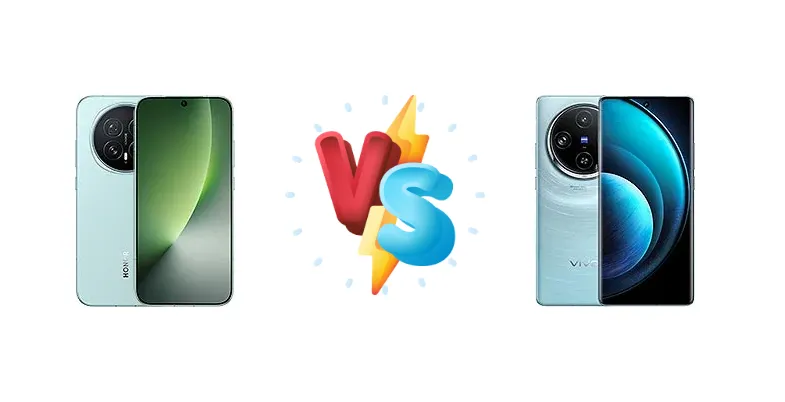
|
🏆 Quick Verdict
For users prioritizing peak performance and cutting-edge CPU architecture, the Honor Magic8 with its Snapdragon 8 Elite Gen 5 is the clear winner. However, the vivo X100 Pro offers a compelling package with excellent battery life and a measured 13:53h active use score, making it ideal for power users who value longevity.
| PHONES | ||
|---|---|---|
| Phone Names | Honor Magic8 | vivo X100 Pro |
| Network | ||
|---|---|---|
| 2G bands | GSM 850 / 900 / 1800 / 1900 | GSM 850 / 900 / 1800 / 1900 |
| 3G bands | HSDPA 800 / 850 / 900 / 1700(AWS) / 1900 / 2100 | HSDPA 800 / 850 / 900 / 1700(AWS) / 1900 / 2100 |
| 4G bands | LTE | 1, 2, 3, 4, 5, 7, 8, 12, 17, 18, 19, 20, 26, 28, 32, 38, 39, 40, 41, 42, 66 - International |
| 5G bands | SA/NSA | 1, 3, 5, 7, 8, 20, 28, 38, 40, 41, 66, 75, 77, 78, 79 SA/NSA - International |
| Speed | HSPA, LTE, 5G | HSPA, LTE, 5G |
| Technology | GSM / HSPA / LTE / 5G | GSM / CDMA / HSPA / LTE / 5G |
| Launch | ||
|---|---|---|
| Announced | 2025, October 15 | 2023, November 13 |
| Status | Available. Released 2025, October 23 | Available. Released 2023, November 21 |
| Body | ||
|---|---|---|
| Build | - | Glass front, aluminum frame, glass back |
| Dimensions | 157.1 x 74 x 8 mm (6.19 x 2.91 x 0.31 in) | 164.1 x 75.3 x 8.9 mm or 9.1 mm |
| SIM | Nano-SIM + Nano-SIM | · Nano-SIM + eSIM· Nano-SIM + Nano-SIM |
| Weight | 205 g (7.23 oz) | 221 g or 225 g (7.80 oz) |
| Display | ||
|---|---|---|
| Protection | Giant Rhino Glass | - |
| Resolution | 1256 x 2760 pixels (~461 ppi density) | 1260 x 2800 pixels, 20:9 ratio (~452 ppi density) |
| Size | 6.58 inches, 105.3 cm2 (~90.6% screen-to-body ratio) | 6.78 inches, 111.5 cm2 (~90.2% screen-to-body ratio) |
| Type | LTPO OLED, 1B colors, 120Hz, 4320Hz PWM, Dolby Vision, HDR Vivid, 1800 nits (HBM), 6000 nits (peak) | LTPO AMOLED, 1B colors, 120Hz, HDR10+, 3000 nits (peak) |
| Platform | ||
|---|---|---|
| CPU | Octa-core (2x4.6 GHz Oryon V3 Phoenix L + 6x3.62 GHz Oryon V3 Phoenix M) | Octa-core (1x3.25 GHz Cortex-X4 & 3x2.85 GHz Cortex-X4 & 4x2.0 GHz Cortex-A720) |
| Chipset | Qualcomm SM8850-AC Snapdragon 8 Elite Gen 5 (3 nm) | Mediatek Dimensity 9300 (4 nm) |
| GPU | Adreno 840 | Immortalis-G720 MC12 |
| OS | Android 16, up to 7 major Android upgrades, MagicOS 10 | Android 14, upgradable to Android 15, Funtouch 15 (International), OriginOS 4 (China) |
| Memory | ||
|---|---|---|
| Card slot | No | No |
| Internal | 256GB 12GB RAM, 512GB 12GB RAM, 512GB 16GB RAM, 1TB 16GB RAM | 256GB 12GB RAM, 256GB 16GB RAM, 512GB 16GB RAM, 1TB 16GB RAM |
| Main Camera | ||
|---|---|---|
| Features | Color spectrum sensor, LED flash, HDR, panorama | Laser AF, color spectrum sensor, Zeiss optics, Zeiss T* lens coating, LED flash, panorama, HDR, 3D LUT import |
| Triple | 50 MP, f/1.9, 24mm (wide), 1/1.56", 1.0µm, multi-directional PDAF, OIS 64 MP, f/2.5, (telephoto), PDAF, OIS, 3x optical zoom 50 MP, f/2.0, 12mm, 122˚ (ultrawide), 1/2.88", 0.61µm, dual pixel PDAF | 50 MP, f/1.8, 23mm (wide), 1/0.98", 1.6µm, dual pixel PDAF, OIS 50 MP, f/2.5, 100mm (periscope telephoto), 1/2.51", 0.7µm, PDAF (18cm - ∞), OIS, 4.3x optical zoom 50 MP, f/2.0, 15mm, 119˚ (ultrawide), 1/2.76", 0.64µm, AF |
| Video | 4K@24/30/60fps, 1080p@24/30/60/120/240fps, gyro-EIS, OIS, HDR, 10-bit video | 8K@30fps, 4K@30/60fps, 1080p, gyro-EIS |
| Selfie camera | ||
|---|---|---|
| Features | - | HDR |
| Single | 50 MP, f/2.0, 21mm (wide), 1/2.93", 0.6µm | 32 MP, f/2.0, 20mm (ultrawide) |
| Video | 4K@30/60fps, 1080p@30/60fps, gyro-EIS | 4K@30/60fps, 1080p@30/60fps |
| Sound | ||
|---|---|---|
| 35mm jack | No | No |
| Loudspeaker | Yes, with large amplitude stereo speakers | Yes, with stereo speakers |
| Comms | ||
|---|---|---|
| Bluetooth | 6.0, A2DP, LE, aptX HD, aptX Adaptive, aptX Lossless, LHDC 5, Auracast, ASHA | 5.4, A2DP, LE, aptX HD, LHDC |
| Infrared port | Yes | Yes |
| NFC | Yes | Yes |
| Positioning | GPS (L1+L5), BDS (B1I+B1c+B2a+B2b), GALILEO (E1+E5a+E5b), QZSS (L1+L5), NavIC (L1+L5), GLONASS | GPS (L1+L5), GLONASS (L1), BDS (B1I+B1c+B2a+B2b), GALILEO (E1+E5a+E5b), QZSS (L1+L5), NavIC (L5) |
| Radio | No | No |
| USB | USB Type-C 2.0, DisplayPort 1.2, OTG | USB Type-C 3.2, OTG |
| WLAN | Wi-Fi 802.11 a/b/g/n/ac/6/7, dual-band, Wi-Fi Direct | Wi-Fi 802.11 a/b/g/n/ac/6/7, tri-band, Wi-Fi Direct |
| Features | ||
|---|---|---|
| Sensors | Fingerprint (under display, ultrasonic), accelerometer, gyro, proximity, compass | Fingerprint (under display, optical), accelerometer, gyro, proximity, compass |
| Battery | ||
|---|---|---|
| Charging | 90W wired, 90W PPS, 40W UFCS 80W wireless Reverse wireless 5W reverse wired | 100W wired, 50% in 14 min 50W wireless Reverse wired |
| Type | Si/C Li-Ion 7000 mAh | Li-Ion 5400 mAh |
| Misc | ||
|---|---|---|
| Colors | Black, White, Gold, Mint | Startrail Blue, Asteroid Black, Sunset Orange, White |
| Models | BKQ-AN80, BKQ-AN00 | V2324A, V2309 |
| Price | About 540 EUR | ₹ 59,999 |
| SAR EU | - | 0.99 W/kg (head) 1.19 W/kg (body) |
Honor Magic8
- Potentially superior CPU performance with Snapdragon 8 Elite Gen 5 and Oryon cores
- More efficient 3nm manufacturing process
- Versatile charging options including reverse wired charging
- Battery life is unknown and potentially lower than the X100 Pro
- Camera performance details are lacking
vivo X100 Pro
- Excellent battery life with 13:53h active use score
- Very bright display (1472 nits)
- Fast 100W wired and 50W wireless charging
- 4nm Dimensity 9300 may not match Snapdragon 8 Elite Gen 5 in peak performance
- Thermal throttling potential under sustained load
Display Comparison
The vivo X100 Pro boasts a significantly brighter display, reaching a measured 1472 nits, which translates to superior visibility in direct sunlight. While the Honor Magic8’s display specifications are not provided, the X100 Pro’s brightness advantage is substantial. Both devices likely employ LTPO technology for adaptive refresh rates, conserving battery life, but the X100 Pro’s peak brightness is a clear differentiator. Color accuracy and delta-E values would require further testing, but the X100 Pro’s brightness gives it an edge for outdoor use.
Camera Comparison
The context data for both devices is limited regarding camera specifics. However, the vivo X100 Pro is known for its camera capabilities, and its image processing is a key strength. The larger the main sensor, the better the low-light performance and dynamic range. Without sensor size details for the Magic8, it’s difficult to make a direct comparison. The X100 Pro’s focus on photo and video suggests a more refined camera experience, while the Magic8’s camera performance remains an unknown quantity. Ignoring the typical 2MP macro sensors found on many phones, the quality of the primary and ultrawide lenses will be crucial.
Performance
The core of the battle lies in the chipsets. The Honor Magic8’s Snapdragon 8 Elite Gen 5, built on a 3nm process, features a unique octa-core configuration with Oryon V3 Phoenix L and M cores clocked up to 4.6 GHz. This architecture is designed for exceptional single-core and multi-core performance. The vivo X100 Pro’s Dimensity 9300, fabricated on a 4nm node, utilizes a different core arrangement – one Cortex-X4 prime core, three Cortex-X4 performance cores, and four Cortex-A720 efficiency cores. While the Dimensity 9300 is a powerful chip, the Snapdragon 8 Elite Gen 5’s Oryon cores and 3nm process likely provide a performance advantage, particularly in sustained workloads. The Snapdragon’s efficiency gains from the 3nm node should also translate to better thermal management, reducing throttling during extended gaming sessions.
Battery Life
The vivo X100 Pro demonstrates a clear advantage in battery life, achieving an active use score of 13:53h. The Honor Magic8’s battery capacity is not specified, but the X100 Pro’s longevity is a significant benefit. Charging speeds are competitive, with the X100 Pro offering 100W wired charging (50% in 14 minutes) and 50W wireless charging. The Magic8 counters with 90W wired charging (with PPS and UFCS support for broader compatibility), 80W wireless charging, and even 5W reverse wired charging. The Magic8’s reverse charging options provide added versatility, but the X100 Pro’s longer battery life is more impactful for most users.
Buying Guide
Buy the Honor Magic8 if you demand the absolute fastest processing speeds for demanding tasks like video editing, high-end gaming, and AI workloads. Its Oryon-based CPU offers a significant advantage in multi-core performance. Buy the vivo X100 Pro if you prioritize all-day battery life, a bright and vibrant display, and a well-rounded camera experience, even if it means sacrificing a small amount of peak CPU performance.