
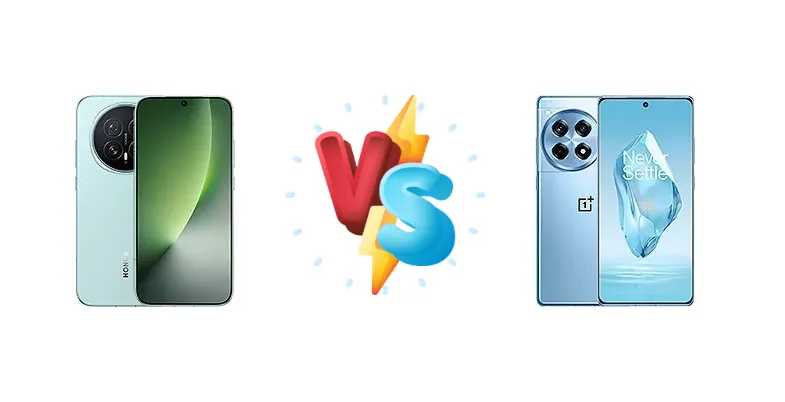
Honor Magic8 vs. OnePlus 12R: A Deep Dive into Flagship Performance and Value
| Phones Images | |||||
|---|---|---|---|---|---|
|
🏆 Quick Verdict
For users prioritizing raw performance and the latest technology, the Honor Magic8 is the clear winner, thanks to its Snapdragon 8 Elite Gen 5. However, the OnePlus 12R provides exceptional value with its strong performance, impressive 14:32h battery life, and 100W charging, making it the better choice for most users.
| PHONES | ||
|---|---|---|
| Phone Names | Honor Magic8 | OnePlus 12R |
| Network | ||
|---|---|---|
| 2G bands | GSM 850 / 900 / 1800 / 1900 | GSM 850 / 900 / 1800 / 1900 |
| 3G bands | HSDPA 800 / 850 / 900 / 1700(AWS) / 1900 / 2100 | HSDPA 850 / 900 / 1700(AWS) / 1900 / 2100 |
| 4G bands | LTE | 1, 2, 3, 4, 5, 7, 8, 12, 17, 18, 19, 20, 26, 28, 32, 38, 39, 40, 41, 66 |
| 5G bands | SA/NSA | 1, 2, 3, 5, 7, 8, 12, 20, 28, 38, 40, 41, 66, 77, 78 SA/NSA |
| Speed | HSPA, LTE, 5G | HSPA, LTE, 5G |
| Technology | GSM / HSPA / LTE / 5G | GSM / CDMA / HSPA / LTE / 5G |
| Launch | ||
|---|---|---|
| Announced | 2025, October 15 | 2024, January 23 |
| Status | Available. Released 2025, October 23 | Available. Released 2024, February 06 |
| Body | ||
|---|---|---|
| Build | - | Glass front (Gorilla Glass Victus 2), aluminum frame, glass back |
| Dimensions | 157.1 x 74 x 8 mm (6.19 x 2.91 x 0.31 in) | 163.3 x 75.3 x 8.8 mm (6.43 x 2.96 x 0.35 in) |
| SIM | Nano-SIM + Nano-SIM | · Nano-SIM + Nano-SIM + eSIM (max 2 at a time)· Nano-SIM + Nano-SIM |
| Weight | 205 g (7.23 oz) | 207 g (7.30 oz) |
| Display | ||
|---|---|---|
| Protection | Giant Rhino Glass | Corning Gorilla Glass Victus 2 |
| Resolution | 1256 x 2760 pixels (~461 ppi density) | 1264 x 2780 pixels (~450 ppi density) |
| Size | 6.58 inches, 105.3 cm2 (~90.6% screen-to-body ratio) | 6.78 inches, 111.7 cm2 (~90.9% screen-to-body ratio) |
| Type | LTPO OLED, 1B colors, 120Hz, 4320Hz PWM, Dolby Vision, HDR Vivid, 1800 nits (HBM), 6000 nits (peak) | LTPO4 AMOLED, 1B colors, 120Hz, HDR10+, Dolby Vision, 1600 nits (HBM), 4500 nits (peak) |
| Platform | ||
|---|---|---|
| CPU | Octa-core (2x4.6 GHz Oryon V3 Phoenix L + 6x3.62 GHz Oryon V3 Phoenix M) | Octa-core (1x3.2 GHz Cortex-X3 & 2x2.8 GHz Cortex-A715 & 2x2.8 GHz Cortex-A710 & 3x2.0 GHz Cortex-A510) |
| Chipset | Qualcomm SM8850-AC Snapdragon 8 Elite Gen 5 (3 nm) | Qualcomm SM8550-AB Snapdragon 8 Gen 2 (4 nm) |
| GPU | Adreno 840 | Adreno 740 |
| OS | Android 16, up to 7 major Android upgrades, MagicOS 10 | Android 14, up to 3 major Android upgrades, OxygenOS 15 |
| Memory | ||
|---|---|---|
| Card slot | No | No |
| Internal | 256GB 12GB RAM, 512GB 12GB RAM, 512GB 16GB RAM, 1TB 16GB RAM | 128GB 8GB RAM, 256GB 8GB RAM, 256GB 12GB RAM, 256GB 16GB RAM |
| Main Camera | ||
|---|---|---|
| Features | Color spectrum sensor, LED flash, HDR, panorama | Laser AF, color spectrum sensor, LED flash, HDR, panorama |
| Triple | 50 MP, f/1.9, 24mm (wide), 1/1.56", 1.0µm, multi-directional PDAF, OIS 64 MP, f/2.5, (telephoto), PDAF, OIS, 3x optical zoom 50 MP, f/2.0, 12mm, 122˚ (ultrawide), 1/2.88", 0.61µm, dual pixel PDAF | 50 MP, f/1.8, 24mm (wide), 1/1.56", 1.0µm, multi-directional PDAF, OIS 8 MP, f/2.2, 16mm, 112˚ (ultrawide), 1/4.0", 1.12µm 2 MP (macro) |
| Video | 4K@24/30/60fps, 1080p@24/30/60/120/240fps, gyro-EIS, OIS, HDR, 10-bit video | 4K@30/60fps, 1080p@30/60/120/240fps, gyro-EIS, OIS |
| Selfie camera | ||
|---|---|---|
| Features | - | HDR, panorama |
| Single | 50 MP, f/2.0, 21mm (wide), 1/2.93", 0.6µm | 16 MP, f/2.4, 26mm (wide), 1/3", 1.0µm |
| Video | 4K@30/60fps, 1080p@30/60fps, gyro-EIS | 1080p@30fps, gyro-EIS |
| Sound | ||
|---|---|---|
| 35mm jack | No | No |
| Loudspeaker | Yes, with large amplitude stereo speakers | Yes, with stereo speakers |
| Comms | ||
|---|---|---|
| Bluetooth | 6.0, A2DP, LE, aptX HD, aptX Adaptive, aptX Lossless, LHDC 5, Auracast, ASHA | 5.3, A2DP, LE, aptX HD |
| Infrared port | Yes | Yes |
| NFC | Yes | Yes |
| Positioning | GPS (L1+L5), BDS (B1I+B1c+B2a+B2b), GALILEO (E1+E5a+E5b), QZSS (L1+L5), NavIC (L1+L5), GLONASS | GPS, GALILEO, GLONASS, BDS, QZSS |
| Radio | No | No |
| USB | USB Type-C 2.0, DisplayPort 1.2, OTG | USB Type-C 2.0 |
| WLAN | Wi-Fi 802.11 a/b/g/n/ac/6/7, dual-band, Wi-Fi Direct | Wi-Fi 802.11 a/b/g/n/ac/6/7, dual-band |
| Features | ||
|---|---|---|
| Sensors | Fingerprint (under display, ultrasonic), accelerometer, gyro, proximity, compass | Fingerprint (under display, optical), accelerometer, gyro, proximity, compass |
| Battery | ||
|---|---|---|
| Charging | 90W wired, 90W PPS, 40W UFCS 80W wireless Reverse wireless 5W reverse wired | 100W wired, 100% in 26 min |
| Type | Si/C Li-Ion 7000 mAh | Li-Ion 5500 mAh |
| Misc | ||
|---|---|---|
| Colors | Black, White, Gold, Mint | Iron Gray, Cool Blue, Electric Violet, Sunset Dune |
| Models | BKQ-AN80, BKQ-AN00 | CPH2609, CPH2585, CPH2611 |
| Price | About 540 EUR | € 410.84 / $ 399.95 / £ 649.00 |
| SAR | - | 1.19 W/kg (head) 0.82 W/kg (body) |
Honor Magic8
- Cutting-edge Snapdragon 8 Elite Gen 5 processor
- Ultra-fast 90W wired and 80W wireless charging
- Potential for superior thermal management due to 3nm process
- Battery life is currently unknown
- Camera specifications are currently unavailable
OnePlus 12R
- Excellent 14:32h battery life
- Fast 100W wired charging (26 minutes to full)
- Bright 1181 nit display
- Snapdragon 8 Gen 2 is a generation behind
- No wireless charging
Display Comparison
The OnePlus 12R boasts a bright display, peaking at 1181 nits measured, ensuring excellent visibility outdoors. While the Honor Magic8’s display specs are currently unavailable, Honor typically employs high-quality panels. The OnePlus 12R’s brightness is a significant advantage for outdoor use. The absence of LTPO on the 12R means it won't dynamically adjust refresh rates for maximum efficiency like some higher-end displays, but the brightness advantage is a tangible benefit.
Camera Comparison
Without detailed camera specifications for the Honor Magic8, a direct comparison is limited. However, the OnePlus 12R’s camera system is likely to focus on delivering consistent, high-quality images. The Snapdragon 8 Gen 2’s ISP (Image Signal Processor) is capable of excellent image processing. The absence of detailed sensor information for the Magic8 makes it difficult to assess its potential advantages. We can assume Honor will leverage computational photography to enhance image quality, but the OnePlus 12R provides a known quantity in terms of image processing capabilities.
Performance
The Honor Magic8’s Snapdragon 8 Elite Gen 5, built on a 3nm process, represents a significant leap forward. Its octa-core CPU, featuring Oryon V3 Phoenix L and M cores clocked up to 4.6 GHz, promises substantial performance gains over the OnePlus 12R’s Snapdragon 8 Gen 2 (4nm). The Oryon architecture is designed for improved IPC (Instructions Per Clock), meaning more work done per clock cycle. While the Snapdragon 8 Gen 2 is no slouch – with its Cortex-X3 prime core at 3.2 GHz – the Magic8’s chipset is expected to deliver superior performance in CPU-intensive tasks. The 3nm node of the Magic8’s chip also implies better thermal efficiency, potentially leading to sustained performance during prolonged gaming sessions.
Battery Life
The OnePlus 12R shines in battery life, achieving an impressive 14 hours and 32 minutes of active use. While the Honor Magic8’s battery capacity is unknown, its 90W wired, 90W PPS, 40W UFCS, and 80W wireless charging capabilities are a major draw. The OnePlus 12R’s 100W wired charging can fully charge the device in just 26 minutes. The Magic8’s wireless charging is significantly faster than the 12R’s (assuming it has wireless charging), offering a convenient alternative. The 12R’s longer battery life provides peace of mind for all-day use, while the Magic8 prioritizes charging speed and flexibility.
Buying Guide
Buy the Honor Magic8 if you demand the absolute fastest processing speeds for demanding tasks like video editing or high-end gaming, and if you value the convenience of 90W wired *and* 80W wireless charging. Buy the OnePlus 12R if you prioritize all-day battery life, fast charging, and a balanced experience without the premium price tag. It’s the ideal choice for power users who don’t necessarily need the bleeding edge.