
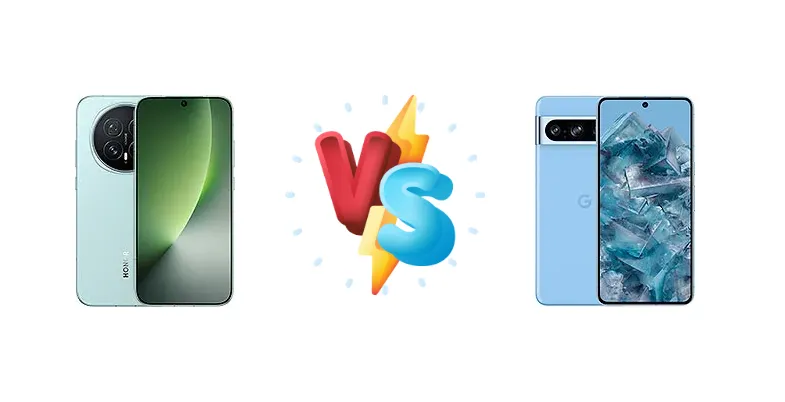
Honor Magic8 Pro vs. Google Pixel 8 Pro: A Head-to-Head Flagship Battle
| Phones Images | |||||
|---|---|---|---|---|---|
|
🏆 Quick Verdict
For users prioritizing peak performance and blazing-fast charging, the Honor Magic8 Pro is the clear winner. Its Snapdragon 8 Elite Gen 5 and 90W charging significantly outperform the Pixel 8 Pro. However, the Pixel 8 Pro’s superior camera software and long-term software support make it the better choice for photography enthusiasts and those deeply invested in the Google ecosystem.
| PHONES | ||
|---|---|---|
| Phone Names | Honor Magic8 | Google Pixel 8 Pro |
| Network | ||
|---|---|---|
| 2G bands | GSM 850 / 900 / 1800 / 1900 | GSM 850 / 900 / 1800 / 1900 |
| 3G bands | HSDPA 800 / 850 / 900 / 1700(AWS) / 1900 / 2100 | HSDPA 800 / 850 / 900 / 1700(AWS) / 1900 / 2100 |
| 4G bands | LTE | 1, 2, 3, 4, 5, 7, 8, 12, 13, 14, 17, 18, 19, 20, 25, 26, 28, 29, 30, 38, 39, 40, 41, 46, 48, 66, 71 - G1MNW |
| 5G bands | SA/NSA | 1, 2, 3, 5, 7, 8, 12, 20, 25, 26, 28, 29, 30, 38, 40, 41, 48, 66, 70, 71, 77, 78, 257, 258, 260, 261 SA/NSA/Sub6/mmWave - G1MNW |
| Speed | HSPA, LTE, 5G | HSPA, LTE, 5G |
| Technology | GSM / HSPA / LTE / 5G | GSM / HSPA / LTE / 5G |
| Launch | ||
|---|---|---|
| Announced | 2025, October 15 | 2023, October 04 |
| Status | Available. Released 2025, October 23 | Available. Released 2023, October 12 |
| Body | ||
|---|---|---|
| Build | - | Glass front (Gorilla Glass Victus 2), glass back (Gorilla Glass Victus 2), aluminum frame |
| Dimensions | 157.1 x 74 x 8 mm (6.19 x 2.91 x 0.31 in) | 162.6 x 76.5 x 8.8 mm (6.40 x 3.01 x 0.35 in) |
| SIM | Nano-SIM + Nano-SIM | Nano-SIM + eSIM |
| Weight | 205 g (7.23 oz) | 213 g (7.51 oz) |
| Display | ||
|---|---|---|
| Protection | Giant Rhino Glass | Corning Gorilla Glass Victus 2 |
| Resolution | 1256 x 2760 pixels (~461 ppi density) | 1344 x 2992 pixels, 20:9 ratio (~489 ppi density) |
| Size | 6.58 inches, 105.3 cm2 (~90.6% screen-to-body ratio) | 6.7 inches, 108.7 cm2 (~87.4% screen-to-body ratio) |
| Type | LTPO OLED, 1B colors, 120Hz, 4320Hz PWM, Dolby Vision, HDR Vivid, 1800 nits (HBM), 6000 nits (peak) | LTPO OLED, 120Hz, HDR10+, 1600 nits (HBM), 2400 nits (peak) |
| Platform | ||
|---|---|---|
| CPU | Octa-core (2x4.6 GHz Oryon V3 Phoenix L + 6x3.62 GHz Oryon V3 Phoenix M) | Nona-core (1x3.0 GHz Cortex-X3 & 4x2.45 GHz Cortex-A715 & 4x2.15 GHz Cortex-A510) |
| Chipset | Qualcomm SM8850-AC Snapdragon 8 Elite Gen 5 (3 nm) | Google Tensor G3 (4 nm) |
| GPU | Adreno 840 | Immortalis-G715s MC10 |
| OS | Android 16, up to 7 major Android upgrades, MagicOS 10 | Android 14, upgradable to Android 16, up to 7 major Android upgrades |
| Memory | ||
|---|---|---|
| Card slot | No | No |
| Internal | 256GB 12GB RAM, 512GB 12GB RAM, 512GB 16GB RAM, 1TB 16GB RAM | 128GB 12GB RAM, 256GB 12GB RAM, 512GB 12GB RAM, 1TB 12GB RAM |
| Main Camera | ||
|---|---|---|
| Features | Color spectrum sensor, LED flash, HDR, panorama | Multi-zone Laser AF, Dual-LED flash, Pixel Shift, Ultra-HDR, panorama, Best Take, Zoom Enhance |
| Triple | 50 MP, f/1.9, 24mm (wide), 1/1.56", 1.0µm, multi-directional PDAF, OIS 64 MP, f/2.5, (telephoto), PDAF, OIS, 3x optical zoom 50 MP, f/2.0, 12mm, 122˚ (ultrawide), 1/2.88", 0.61µm, dual pixel PDAF | 50 MP, f/1.7, 25mm (wide), 1/1.31", 1.2µm, dual pixel PDAF, OIS 48 MP, f/2.8, 113mm (periscope telephoto), 1/2.55", 0.7µm, dual pixel PDAF, OIS, 5x optical zoom 48 MP, f/2.0, 126˚ (ultrawide), 1/2.0", 0.8µm, dual pixel PDAF |
| Video | 4K@24/30/60fps, 1080p@24/30/60/120/240fps, gyro-EIS, OIS, HDR, 10-bit video | 4K@30/60fps, 1080p@24/30/60/120/240fps; gyro-EIS, OIS, 10-bit HDR |
| Selfie camera | ||
|---|---|---|
| Features | - | HDR, panorama |
| Single | 50 MP, f/2.0, 21mm (wide), 1/2.93", 0.6µm | 10.5 MP, f/2.2, 20mm (ultrawide), 1/3.1", 1.22µm, PDAF |
| Video | 4K@30/60fps, 1080p@30/60fps, gyro-EIS | 4K@24/30/60fps, 1080p@30/60fps |
| Sound | ||
|---|---|---|
| 35mm jack | No | No |
| Loudspeaker | Yes, with large amplitude stereo speakers | Yes, with stereo speakers |
| Comms | ||
|---|---|---|
| Bluetooth | 6.0, A2DP, LE, aptX HD, aptX Adaptive, aptX Lossless, LHDC 5, Auracast, ASHA | 5.3, A2DP, LE, aptX HD |
| Infrared port | Yes | - |
| NFC | Yes | Yes |
| Positioning | GPS (L1+L5), BDS (B1I+B1c+B2a+B2b), GALILEO (E1+E5a+E5b), QZSS (L1+L5), NavIC (L1+L5), GLONASS | GPS (L1+L5), GLONASS (G1), GALILEO (E1+E5a), QZSS (L1+L5) |
| Radio | No | No |
| USB | USB Type-C 2.0, DisplayPort 1.2, OTG | USB Type-C 3.2 |
| WLAN | Wi-Fi 802.11 a/b/g/n/ac/6/7, dual-band, Wi-Fi Direct | Wi-Fi 802.11 a/b/g/n/ac/6e/7, tri-band, Wi-Fi Direct |
| Features | ||
|---|---|---|
| Sensors | Fingerprint (under display, ultrasonic), accelerometer, gyro, proximity, compass | Fingerprint (under display, optical), accelerometer, gyro, proximity, compass, barometer, thermometer (skin temperature) |
| Battery | ||
|---|---|---|
| Charging | 90W wired, 90W PPS, 40W UFCS 80W wireless Reverse wireless 5W reverse wired | 30W wired, PD3.0, PPS, 50% in 30 min 23W wireless Reverse wireless Bypass charging |
| Type | Si/C Li-Ion 7000 mAh | Li-Ion 5050 mAh |
| Misc | ||
|---|---|---|
| Colors | Black, White, Gold, Mint | Obsidian, Porcelain, Bay, Mint |
| Models | BKQ-AN80, BKQ-AN00 | GC3VE, G1MNW |
| Price | About 540 EUR | € 362.00 / $ 289.97 / £ 329.95 / ₹ 54,999 |
Honor Magic8
- Blazing-fast 90W charging
- Superior CPU performance with Snapdragon 8 Elite Gen 5
- Potentially better thermal management due to 3nm process
- Long-term software support may be less extensive than Pixel
- Camera software may not match Pixel's computational photography
Google Pixel 8 Pro
- Exceptional camera software and image processing
- Guaranteed software updates and Google ecosystem integration
- Excellent battery life and endurance
- Slower charging speeds compared to Honor Magic8 Pro
- Tensor G3 performance lags behind Snapdragon 8 Elite Gen 5
Display Comparison
The Google Pixel 8 Pro boasts a measured peak brightness of 1600 nits, ensuring excellent visibility even in direct sunlight. While the Honor Magic8 Pro’s display specs are not provided, Honor typically employs high-quality panels. The Pixel 8 Pro’s LTPO technology dynamically adjusts the refresh rate, optimizing battery life. The Pixel 8 Pro’s color accuracy is expected to be excellent, given Google’s calibration standards, while the Magic8 Pro’s display quality will depend on its panel type and calibration.
Camera Comparison
The Pixel 8 Pro is renowned for its computational photography prowess, leveraging Google’s advanced image processing algorithms. While specific sensor details aren’t provided, the Pixel 8 Pro excels in dynamic range, low-light performance, and portrait mode. The Honor Magic8 Pro’s camera specifications are not detailed, but Honor has been increasingly focusing on camera capabilities in its flagship devices. The Pixel 8 Pro’s video capabilities are also expected to be strong, with features like Cinematic Blur and improved stabilization. The Pixel 8 Pro’s strength lies in its software, consistently delivering excellent results across various shooting scenarios.
Performance
The Honor Magic8 Pro’s Qualcomm SM8850-AC Snapdragon 8 Elite Gen 5, built on a 3nm process, represents a significant leap in mobile silicon. Its octa-core CPU, featuring 2x4.6 GHz Oryon V3 Phoenix L cores and 6x3.62 GHz Oryon V3 Phoenix M cores, promises exceptional performance. This contrasts with the Google Pixel 8 Pro’s Google Tensor G3 (4nm), a nona-core processor with a 3.0 GHz Cortex-X3 prime core. The Snapdragon 8 Elite Gen 5’s 3nm node offers superior thermal efficiency, potentially leading to less throttling during sustained workloads compared to the Tensor G3’s 4nm process. The Oryon cores are designed for high single-core and multi-core performance, giving the Magic8 Pro an edge in demanding applications.
Battery Life
The Google Pixel 8 Pro achieves an impressive 11:14h active use score and an endurance rating of 90 hours, indicating excellent battery life. The Honor Magic8 Pro compensates for potentially lower mAh with its incredibly fast charging capabilities: 90W wired, 90W PPS, 40W UFCS, and 80W wireless. This allows for a significantly faster recharge time than the Pixel 8 Pro’s 30W wired and 23W wireless charging. The Honor Magic8 Pro also offers reverse wireless and wired charging, adding to its versatility. While the Pixel 8 Pro prioritizes longevity, the Magic8 Pro prioritizes minimizing downtime.
Buying Guide
Buy the Honor Magic8 Pro if you need uncompromising processing power for demanding tasks like gaming or video editing, and if minimizing charging downtime is critical. Buy the Google Pixel 8 Pro if you prioritize exceptional camera capabilities, seamless integration with Google services, and guaranteed software updates for years to come. The Pixel 8 Pro is the better choice for users who value a polished, AI-enhanced experience.