
Honor Magic8 Pro vs. Asus ROG Phone 8 Pro: A Clash of Titans
| Phones Images | |||||
|---|---|---|---|---|---|
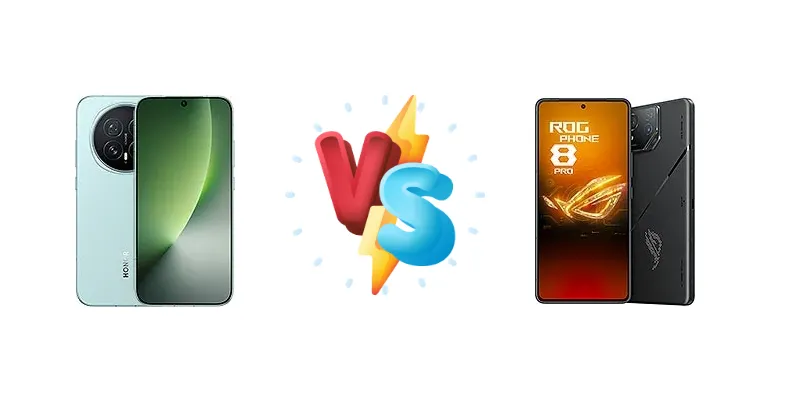
|
🏆 Quick Verdict
For the average user prioritizing peak performance and incredibly fast charging, the Honor Magic8 Pro takes the lead thanks to its Snapdragon 8 Elite Gen 5 and 90W wired/80W wireless charging. However, gamers will find the ROG Phone 8 Pro’s optimized software and longer battery life more compelling.
| PHONES | ||
|---|---|---|
| Phone Names | Honor Magic8 | Asus ROG Phone 8 Pro |
| Network | ||
|---|---|---|
| 2G bands | GSM 850 / 900 / 1800 / 1900 | GSM 850 / 900 / 1800 / 1900 |
| 3G bands | HSDPA 800 / 850 / 900 / 1700(AWS) / 1900 / 2100 | HSDPA 850 / 900 / 1700(AWS) / 1800 / 1900 / 2100 - International |
| 4G bands | LTE | 1, 2, 3, 4, 5, 7, 8, 12, 17, 18, 19, 20, 25, 26, 28, 32, 34, 38, 39, 40, 41, 42, 43, 48, 66 - International |
| 5G bands | SA/NSA | 1, 2, 3, 5, 7, 8, 12, 18, 20, 25, 26, 28, 38, 40, 41, 48, 66, 77, 78, 79 SA/NSA/Sub6 - International |
| Speed | HSPA, LTE, 5G | HSPA, LTE (Up to 7CA), 5G |
| Technology | GSM / HSPA / LTE / 5G | GSM / CDMA / HSPA / LTE / 5G |
| Launch | ||
|---|---|---|
| Announced | 2025, October 15 | 2024, January 08 |
| Status | Available. Released 2025, October 23 | Available. Released 2024, January 18 |
| Body | ||
|---|---|---|
| Build | - | Glass front (Gorilla Glass Victus 2), glass back (Gorilla Glass), aluminum frame |
| Dimensions | 157.1 x 74 x 8 mm (6.19 x 2.91 x 0.31 in) | 163.8 x 76.8 x 8.9 mm (6.45 x 3.02 x 0.35 in) |
| SIM | Nano-SIM + Nano-SIM | Nano-SIM + Nano-SIM |
| Weight | 205 g (7.23 oz) | 225 g (7.94 oz) |
| Display | ||
|---|---|---|
| Protection | Giant Rhino Glass | Corning Gorilla Glass Victus 2 |
| Resolution | 1256 x 2760 pixels (~461 ppi density) | 1080 x 2400 pixels, 20:9 ratio (~388 ppi density) |
| Size | 6.58 inches, 105.3 cm2 (~90.6% screen-to-body ratio) | 6.78 inches, 111.0 cm2 (~88.2% screen-to-body ratio) |
| Type | LTPO OLED, 1B colors, 120Hz, 4320Hz PWM, Dolby Vision, HDR Vivid, 1800 nits (HBM), 6000 nits (peak) | LTPO AMOLED, 1B colors, 165Hz, HDR10, 1600 nits (HBM), 2500 nits (peak) |
| Platform | ||
|---|---|---|
| CPU | Octa-core (2x4.6 GHz Oryon V3 Phoenix L + 6x3.62 GHz Oryon V3 Phoenix M) | Octa-core (1x3.3 GHz Cortex-X4 & 3x3.2 GHz Cortex-A720 & 2x3.0 GHz Cortex-A720 & 2x2.3 GHz Cortex-A520) |
| Chipset | Qualcomm SM8850-AC Snapdragon 8 Elite Gen 5 (3 nm) | Qualcomm SM8650-AB Snapdragon 8 Gen 3 (4 nm) |
| GPU | Adreno 840 | Adreno 750 |
| OS | Android 16, up to 7 major Android upgrades, MagicOS 10 | Android 14, up to 2 major Android upgrades |
| Memory | ||
|---|---|---|
| Card slot | No | No |
| Internal | 256GB 12GB RAM, 512GB 12GB RAM, 512GB 16GB RAM, 1TB 16GB RAM | 512GB 16GB RAM, 1TB 24GB RAM |
| Main Camera | ||
|---|---|---|
| Features | Color spectrum sensor, LED flash, HDR, panorama | LED flash, HDR, panorama |
| Triple | 50 MP, f/1.9, 24mm (wide), 1/1.56", 1.0µm, multi-directional PDAF, OIS 64 MP, f/2.5, (telephoto), PDAF, OIS, 3x optical zoom 50 MP, f/2.0, 12mm, 122˚ (ultrawide), 1/2.88", 0.61µm, dual pixel PDAF | 50 MP, f/1.9, 24mm (wide), 1/1.56", 1.0µm, PDAF, gimbal OIS 32 MP, f/2.4, (telephoto), 1/3.2", 0.7µm, PDAF, OIS, 3x optical zoom 13 MP, f/2.2, 13mm, 120˚ (ultrawide) |
| Video | 4K@24/30/60fps, 1080p@24/30/60/120/240fps, gyro-EIS, OIS, HDR, 10-bit video | 8K@24fps, 4K@30/60fps, 1080p@30/60/120/240fps, 720p@480fps; gyro-EIS, HDR10+ |
| Selfie camera | ||
|---|---|---|
| Features | - | Panorama, HDR |
| Single | 50 MP, f/2.0, 21mm (wide), 1/2.93", 0.6µm | 32 MP, f/2.5, 22mm (wide), 1/3.2", 0.7µm |
| Video | 4K@30/60fps, 1080p@30/60fps, gyro-EIS | 1080p@30fps |
| Sound | ||
|---|---|---|
| 35mm jack | No | Yes |
| Loudspeaker | Yes, with large amplitude stereo speakers | Yes, with stereo speakers |
| Comms | ||
|---|---|---|
| Bluetooth | 6.0, A2DP, LE, aptX HD, aptX Adaptive, aptX Lossless, LHDC 5, Auracast, ASHA | 5.4, A2DP, LE, aptX HD, aptX Adaptive, aptX Lossless |
| Infrared port | Yes | - |
| NFC | Yes | Yes |
| Positioning | GPS (L1+L5), BDS (B1I+B1c+B2a+B2b), GALILEO (E1+E5a+E5b), QZSS (L1+L5), NavIC (L1+L5), GLONASS | GPS (L1+L5), BDS (B1I+B1c+B2a), GALILEO (E1+E5a), QZSS (L1+L5), NavIC (L5), GLONASS |
| Radio | No | No |
| USB | USB Type-C 2.0, DisplayPort 1.2, OTG | USB Type-C (side), DisplayPort 1.4; USB Type-C (bottom), OTG |
| WLAN | Wi-Fi 802.11 a/b/g/n/ac/6/7, dual-band, Wi-Fi Direct | Wi-Fi 802.11 a/b/g/n/ac/6e/7, tri-band, Wi-Fi Direct |
| Features | ||
|---|---|---|
| Sensors | Fingerprint (under display, ultrasonic), accelerometer, gyro, proximity, compass | Fingerprint (under display, optical), accelerometer, gyro, proximity, compass |
| Battery | ||
|---|---|---|
| Charging | 90W wired, 90W PPS, 40W UFCS 80W wireless Reverse wireless 5W reverse wired | 65W wired, PD3.0, PPS, QC5, 100% in 39 min - International 30W wired, PD3.0, PPS - India 15W wireless (Qi) 10W reverse wired |
| Type | Si/C Li-Ion 7000 mAh | 5500 mAh |
| Misc | ||
|---|---|---|
| Colors | Black, White, Gold, Mint | Phantom Black |
| Models | BKQ-AN80, BKQ-AN00 | AI2401, AI2401_A, AI2401_D |
| Price | About 540 EUR | $ 1,157.98 / £ 1,693.75 / € 632.66 |
Honor Magic8
- Potentially fastest CPU performance with Snapdragon 8 Elite Gen 5
- Extremely fast 90W wired and 80W wireless charging
- UFCS charging standard for wider compatibility
- Battery life potentially lower than ROG Phone 8 Pro
- Camera specs currently unknown
Asus ROG Phone 8 Pro
- Excellent battery life (14:43h active use)
- Bright 1765 nit display for outdoor visibility
- Optimized gaming experience with ROG software
- Slower charging speeds compared to Honor Magic8 Pro
- Snapdragon 8 Gen 3 is a generation behind the Elite Gen 5
Display Comparison
The Asus ROG Phone 8 Pro boasts a significantly brighter display, reaching a measured 1765 nits, making it more visible outdoors. While the Magic8 Pro’s display specs are not provided, Asus’s brightness advantage is substantial. Both likely employ high refresh rate panels, but the ROG Phone’s brightness is a clear win. The ROG Phone’s display is also likely optimized for color accuracy and low blue light emission, catering to extended gaming sessions.
Camera Comparison
Detailed camera specs for the Honor Magic8 Pro are missing, making a direct comparison difficult. The ROG Phone 8 Pro’s camera capabilities are not highlighted in the provided data, suggesting it’s not a primary focus. Both phones likely feature capable camera systems, but without sensor size or aperture information for the Magic8 Pro, the ROG Phone 8 Pro’s photo/video capabilities are difficult to assess relative to the competition. We can assume both will offer standard features like HDR and night mode.
Performance
The Honor Magic8 Pro’s Snapdragon 8 Elite Gen 5 (3nm) with its Oryon V3 Phoenix cores represents a leap in mobile CPU architecture. The 4.6 GHz peak clock speeds on the prime cores suggest a significant advantage over the ROG Phone 8 Pro’s Snapdragon 8 Gen 3 (4nm) with its 3.3 GHz Cortex-X4. While the Gen 3 is a powerful chip, the Elite Gen 5’s newer architecture and higher clock speeds should translate to faster application loading and smoother multitasking. However, the ROG Phone 8 Pro benefits from Asus’s extensive thermal management system, potentially mitigating throttling during prolonged gaming.
Battery Life
The Asus ROG Phone 8 Pro demonstrates a clear advantage in battery endurance, achieving 14 hours and 43 minutes of active use. The Honor Magic8 Pro’s battery capacity is not specified, but its faster charging capabilities (90W wired, 80W wireless) partially offset this. The ROG Phone 8 Pro supports 65W wired charging, reaching 100% in 39 minutes internationally, while the Magic8 Pro’s 90W wired charging is even faster. The Magic8 Pro also offers 80W wireless charging, a significant advantage over the ROG Phone’s 15W wireless charging.
Buying Guide
Buy the Honor Magic8 Pro if you demand the absolute fastest processing speeds for demanding tasks like video editing or AI workloads, and value the convenience of extremely rapid wired and wireless charging. Buy the Asus ROG Phone 8 Pro if you are a dedicated mobile gamer who prioritizes sustained performance, long battery life during gaming sessions, and a feature-rich gaming ecosystem.