
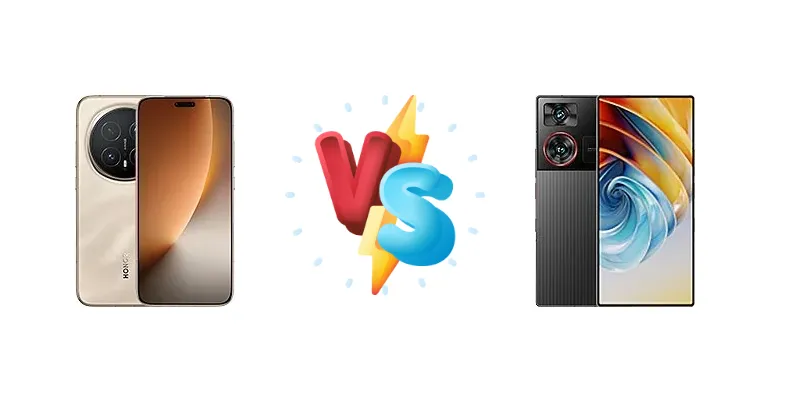
Honor Magic8 Pro vs. ZTE nubia Z60 Ultra Leading: A Deep Dive into Flagship Android Power
| Phones Images | |||||
|---|---|---|---|---|---|
|
🏆 Quick Verdict
For users prioritizing peak performance and the fastest charging speeds, the Honor Magic8 Pro emerges as the winner. Its Snapdragon 8 Elite Gen 5, with its Oryon cores, offers a demonstrable performance advantage. However, the ZTE nubia Z60 Ultra Leading provides exceptional battery life and a more balanced experience for those valuing longevity.
| PHONES | ||
|---|---|---|
| Phone Names | Honor Magic8 Pro | ZTE nubia Z60 Ultra Leading |
| Network | ||
|---|---|---|
| 2G bands | GSM 850 / 900 / 1800 / 1900 | GSM 850 / 900 / 1800 / 1900 |
| 3G bands | HSDPA 800 / 850 / 900 / 1700(AWS) / 1900 / 2100 | HSDPA 850 / 900 / 1700(AWS) / 1900 / 2100 |
| 4G bands | LTE | 1, 2, 3, 4, 5, 7, 8, 12, 17, 18, 19, 20, 26, 28, 34, 38, 39, 40, 41, 66 - International |
| 5G bands | SA/NSA | 1, 2, 3, 5, 7, 8, 28, 38, 40, 41, 66, 77, 78 SA/NSA - International |
| Speed | HSPA, LTE, 5G | HSPA, LTE, 5G |
| Technology | GSM / HSPA / LTE / 5G | GSM / CDMA / HSPA / CDMA2000 / LTE / 5G |
| Launch | ||
|---|---|---|
| Announced | 2025, October 15 | 2024, July 23 |
| Status | Available. Released 2025, October 23 | Available. Released 2024, August 12 |
| Body | ||
|---|---|---|
| Build | Glass front (NanoCrystal Shield), fiber-reinforced plastic back | Glass front, aluminum frame, glass back |
| Dimensions | 161.2 x 75 x 8.3 mm (6.35 x 2.95 x 0.33 in) | 164 x 76.4 x 8.8 mm (6.46 x 3.01 x 0.35 in) |
| SIM | · Nano-SIM + Nano-SIM + eSIM + eSIM (max 2 at a time) - International· Nano-SIM + Nano-SIM - China | Nano-SIM + Nano-SIM |
| Weight | 219 g (7.72 oz) | 246 g (8.68 oz) |
| Display | ||
|---|---|---|
| Protection | NanoCrystal Shield (INT); Giant Rhino Glass (China) | - |
| Resolution | 1256 x 2808 pixels, 20:9 ratio (~458 ppi density) | 1116 x 2480 pixels, 20:9 ratio (~400 ppi density) |
| Size | 6.71 inches, 108.3 cm2 (~89.6% screen-to-body ratio) | 6.8 inches, 111.6 cm2 (~89.1% screen-to-body ratio) |
| Type | LTPO OLED, 1B colors, 120Hz, 4320Hz PWM, Dolby Vision, HDR Vivid, 1800 nits (HBM), 6000 nits (peak) | AMOLED, 1B colors, 120Hz, HDR10, 1500 nits (peak) |
| Platform | ||
|---|---|---|
| CPU | Octa-core (2x4.6 GHz Oryon V3 Phoenix L + 6x3.62 GHz Oryon V3 Phoenix M) | Octa-core (1x3.4 GHz Cortex-X4 & 3x3.2 GHz Cortex-A720 & 2x3.0 GHz Cortex-A720 & 2x2.3 GHz Cortex-A520) |
| Chipset | Qualcomm SM8850-AC Snapdragon 8 Elite Gen 5 (3 nm) | Qualcomm SM8650-AC Snapdragon 8 Gen 3 (4 nm) |
| GPU | Adreno 840 | Adreno 750 (1 GHz) |
| OS | Android 16, up to 7 major Android upgrades, MagicOS 10 | Android 14, MyOS 14 (International), MyOS 14.5 (China) |
| Memory | ||
|---|---|---|
| Card slot | No | No |
| Internal | 256GB 12GB RAM, 512GB 12GB RAM, 512GB 16GB RAM, 1TB 16GB RAM | 256GB 8GB RAM, 256GB 12GB RAM, 512GB 16GB RAM, 1TB 16GB RAM, 1TB 24GB RAM |
| Main Camera | ||
|---|---|---|
| Features | Laser AF, color spectrum sensor, LED flash, HDR, panorama | Laser AF, color spectrum sensor, Ring-LED, dual-tone flash, panorama, HDR |
| Triple | 50 MP, f/1.6, 23mm (wide), 1/1.3", 1.2µm, multi-directional PDAF, OIS 200 MP, f/2.6, 85mm (periscope telephoto), 1/1.4", 0.56µm, multi-directional PDAF, OIS, 3.7x optical zoom 50 MP, f/2.0, 12mm, 122˚ (ultrawide), 1/2.88", 0.61µm, dual pixel PDAF | 50 MP, f/1.6, 35mm (standard), 1/1.56", 1.0µm, PDAF, OIS 64 MP, f/3.3, 85mm (periscope telephoto), 1/2.0", PDAF, OIS, 3.3x optical zoom (vs. 26mm cam) 50 MP, f/1.8, 18mm, 100˚ (ultrawide), 1/1.55", 1.0µm, PDAF, OIS |
| Video | 4K@24/30/60/120fps, 1080p@24/30/60/120/240fps, gyro-EIS, OIS, HDR, 10-bit video | 8K@30fps, 4K@30/60/120fps, 1080p@30/60fps, gyro-EIS, HDR10, 10‑bit video |
| Selfie camera | ||
|---|---|---|
| Features | - | HDR |
| Single | 50 MP, f/2.0, 21mm (wide), 1/2.93", 0.6µm, PDAF TOF 3D, (depth/biometrics sensor) | 12 MP, under display |
| Video | 4K@30/60fps, 1080p@30/60fps, gyro-EIS | 1080p@30fps |
| Sound | ||
|---|---|---|
| 35mm jack | No | No |
| Loudspeaker | Yes, with large amplitude stereo speakers | Yes, with stereo speakers |
| Comms | ||
|---|---|---|
| Bluetooth | 6.0, A2DP, LE, aptX HD, aptX Adaptive, aptX Lossless, LHDC 5, Auracast, ASHA | 5.4, A2DP, LE, aptX HD, aptX Adaptive, aptX Lossless |
| Infrared port | Yes | Yes |
| NFC | Yes | Yes (market/region dependent) |
| Positioning | GPS (L1+L5), BDS (B1I+B1c+B2a+B2b), GALILEO (E1+E5a+E5b), QZSS (L1+L5), NavIC (L1+L5), GLONASS | GPS (L1+L2+L5), GLONASS (G1+G5), BDS (B1I+B1C+B2a+B2b), GALILEO (E1+E5a), QZSS (L1+L5) |
| Radio | No | No |
| USB | USB Type-C 3.2, DisplayPort 1.2, OTG | USB Type-C 3.1, OTG |
| WLAN | Wi-Fi 802.11 a/b/g/n/ac/6/7, dual-band or tri-band, Wi-Fi Direct | Wi-Fi 802.11 a/b/g/n/ac/6e/7, dual-band, Wi-Fi Direct |
| Features | ||
|---|---|---|
| Sensors | Fingerprint (under display, ultrasonic), Face ID, accelerometer, gyro, proximity, compass | Fingerprint (under display, optical), accelerometer, gyro, proximity, compass |
| Battery | ||
|---|---|---|
| Charging | 100W wired (Global) 120W wired, 100W PPS, 40W UFCS (China) 80W wireless Reverse wireless 5W reverse wired | 80W wired, PD3.0, QC4 |
| Type | Si/C Li-Ion 7100 mAh (Global); 6270 mAh (Europe); 7200 mAh (China) | Li-Po 6000 mAh |
| Misc | ||
|---|---|---|
| Colors | Sunrise Gold, Sky Cyan, Black, White | Black, Silver |
| Models | BKQ-N49, BKQ-AN90, BKQ-AN10 | - |
| Price | About 960 EUR | About 730 EUR |
Honor Magic8 Pro
- Unmatched CPU performance with Snapdragon 8 Elite Gen 5 and Oryon cores
- Industry-leading charging speeds (120W wired in China)
- Potentially superior image processing capabilities
- Likely shorter battery life compared to the nubia Z60 Ultra Leading
- Potential for thermal throttling under sustained load
ZTE nubia Z60 Ultra Leading
- Exceptional battery life (14:04h active use)
- Thermally efficient Snapdragon 8 Gen 3
- Fast 80W wired charging with PD3.0 and QC4
- Lower peak CPU performance compared to the Magic8 Pro
- May not offer the same level of image processing sophistication
Display Comparison
While specific display details are absent, both phones are expected to feature high-refresh-rate AMOLED panels. However, the chipset difference impacts display capabilities indirectly. The Snapdragon 8 Elite Gen 5’s superior processing power allows for more complex display processing, potentially leading to more accurate color calibration and smoother animations. The nubia Z60 Ultra Leading, while capable, will likely rely more on the Snapdragon 8 Gen 3’s ISP for display enhancements. Bezels and peak brightness are unknown, but both are likely to be competitive within the flagship segment.
Camera Comparison
Without specific camera specs, it’s difficult to make a definitive comparison. However, both manufacturers have a history of incorporating high-resolution sensors. The Snapdragon 8 Elite Gen 5’s advanced ISP (Image Signal Processor) in the Magic8 Pro will likely offer superior image processing capabilities, including better noise reduction and dynamic range. The nubia Z60 Ultra Leading’s ISP is also capable, but may not match the Magic8 Pro’s processing power. The absence of details regarding sensor size and OIS makes a precise assessment impossible, but the Magic8 Pro’s chipset advantage suggests a potential edge in computational photography.
Performance
The core of the difference lies in the chipsets. The Honor Magic8 Pro’s Snapdragon 8 Elite Gen 5, built on a 3nm process, features a unique octa-core configuration with Oryon V3 Phoenix L and M cores clocked up to 4.6 GHz. This architecture is designed for significantly higher single-core and multi-core performance compared to the ZTE nubia Z60 Ultra Leading’s Snapdragon 8 Gen 3 (4nm). The Gen 3 utilizes a more traditional core arrangement (1x Cortex-X4, 3x Cortex-A720, 2x Cortex-A720, 2x Cortex-A520) peaking at 3.4 GHz. While the Gen 3 is a powerful chip, the Oryon cores in the 8 Elite Gen 5 provide a substantial performance uplift, particularly in CPU-bound tasks. The Magic8 Pro will likely exhibit faster app loading times and smoother multitasking. However, the 4nm process of the Gen 3 in the nubia Z60 Ultra Leading offers better thermal efficiency, potentially mitigating throttling during prolonged gaming sessions.
Battery Life
The ZTE nubia Z60 Ultra Leading boasts a significant advantage in battery endurance, achieving an active use score of 14:04h. This suggests a larger battery capacity and/or more efficient power management. The Honor Magic8 Pro, while offering incredibly fast 100W (Global) or 120W (China) wired charging, 80W wireless charging, and reverse wireless charging, likely has a smaller battery capacity to accommodate the faster charging speeds. The nubia Z60 Ultra Leading’s 80W wired charging with PD3.0 and QC4 is still fast, but doesn’t match the Magic8 Pro’s peak charging rate. The Magic8 Pro can potentially recoup hours of usage in minutes, while the nubia Z60 Ultra Leading prioritizes longevity.
Buying Guide
Buy the Honor Magic8 Pro if you demand the absolute fastest Android performance for demanding tasks like video editing, gaming, or AI workloads, and if 100W+ charging is a must-have. Buy the ZTE nubia Z60 Ultra Leading if you prioritize all-day battery life, consistent performance during extended use, and a more thermally efficient experience, even if it means sacrificing some peak processing power.