
Honor Magic8 Pro vs. vivo X100 Pro: A Deep Dive into Flagship Performance
| Phones Images | |||||
|---|---|---|---|---|---|
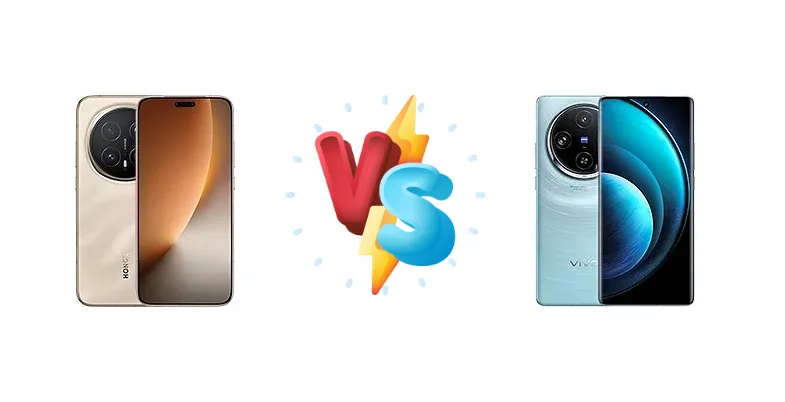
|
🏆 Quick Verdict
For users prioritizing raw processing power and potentially superior gaming performance, the Honor Magic8 Pro, with its Snapdragon 8 Elite Gen 5 and Oryon CPU architecture, is the better choice. However, the vivo X100 Pro offers excellent battery life and a competitive camera system, making it a strong contender for those valuing efficiency and all-day usability.
| PHONES | ||
|---|---|---|
| Phone Names | Honor Magic8 Pro | vivo X100 Pro |
| Network | ||
|---|---|---|
| 2G bands | GSM 850 / 900 / 1800 / 1900 | GSM 850 / 900 / 1800 / 1900 |
| 3G bands | HSDPA 800 / 850 / 900 / 1700(AWS) / 1900 / 2100 | HSDPA 800 / 850 / 900 / 1700(AWS) / 1900 / 2100 |
| 4G bands | LTE | 1, 2, 3, 4, 5, 7, 8, 12, 17, 18, 19, 20, 26, 28, 32, 38, 39, 40, 41, 42, 66 - International |
| 5G bands | SA/NSA | 1, 3, 5, 7, 8, 20, 28, 38, 40, 41, 66, 75, 77, 78, 79 SA/NSA - International |
| Speed | HSPA, LTE, 5G | HSPA, LTE, 5G |
| Technology | GSM / HSPA / LTE / 5G | GSM / CDMA / HSPA / LTE / 5G |
| Launch | ||
|---|---|---|
| Announced | 2025, October 15 | 2023, November 13 |
| Status | Available. Released 2025, October 23 | Available. Released 2023, November 21 |
| Body | ||
|---|---|---|
| Build | Glass front (NanoCrystal Shield), fiber-reinforced plastic back | Glass front, aluminum frame, glass back |
| Dimensions | 161.2 x 75 x 8.3 mm (6.35 x 2.95 x 0.33 in) | 164.1 x 75.3 x 8.9 mm or 9.1 mm |
| SIM | · Nano-SIM + Nano-SIM + eSIM + eSIM (max 2 at a time) - International· Nano-SIM + Nano-SIM - China | · Nano-SIM + eSIM· Nano-SIM + Nano-SIM |
| Weight | 219 g (7.72 oz) | 221 g or 225 g (7.80 oz) |
| Display | ||
|---|---|---|
| Protection | NanoCrystal Shield (INT); Giant Rhino Glass (China) | - |
| Resolution | 1256 x 2808 pixels, 20:9 ratio (~458 ppi density) | 1260 x 2800 pixels, 20:9 ratio (~452 ppi density) |
| Size | 6.71 inches, 108.3 cm2 (~89.6% screen-to-body ratio) | 6.78 inches, 111.5 cm2 (~90.2% screen-to-body ratio) |
| Type | LTPO OLED, 1B colors, 120Hz, 4320Hz PWM, Dolby Vision, HDR Vivid, 1800 nits (HBM), 6000 nits (peak) | LTPO AMOLED, 1B colors, 120Hz, HDR10+, 3000 nits (peak) |
| Platform | ||
|---|---|---|
| CPU | Octa-core (2x4.6 GHz Oryon V3 Phoenix L + 6x3.62 GHz Oryon V3 Phoenix M) | Octa-core (1x3.25 GHz Cortex-X4 & 3x2.85 GHz Cortex-X4 & 4x2.0 GHz Cortex-A720) |
| Chipset | Qualcomm SM8850-AC Snapdragon 8 Elite Gen 5 (3 nm) | Mediatek Dimensity 9300 (4 nm) |
| GPU | Adreno 840 | Immortalis-G720 MC12 |
| OS | Android 16, up to 7 major Android upgrades, MagicOS 10 | Android 14, upgradable to Android 15, Funtouch 15 (International), OriginOS 4 (China) |
| Memory | ||
|---|---|---|
| Card slot | No | No |
| Internal | 256GB 12GB RAM, 512GB 12GB RAM, 512GB 16GB RAM, 1TB 16GB RAM | 256GB 12GB RAM, 256GB 16GB RAM, 512GB 16GB RAM, 1TB 16GB RAM |
| Main Camera | ||
|---|---|---|
| Features | Laser AF, color spectrum sensor, LED flash, HDR, panorama | Laser AF, color spectrum sensor, Zeiss optics, Zeiss T* lens coating, LED flash, panorama, HDR, 3D LUT import |
| Triple | 50 MP, f/1.6, 23mm (wide), 1/1.3", 1.2µm, multi-directional PDAF, OIS 200 MP, f/2.6, 85mm (periscope telephoto), 1/1.4", 0.56µm, multi-directional PDAF, OIS, 3.7x optical zoom 50 MP, f/2.0, 12mm, 122˚ (ultrawide), 1/2.88", 0.61µm, dual pixel PDAF | 50 MP, f/1.8, 23mm (wide), 1/0.98", 1.6µm, dual pixel PDAF, OIS 50 MP, f/2.5, 100mm (periscope telephoto), 1/2.51", 0.7µm, PDAF (18cm - ∞), OIS, 4.3x optical zoom 50 MP, f/2.0, 15mm, 119˚ (ultrawide), 1/2.76", 0.64µm, AF |
| Video | 4K@24/30/60/120fps, 1080p@24/30/60/120/240fps, gyro-EIS, OIS, HDR, 10-bit video | 8K@30fps, 4K@30/60fps, 1080p, gyro-EIS |
| Selfie camera | ||
|---|---|---|
| Features | - | HDR |
| Single | 50 MP, f/2.0, 21mm (wide), 1/2.93", 0.6µm, PDAF TOF 3D, (depth/biometrics sensor) | 32 MP, f/2.0, 20mm (ultrawide) |
| Video | 4K@30/60fps, 1080p@30/60fps, gyro-EIS | 4K@30/60fps, 1080p@30/60fps |
| Sound | ||
|---|---|---|
| 35mm jack | No | No |
| Loudspeaker | Yes, with large amplitude stereo speakers | Yes, with stereo speakers |
| Comms | ||
|---|---|---|
| Bluetooth | 6.0, A2DP, LE, aptX HD, aptX Adaptive, aptX Lossless, LHDC 5, Auracast, ASHA | 5.4, A2DP, LE, aptX HD, LHDC |
| Infrared port | Yes | Yes |
| NFC | Yes | Yes |
| Positioning | GPS (L1+L5), BDS (B1I+B1c+B2a+B2b), GALILEO (E1+E5a+E5b), QZSS (L1+L5), NavIC (L1+L5), GLONASS | GPS (L1+L5), GLONASS (L1), BDS (B1I+B1c+B2a+B2b), GALILEO (E1+E5a+E5b), QZSS (L1+L5), NavIC (L5) |
| Radio | No | No |
| USB | USB Type-C 3.2, DisplayPort 1.2, OTG | USB Type-C 3.2, OTG |
| WLAN | Wi-Fi 802.11 a/b/g/n/ac/6/7, dual-band or tri-band, Wi-Fi Direct | Wi-Fi 802.11 a/b/g/n/ac/6/7, tri-band, Wi-Fi Direct |
| Features | ||
|---|---|---|
| Sensors | Fingerprint (under display, ultrasonic), Face ID, accelerometer, gyro, proximity, compass | Fingerprint (under display, optical), accelerometer, gyro, proximity, compass |
| Battery | ||
|---|---|---|
| Charging | 100W wired (Global) 120W wired, 100W PPS, 40W UFCS (China) 80W wireless Reverse wireless 5W reverse wired | 100W wired, 50% in 14 min 50W wireless Reverse wired |
| Type | Si/C Li-Ion 7100 mAh (Global); 6270 mAh (Europe); 7200 mAh (China) | Li-Ion 5400 mAh |
| Misc | ||
|---|---|---|
| Colors | Sunrise Gold, Sky Cyan, Black, White | Startrail Blue, Asteroid Black, Sunset Orange, White |
| Models | BKQ-N49, BKQ-AN90, BKQ-AN10 | V2324A, V2309 |
| Price | About 960 EUR | ₹ 59,999 |
| SAR EU | - | 0.99 W/kg (head) 1.19 W/kg (body) |
Honor Magic8 Pro
- Potentially superior CPU performance with Snapdragon 8 Elite Gen 5 and Oryon architecture
- Faster wired charging speeds (up to 120W in China)
- More versatile charging options (PPS, UFCS, reverse wired)
- Battery life data unavailable
- Display specs less detailed than the vivo X100 Pro
vivo X100 Pro
- Excellent battery life (13:53h active use)
- High peak display brightness (1472 nits)
- Competitive camera system (implied)
- Less powerful CPU compared to Snapdragon 8 Elite Gen 5
- Slower wireless charging (50W)
Display Comparison
The vivo X100 Pro boasts a measured peak brightness of 1472 nits, suggesting a superior outdoor visibility experience compared to the Honor Magic8 Pro (brightness data unavailable). While both likely employ LTPO panels for adaptive refresh rates, the X100 Pro’s higher peak brightness is a tangible advantage. The absence of detailed display specs for the Magic8 Pro leaves questions about color accuracy and panel technology unanswered, but Honor typically delivers high-quality displays in its flagship models.
Camera Comparison
Detailed camera specs are limited, but both phones are expected to deliver flagship-level image quality. The vivo X100 Pro’s camera is highlighted, suggesting a strong focus on photography and videography. Sensor sizes and lens apertures are crucial here, but unavailable in the provided data. The absence of specific details for the Magic8 Pro’s camera system makes a direct comparison difficult. However, both manufacturers have a history of incorporating advanced image processing algorithms and optical image stabilization (OIS) in their flagship devices.
Performance
The core difference lies in the chipsets. The Honor Magic8 Pro’s Snapdragon 8 Elite Gen 5, built on a 3nm process, features a unique Oryon V3 Phoenix CPU configuration (2x4.6 GHz + 6x3.62 GHz). This architecture, designed by Qualcomm, aims to deliver exceptional performance and efficiency. The vivo X100 Pro utilizes the MediaTek Dimensity 9300 (4nm), with a more traditional core arrangement (1x3.25 GHz Cortex-X4 + 3x2.85 GHz Cortex-X4 + 4x2.0 GHz Cortex-A720). While the Dimensity 9300 is a powerful chip, the 3nm process of the Snapdragon 8 Elite Gen 5 should translate to better thermal management and sustained performance under heavy load. The Magic8 Pro’s potential for higher clock speeds and architectural advantages gives it an edge in CPU-intensive tasks.
Battery Life
The vivo X100 Pro demonstrates a strong battery performance with an active use score of 13:53h, indicating excellent efficiency. The Honor Magic8 Pro’s battery capacity is not specified, but its charging capabilities are more versatile. The Magic8 Pro supports 100W wired charging globally, with up to 120W in China, 100W PPS, 40W UFCS, and 80W wireless charging, alongside reverse wireless and wired charging. The X100 Pro offers 100W wired (50% in 14 minutes) and 50W wireless charging, with reverse wired charging. While the X100 Pro’s battery life is confirmed, the Magic8 Pro’s faster charging speeds, particularly the 120W option in China, offer a quicker top-up experience.
Buying Guide
Buy the Honor Magic8 Pro if you demand the absolute fastest performance for demanding tasks like video editing, high-end gaming, and multitasking. Its Snapdragon 8 Elite Gen 5 offers a potential edge in sustained performance. Buy the vivo X100 Pro if you prioritize battery life, consistent performance throughout the day, and a well-rounded camera experience, even if it means sacrificing a small amount of peak processing power.