
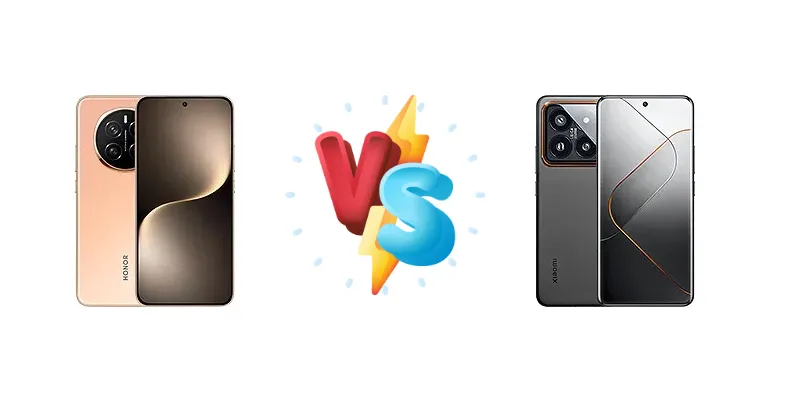
Honor Magic7 vs. Xiaomi 14 Pro: A Deep Dive into Flagship Android Power
| Phones Images | |||||
|---|---|---|---|---|---|
|
🏆 Quick Verdict
For users prioritizing raw CPU performance and potentially longer sustained workloads, the Honor Magic7 with its Snapdragon 8 Elite is the winner. However, the Xiaomi 14 Pro offers a more refined overall package with faster wired charging and a proven track record, making it the better choice for most consumers.
| PHONES | ||
|---|---|---|
| Phone Names | Honor Magic7 | Xiaomi 14 Pro |
| Network | ||
|---|---|---|
| 2G bands | GSM 850 / 900 / 1800 / 1900 | GSM 850 / 900 / 1800 / 1900 |
| 3G bands | HSDPA 800 / 850 / 900 / 1700(AWS) / 1900 / 2100 | HSDPA 800 / 850 / 900 / 1700(AWS) / 1900 / 2100 |
| 4G bands | LTE | 1, 3, 4, 5, 7, 8, 18, 19, 26, 28, 34, 38, 39, 40, 41, 42, 48, 66 |
| 5G bands | SA/NSA | 1, 3, 5, 7, 8, 28, 38, 40, 41, 48, 66, 77, 78, 79 SA/NSA |
| Speed | HSPA, LTE, 5G | HSPA, LTE, 5G |
| Technology | GSM / HSPA / LTE / 5G | GSM / CDMA / HSPA / CDMA2000 / LTE / 5G |
| Launch | ||
|---|---|---|
| Announced | 2024, October 30 | 2023, October 26 |
| Status | Available. Released 2024, November 08 | Available. Released 2023, November 01 |
| Body | ||
|---|---|---|
| Build | Glass front (Giant Rhino Glass), fiber-reinforced plastic back | Glass front, aluminum frame or titanium frame, glass back |
| Dimensions | 162.1 x 75.8 x 8 mm (6.38 x 2.98 x 0.31 in) | 161.4 x 75.3 x 8.5 mm |
| SIM | Nano-SIM + Nano-SIM | Nano-SIM + Nano-SIM |
| Weight | 199 g (7.02 oz) | 223 g or 230 g (7.87 oz) |
| Display | ||
|---|---|---|
| Protection | Giant rhino glass | Shatterproof glass |
| Resolution | 1264 x 2800 pixels (~453 ppi density) | 1440 x 3200 pixels, 20:9 ratio (~522 ppi density) |
| Size | 6.78 inches, 111.2 cm2 (~90.5% screen-to-body ratio) | 6.73 inches, 108.9 cm2 (~89.6% screen-to-body ratio) |
| Type | LTPO OLED, 1B colors, 120Hz, 4320Hz PWM, Dolby Vision, HDR, 1600 nits (HBM), 5000 nits (peak) | LTPO AMOLED, 68B colors, 120Hz, Dolby Vision, HDR10+, 3000 nits (peak) |
| Platform | ||
|---|---|---|
| CPU | Octa-core (2x4.32 GHz Oryon V2 Phoenix L + 6x3.53 GHz Oryon V2 Phoenix M) | Octa-core (1x3.3 GHz Cortex-X4 & 3x3.2 GHz Cortex-A720 & 2x3.0 GHz Cortex-A720 & 2x2.3 GHz Cortex-A520) |
| Chipset | Qualcomm SM8750-AB Snapdragon 8 Elite (3 nm) | Qualcomm SM8650-AB Snapdragon 8 Gen 3 (4 nm) |
| GPU | Adreno 830 | Adreno 750 |
| OS | Android 15, MagicOS 9 | Android 14, HyperOS |
| Memory | ||
|---|---|---|
| Card slot | No | No |
| Internal | 256GB 12GB RAM, 512GB 12GB RAM, 512GB 16GB RAM, 1TB 16GB RAM | 256GB 12GB RAM, 512GB 16GB RAM, 1TB 16GB RAM |
| Main Camera | ||
|---|---|---|
| Features | Laser AF, color spectrum sensor, LED flash, HDR, panorama | Laser AF, color spectrum sensor, Leica lens, Dual-LED dual-tone flash, HDR, panorama |
| Triple | 50 MP, f/1.9, 24mm (wide), 1/1.3", 1.2µm, dual pixel PDAF 50 MP, f/2.4, 68mm (telephoto), PDAF, OIS, 3x optical zoom 50 MP, f/2.0, 12mm, 122˚ (ultrawide), 1/2.88", 0.61µm, dual pixel PDAF | 50 MP, f/1.4-f/4.0, 23mm (wide), 1/1.31", 1.2µm, dual pixel PDAF, OIS 50 MP, f/2.0, 75mm (telephoto), PDAF (10cm - ∞), OIS, 3.2x optical zoom 50 MP, f/2.2, 14mm, 115˚ (ultrawide), AF |
| Video | 4K@24/30/60fps, 1080p@24/30/60/120/240fps, gyro-EIS, OIS, HDR, 10-bit video | 8K@24fps (HDR), 4K@24/30/60fps (HDR10+, 10-bit Dolby Vision HDR, 10-bit LOG), 1080p@30/60/120/240/960fps, 720p@1920fps, gyro-EIS |
| Selfie camera | ||
|---|---|---|
| Features | - | HDR, panorama |
| Single | 50 MP, f/2.0, 22mm (wide), 1/2.93", 0.6µm | 32 MP, f/2.0, 22mm (wide), 0.7µm |
| Video | 4K@30/60fps, 1080p@30/60fps, gyro-EIS | 4K@30/60fps, 1080p@30/60fps, gyro-EIS |
| Sound | ||
|---|---|---|
| 35mm jack | No | No |
| Loudspeaker | Yes, with large amplitude stereo speakers | Yes, with stereo speakers |
| Comms | ||
|---|---|---|
| Bluetooth | 5.4, A2DP, LE, aptX HD | 5.4, A2DP, LE, aptX HD, aptX Adaptive |
| Infrared port | Yes | Yes |
| NFC | Yes | Yes |
| Positioning | GPS (L1+L5), GLONASS, BDS (B1I+B1c+B2a), GALILEO (E1+E5a) | GPS (L1+L5), GLONASS (G1), BDS (B1I+B1c+B2a), GALILEO (E1+E5a), QZSS (L1+L5), NavIC (L5) |
| Radio | No | No |
| USB | USB Type-C 2.0, OTG | USB Type-C 3.2 Gen 2, OTG |
| WLAN | Wi-Fi 802.11 a/b/g/n/ac/6/7, dual-band, Wi-Fi Direct | Wi-Fi 802.11 a/b/g/n/ac/6e/7, dual-band, Wi-Fi Direct |
| Features | ||
|---|---|---|
| Sensors | Fingerprint (under display, ultrasonic), accelerometer, gyro, proximity, compass | Fingerprint (under display, optical), accelerometer, proximity, gyro, compass, barometer |
| Battery | ||
|---|---|---|
| Charging | 100W wired 80W wireless Reverse wireless 5W reverse wired | 120W wired, PD3.0, QC4, 100% in 18 min 50W wireless, 100% in 40 min 10W reverse wireless |
| Type | Si/C Li-Ion 5650 mAh | Li-Po 4880 mAh |
| Misc | ||
|---|---|---|
| Colors | Black, White, Gray, Blue, Gold | Black, Silver, Titanium, Green |
| Models | PTP-AN00 | 23116PN5BC |
| Price | About 580 EUR | About 650 EUR |
Honor Magic7
- Potentially superior CPU performance with Snapdragon 8 Elite and Oryon architecture
- Cutting-edge 3nm process for improved efficiency
- 80W Wireless Charging and Reverse Wired Charging
- Oryon architecture may have initial software optimization challenges
- Software ecosystem potentially less mature than Xiaomi's MIUI
Xiaomi 14 Pro
- Faster 120W wired charging
- Mature and feature-rich MIUI software
- Proven Snapdragon 8 Gen 3 performance
- 4nm process may result in slightly higher thermal output under sustained load
- Potentially less impressive single-core CPU performance compared to the Magic7
Display Comparison
While both devices are expected to feature high-quality AMOLED displays, specific details like peak brightness and refresh rate are missing. However, the focus on LTPO technology is likely present in both, enabling adaptive refresh rates for power efficiency. The Xiaomi 14 Pro’s display is likely to benefit from Xiaomi’s extensive display calibration expertise, potentially offering more accurate color reproduction out of the box. Bezels are expected to be minimal on both, reflecting current flagship trends.
Camera Comparison
Without specific camera sensor details, a direct comparison is difficult. However, both manufacturers are known for their camera prowess. The Xiaomi 14 Pro is expected to feature a large main sensor, potentially a 1-inch type, with advanced OIS. Honor has also been pushing the boundaries of mobile photography. The image processing style will likely differ – Xiaomi tends towards vibrant, saturated colors, while Honor often aims for a more natural look. The absence of details on telephoto and ultrawide lenses prevents a comprehensive assessment, but both are expected to offer versatile camera systems.
Performance
The core difference lies in the chipsets. The Honor Magic7’s Snapdragon 8 Elite (3nm) with its Oryon V2 Phoenix CPU architecture (2x4.32 GHz + 6x3.53 GHz) is a significant departure from traditional Snapdragon designs. Oryon’s focus on single-core performance should translate to snappier app launches and improved responsiveness. The Xiaomi 14 Pro’s Snapdragon 8 Gen 3 (4nm) utilizes a more conventional core configuration (1x3.3 GHz Cortex-X4 + 3x3.2 GHz Cortex-A720 + 2x3.0 GHz Cortex-A720 + 2x2.3 GHz Cortex-A520). While the Gen 3 is incredibly powerful, the 3nm process and Oryon architecture of the 8 Elite suggest a potential performance advantage for the Magic7, particularly in sustained workloads. Both will likely feature LPDDR5x RAM, but the Magic7’s performance will be heavily reliant on how well the Oryon cores are optimized.
Battery Life
The Xiaomi 14 Pro boasts a significant charging advantage with 120W wired charging (0-100% in 18 minutes) compared to the Honor Magic7’s 100W. The Xiaomi also offers 50W wireless charging (0-100% in 40 minutes), faster than the Magic7’s 80W. While the Magic7 offers reverse wired charging at 5W, the Xiaomi provides 10W. The actual battery life will depend on the mAh capacity of each device (currently unknown), but the Xiaomi’s faster charging speeds will be a major convenience factor for many users.
Buying Guide
Buy the Honor Magic7 if you absolutely need the highest possible CPU performance for tasks like video editing or emulation, and are willing to potentially trade off some software polish. Buy the Xiaomi 14 Pro if you prioritize a well-rounded experience with fast charging, a mature software ecosystem, and a consistently high level of performance across all tasks.