
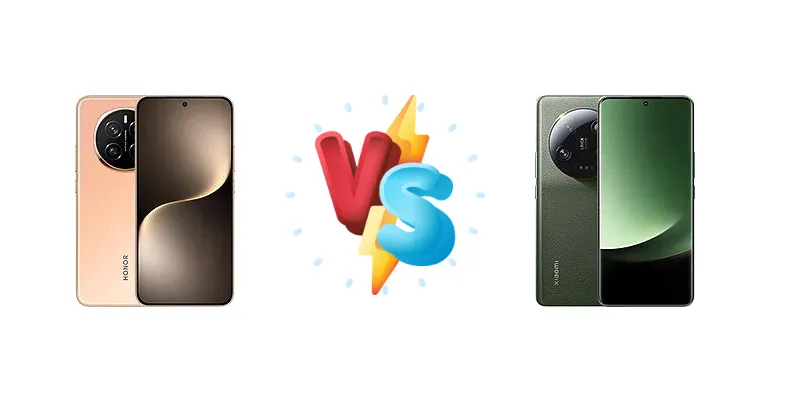
Honor Magic7 vs. Xiaomi 13 Ultra: A Deep Dive into Flagship Performance and Photography
| Phones Images | |||||
|---|---|---|---|---|---|
|
🏆 Quick Verdict
For users prioritizing peak performance and future-proofing, the Honor Magic7’s Snapdragon 8 Elite offers a clear advantage. However, the Xiaomi 13 Ultra’s exceptional camera system and longer battery life make it the more practical choice for everyday users and photography enthusiasts.
| PHONES | ||
|---|---|---|
| Phone Names | Honor Magic7 | Xiaomi 13 Ultra |
| Network | ||
|---|---|---|
| 2G bands | GSM 850 / 900 / 1800 / 1900 | GSM 850 / 900 / 1800 / 1900 |
| 3G bands | HSDPA 800 / 850 / 900 / 1700(AWS) / 1900 / 2100 | HSDPA 800 / 850 / 900 / 1700(AWS) / 1900 / 2100 |
| 4G bands | LTE | 1, 2, 3, 4, 5, 7, 8, 18, 19, 20, 26, 28, 38, 40, 41, 66 - International |
| 5G bands | SA/NSA | 1, 3, 5, 7, 8, 20, 28, 38, 40, 41, 77, 78, 79 SA/NSA - International |
| Speed | HSPA, LTE, 5G | HSPA, LTE, 5G |
| Technology | GSM / HSPA / LTE / 5G | GSM / CDMA / HSPA / EVDO / LTE / 5G |
| - | CDMA2000 1xEV-DO | |
| Launch | ||
|---|---|---|
| Announced | 2024, October 30 | 2023, April 18 |
| Status | Available. Released 2024, November 08 | Available. Released 2023, April 21 |
| Body | ||
|---|---|---|
| Build | Glass front (Giant Rhino Glass), fiber-reinforced plastic back | Glass front (Gorilla Glass Victus), eco leather back, aluminum frame |
| Dimensions | 162.1 x 75.8 x 8 mm (6.38 x 2.98 x 0.31 in) | 163.2 x 74.6 x 9.1 mm (6.43 x 2.94 x 0.36 in) |
| SIM | Nano-SIM + Nano-SIM | Nano-SIM + Nano-SIM |
| Weight | 199 g (7.02 oz) | 227 g (8.01 oz) |
| - | IP68 dust/water resistant (up to 1.5m for 30 min) | |
| Display | ||
|---|---|---|
| Protection | Giant rhino glass | Corning Gorilla Glass Victus |
| Resolution | 1264 x 2800 pixels (~453 ppi density) | 1440 x 3200 pixels, 20:9 ratio (~522 ppi density) |
| Size | 6.78 inches, 111.2 cm2 (~90.5% screen-to-body ratio) | 6.73 inches, 108.9 cm2 (~89.5% screen-to-body ratio) |
| Type | LTPO OLED, 1B colors, 120Hz, 4320Hz PWM, Dolby Vision, HDR, 1600 nits (HBM), 5000 nits (peak) | LTPO AMOLED, 68B colors, 120Hz, Dolby Vision, HDR10+, 1300 nits (HBM), 2600 nits (peak) |
| Platform | ||
|---|---|---|
| CPU | Octa-core (2x4.32 GHz Oryon V2 Phoenix L + 6x3.53 GHz Oryon V2 Phoenix M) | Octa-core (1x3.2 GHz Cortex-X3 & 2x2.8 GHz Cortex-A715 & 2x2.8 GHz Cortex-A710 & 3x2.0 GHz Cortex-A510) |
| Chipset | Qualcomm SM8750-AB Snapdragon 8 Elite (3 nm) | Qualcomm SM8550-AB Snapdragon 8 Gen 2 (4 nm) |
| GPU | Adreno 830 | Adreno 740 |
| OS | Android 15, MagicOS 9 | Android 13, upgradable to Android 14, HyperOS |
| Memory | ||
|---|---|---|
| Card slot | No | No |
| Internal | 256GB 12GB RAM, 512GB 12GB RAM, 512GB 16GB RAM, 1TB 16GB RAM | 256GB 12GB RAM, 512GB 12GB RAM, 512GB 16GB RAM, 1TB 16GB RAM |
| - | UFS 4.0 | |
| Main Camera | ||
|---|---|---|
| Features | Laser AF, color spectrum sensor, LED flash, HDR, panorama | Laser AF, color spectrum sensor, Leica lenses, Dual-LED flash, HDR, panorama, 67mm filter ring holder (optional) |
| Quad | - | 50 MP, f/1.9 or f/4.0, 23mm (wide), 1.0"-type, 1.6µm, dual pixel PDAF, OIS 50 MP, f/1.8, 75mm (telephoto), 1/2.51", 0.7µm, dual pixel PDAF, OIS, 3.2x optical zoom 50 MP, f/3.0, 120mm (periscope telephoto), 1/2.51", 0.7µm, dual pixel PDAF, OIS, 5x optical zoom 50 MP, f/1.8, 12mm, 122˚ (ultrawide), 1/2.51", 0.7µm, dual pixel PDAF TOF 3D, (depth) |
| Triple | 50 MP, f/1.9, 24mm (wide), 1/1.3", 1.2µm, dual pixel PDAF 50 MP, f/2.4, 68mm (telephoto), PDAF, OIS, 3x optical zoom 50 MP, f/2.0, 12mm, 122˚ (ultrawide), 1/2.88", 0.61µm, dual pixel PDAF | - |
| Video | 4K@24/30/60fps, 1080p@24/30/60/120/240fps, gyro-EIS, OIS, HDR, 10-bit video | 8K@24fps, 4K@24/30/60fps, 1080p@30/60/120/240/480/960/1920fps, gyro-EIS, Dolby Vision HDR 10-bit rec. (4K@60fps, 1080p) |
| Selfie camera | ||
|---|---|---|
| Features | - | HDR, panorama |
| Single | 50 MP, f/2.0, 22mm (wide), 1/2.93", 0.6µm | 32 MP, f/2.0, 22mm (wide), 1/3.14", 0.7µm |
| Video | 4K@30/60fps, 1080p@30/60fps, gyro-EIS | 1080p@30/60fps, gyro-EIS |
| Sound | ||
|---|---|---|
| 3.5mm jack | - | No |
| 35mm jack | No | No |
| Loudspeaker | Yes, with large amplitude stereo speakers | Yes, with stereo speakers |
| - | 24-bit/192kHz audio | |
| Comms | ||
|---|---|---|
| Bluetooth | 5.4, A2DP, LE, aptX HD | 5.3, A2DP, LE, aptX HD, aptX Adaptive |
| Infrared port | Yes | Yes |
| NFC | Yes | Yes |
| Positioning | GPS (L1+L5), GLONASS, BDS (B1I+B1c+B2a), GALILEO (E1+E5a) | GPS (L1+L5), GLONASS (L1), BDS (B1I+B1c+B2a), GALILEO (E1+E5a), QZSS (L1+L5), NavIC (L5) |
| Radio | No | No |
| USB | USB Type-C 2.0, OTG | USB Type-C 3.2, DisplayPort, OTG |
| WLAN | Wi-Fi 802.11 a/b/g/n/ac/6/7, dual-band, Wi-Fi Direct | Wi-Fi 802.11 a/b/g/n/ac/6e/7, tri-band, Wi-Fi Direct |
| Features | ||
|---|---|---|
| Sensors | Fingerprint (under display, ultrasonic), accelerometer, gyro, proximity, compass | Fingerprint (under display, optical), accelerometer, proximity, gyro, compass, barometer |
| - | Virtual proximity sensing | |
| Battery | ||
|---|---|---|
| Charging | 100W wired 80W wireless Reverse wireless 5W reverse wired | 90W wired, PD3.0, QC4, 100% in 35 min 50W wireless, 100% in 49 min 10W reverse wireless |
| Type | Si/C Li-Ion 5650 mAh | Li-Po 5000 mAh |
| Misc | ||
|---|---|---|
| Colors | Black, White, Gray, Blue, Gold | Black, Olive Green, White, Orange, Yellow, Blue |
| Models | PTP-AN00 | 2304FPN6DC, 2304FPN6DG |
| Price | About 580 EUR | € 797.98 / $ 389.69 |
| SAR EU | - | 0.99 W/kg (head) 1.00 W/kg (body) |
Honor Magic7
- Cutting-edge Snapdragon 8 Elite processor
- Faster wired and wireless charging speeds
- Potential for superior gaming performance
- Camera specifications currently unknown
- Battery life potentially lower than Xiaomi 13 Ultra
Xiaomi 13 Ultra
- Exceptional camera system and image quality
- Long battery life and excellent endurance
- Fast charging speeds (90W wired, 50W wireless)
- Older generation Snapdragon 8 Gen 2 processor
- May not offer the absolute fastest performance
Display Comparison
The Xiaomi 13 Ultra boasts a measured peak brightness of 1207 nits, suggesting a vibrant and easily viewable display in direct sunlight. While the Magic7’s display specifications are currently unavailable, Honor typically employs high-quality OLED panels. The 13 Ultra’s display technology is likely LTPO, enabling adaptive refresh rates for improved power efficiency. Without further details on the Magic7’s panel, the 13 Ultra currently holds an advantage in confirmed display performance.
Camera Comparison
The Xiaomi 13 Ultra’s camera system is its defining feature, though specific details are missing. Xiaomi’s Ultra series is renowned for its exceptional image quality, likely leveraging a large main sensor, advanced OIS, and sophisticated image processing algorithms. The Magic7’s camera specifications are currently unknown, but Honor has been steadily improving its camera technology. The 13 Ultra’s established reputation and likely larger sensor size give it a significant edge in image quality, particularly in low-light conditions. The 13 Ultra’s focus on photography is a clear differentiator.
Performance
The Honor Magic7’s Qualcomm SM8750-AB Snapdragon 8 Elite, featuring a custom Oryon V2 Phoenix CPU configuration (2x4.32 GHz + 6x3.53 GHz), represents a significant leap in mobile processing. This architecture, built on a 3nm process, promises substantial gains in both performance and efficiency compared to the Xiaomi 13 Ultra’s 4nm Snapdragon 8 Gen 2 (1x3.2 GHz Cortex-X3, 2x2.8 GHz Cortex-A715, 2x2.8 GHz Cortex-A710, 3x2.0 GHz Cortex-A510). The Oryon cores are designed for higher single-core and multi-core performance, translating to faster app loading, smoother multitasking, and superior gaming capabilities. The Magic7 is poised to deliver a noticeably snappier experience, especially in CPU-intensive tasks.
Battery Life
The Xiaomi 13 Ultra achieves an impressive 10:09h active use score and an endurance rating of 108 hours, indicating excellent battery life. The Honor Magic7 offers faster charging with 100W wired and 80W wireless, compared to the 13 Ultra’s 90W wired (35 min to 100%) and 50W wireless (49 min to 100%). The Magic7 also includes 5W reverse wired charging and reverse wireless charging. While the Magic7 charges faster, the 13 Ultra’s superior endurance suggests it will last longer on a single charge, making it more convenient for users who don’t want to constantly top up their battery.
Buying Guide
Buy the Honor Magic7 if you demand the absolute fastest Android experience, frequently engage in demanding mobile gaming, and value the latest processor technology. Buy the Xiaomi 13 Ultra if you prioritize camera quality, all-day battery life, and a more polished, mature software experience, even if it means sacrificing some raw processing power.