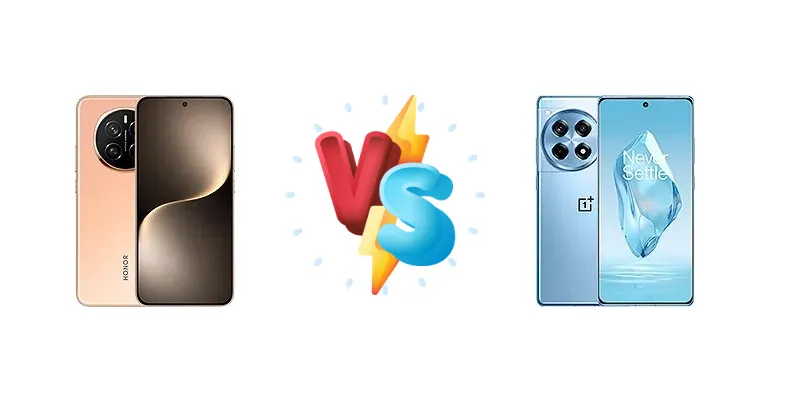
The Honor Magic7 arrives with Qualcomm’s newest Snapdragon 8 Elite, aiming to disrupt the flagship space. However, the OnePlus 12R, powered by the established Snapdragon 8 Gen 2, offers a compelling alternative, particularly given its more accessible price point. This comparison dissects the key differences to determine which device delivers the best overall experience.
🏆 Quick Verdict
For the average user prioritizing sustained performance and a proven track record, the OnePlus 12R emerges as the more sensible choice. While the Honor Magic7’s Snapdragon 8 Elite holds theoretical advantages, the 12R’s excellent battery life and efficient cooling provide a more consistently enjoyable experience.
| Network |
|---|
| 2G bands | GSM 850 / 900 / 1800 / 1900 | GSM 850 / 900 / 1800 / 1900 |
| 3G bands | HSDPA 800 / 850 / 900 / 1700(AWS) / 1900 / 2100 | HSDPA 850 / 900 / 1700(AWS) / 1900 / 2100 |
| 4G bands | LTE | 1, 2, 3, 4, 5, 7, 8, 12, 17, 18, 19, 20, 26, 28, 32, 38, 39, 40, 41, 66 |
| 5G bands | SA/NSA | 1, 2, 3, 5, 7, 8, 12, 20, 28, 38, 40, 41, 66, 77, 78 SA/NSA |
| Speed | HSPA, LTE, 5G | HSPA, LTE, 5G |
| Technology | GSM / HSPA / LTE / 5G | GSM / CDMA / HSPA / LTE / 5G |
| Launch |
|---|
| Announced | 2024, October 30 | 2024, January 23 |
| Status | Available. Released 2024, November 08 | Available. Released 2024, February 06 |
| Body |
|---|
| Build | Glass front (Giant Rhino Glass), fiber-reinforced plastic back | Glass front (Gorilla Glass Victus 2), aluminum frame, glass back |
| Dimensions | 162.1 x 75.8 x 8 mm (6.38 x 2.98 x 0.31 in) | 163.3 x 75.3 x 8.8 mm (6.43 x 2.96 x 0.35 in) |
| SIM | Nano-SIM + Nano-SIM | · Nano-SIM + Nano-SIM + eSIM (max 2 at a time)· Nano-SIM + Nano-SIM |
| Weight | 199 g (7.02 oz) | 207 g (7.30 oz) |
| Display |
|---|
| Protection | Giant rhino glass | Corning Gorilla Glass Victus 2 |
| Resolution | 1264 x 2800 pixels (~453 ppi density) | 1264 x 2780 pixels (~450 ppi density) |
| Size | 6.78 inches, 111.2 cm2 (~90.5% screen-to-body ratio) | 6.78 inches, 111.7 cm2 (~90.9% screen-to-body ratio) |
| Type | LTPO OLED, 1B colors, 120Hz, 4320Hz PWM, Dolby Vision, HDR, 1600 nits (HBM), 5000 nits (peak) | LTPO4 AMOLED, 1B colors, 120Hz, HDR10+, Dolby Vision, 1600 nits (HBM), 4500 nits (peak) |
| Platform |
|---|
| CPU | Octa-core (2x4.32 GHz Oryon V2 Phoenix L + 6x3.53 GHz Oryon V2 Phoenix M) | Octa-core (1x3.2 GHz Cortex-X3 & 2x2.8 GHz Cortex-A715 & 2x2.8 GHz Cortex-A710 & 3x2.0 GHz Cortex-A510) |
| Chipset | Qualcomm SM8750-AB Snapdragon 8 Elite (3 nm) | Qualcomm SM8550-AB Snapdragon 8 Gen 2 (4 nm) |
| GPU | Adreno 830 | Adreno 740 |
| OS | Android 15, MagicOS 9 | Android 14, up to 3 major Android upgrades, OxygenOS 15 |
| Memory |
|---|
| Card slot | No | No |
| Internal | 256GB 12GB RAM, 512GB 12GB RAM, 512GB 16GB RAM, 1TB 16GB RAM | 128GB 8GB RAM, 256GB 8GB RAM, 256GB 12GB RAM, 256GB 16GB RAM |
| Main Camera |
|---|
| Features | Laser AF, color spectrum sensor, LED flash, HDR, panorama | Laser AF, color spectrum sensor, LED flash, HDR, panorama |
| Triple | 50 MP, f/1.9, 24mm (wide), 1/1.3", 1.2µm, dual pixel PDAF
50 MP, f/2.4, 68mm (telephoto), PDAF, OIS, 3x optical zoom
50 MP, f/2.0, 12mm, 122˚ (ultrawide), 1/2.88", 0.61µm, dual pixel PDAF | 50 MP, f/1.8, 24mm (wide), 1/1.56", 1.0µm, multi-directional PDAF, OIS
8 MP, f/2.2, 16mm, 112˚ (ultrawide), 1/4.0", 1.12µm
2 MP (macro) |
| Video | 4K@24/30/60fps, 1080p@24/30/60/120/240fps, gyro-EIS, OIS, HDR, 10-bit video | 4K@30/60fps, 1080p@30/60/120/240fps, gyro-EIS, OIS |
| Selfie camera |
|---|
| Features | - | HDR, panorama |
| Single | 50 MP, f/2.0, 22mm (wide), 1/2.93", 0.6µm | 16 MP, f/2.4, 26mm (wide), 1/3", 1.0µm |
| Video | 4K@30/60fps, 1080p@30/60fps, gyro-EIS | 1080p@30fps, gyro-EIS |
| Sound |
|---|
| 35mm jack | No | No |
| Loudspeaker | Yes, with large amplitude stereo speakers | Yes, with stereo speakers |
| Comms |
|---|
| Bluetooth | 5.4, A2DP, LE, aptX HD | 5.3, A2DP, LE, aptX HD |
| Infrared port | Yes | Yes |
| NFC | Yes | Yes |
| Positioning | GPS (L1+L5), GLONASS, BDS (B1I+B1c+B2a), GALILEO (E1+E5a) | GPS, GALILEO, GLONASS, BDS, QZSS |
| Radio | No | No |
| USB | USB Type-C 2.0, OTG | USB Type-C 2.0 |
| WLAN | Wi-Fi 802.11 a/b/g/n/ac/6/7, dual-band, Wi-Fi Direct | Wi-Fi 802.11 a/b/g/n/ac/6/7, dual-band |
| Features |
|---|
| Sensors | Fingerprint (under display, ultrasonic), accelerometer, gyro, proximity, compass | Fingerprint (under display, optical), accelerometer, gyro, proximity, compass |
| Battery |
|---|
| Charging | 100W wired
80W wireless
Reverse wireless
5W reverse wired | 100W wired, 100% in 26 min |
| Type | Si/C Li-Ion 5650 mAh | Li-Ion 5500 mAh |
| Misc |
|---|
| Colors | Black, White, Gray, Blue, Gold | Iron Gray, Cool Blue, Electric Violet, Sunset Dune |
| Models | PTP-AN00 | CPH2609, CPH2585, CPH2611 |
| Price | About 580 EUR | € 410.84 / $ 399.95 / £ 649.00 |
| SAR | - | 1.19 W/kg (head) 0.82 W/kg (body) |
Honor Magic7
- Latest Snapdragon 8 Elite chipset for potentially unmatched performance
- Ultra-fast 100W wired and 80W wireless charging
- Reverse wireless and wired charging capabilities
- Battery life may be compromised due to focus on charging speed
- Potential for thermal throttling under sustained load
- Price is likely to be significantly higher
OnePlus 12R
- Excellent battery life (14:32h active use)
- Proven Snapdragon 8 Gen 2 performance
- Competitive 100W wired charging
- Slower wireless charging (not specified, likely lower than Magic7)
- Chipset is a generation older
- May not match the Magic7's peak performance in benchmarks
Display Comparison
The OnePlus 12R boasts a display capable of reaching 1181 nits of peak brightness, ensuring excellent visibility even in direct sunlight. While the Magic7’s display specs are currently unknown, Honor typically employs high-quality panels. The 12R’s panel is likely a standard AMOLED, while the Magic7 may incorporate LTPO technology for variable refresh rates and improved power efficiency, a feature not confirmed but expected given the flagship positioning. Bezels are expected to be minimal on both devices, but without direct comparison, it’s difficult to assess which offers a more immersive viewing experience.
Camera Comparison
Without detailed camera specifications for the Honor Magic7, a direct comparison is challenging. However, the OnePlus 12R is expected to feature a capable camera system, focusing on a primary sensor with OIS for stable images and videos. The Magic7, being a flagship, will likely feature a larger main sensor and more advanced image processing algorithms. The inclusion of features like 8K video recording and advanced computational photography are expected on the Magic7. We'll need to see sample images to assess the image processing style of each device – whether they lean towards natural colors or more saturated, punchy results.
Performance
The core difference lies in the chipsets. The Honor Magic7’s Snapdragon 8 Elite (3nm) utilizes Oryon V2 Phoenix cores, promising significant performance gains over the Snapdragon 8 Gen 2 (4nm) in the OnePlus 12R. The 8 Elite’s octa-core configuration (2x4.32 GHz + 6x3.53 GHz) suggests a focus on both peak and sustained performance. However, the 4nm process of the Gen 2 offers better thermal efficiency, potentially mitigating throttling during extended gaming sessions. The 12R’s CPU (1x3.2 GHz Cortex-X3 & 2x2.8 GHz Cortex-A715 & 2x2.8 GHz Cortex-A710 & 3x2.0 GHz Cortex-A510) is a proven performer, and the Magic7 will need to demonstrate a substantial real-world advantage to justify its higher price. RAM speeds are also a factor, with both likely utilizing LPDDR5x, but the Magic7 may benefit from faster configurations.
Battery Life
The OnePlus 12R shines with a reported 14:32 hours of active use, demonstrating excellent battery endurance. The Honor Magic7 boasts impressive charging capabilities with 100W wired and 80W wireless, significantly faster than the 12R’s 100W wired charging (0-100% in 26 minutes). The Magic7 also includes reverse wireless and wired charging, adding to its versatility. While the Magic7’s faster charging is a clear advantage, the 12R’s longer battery life may be preferable for users who prioritize minimizing charging frequency. The actual battery capacity of the Magic7 is currently unknown, but the charging speed suggests a focus on quickly replenishing a potentially smaller battery.
Buying Guide
Buy the Honor Magic7 if you absolutely demand the latest silicon and are willing to potentially trade some battery life for peak, burst performance. This phone caters to early adopters and power users who prioritize raw speed above all else. Buy the OnePlus 12R if you value a balanced experience with exceptional battery life, reliable performance for gaming and everyday tasks, and a more mature software experience. It’s the pragmatic choice for most users.
Frequently Asked Questions
❓ Will the Snapdragon 8 Elite in the Honor Magic7 overheat during prolonged gaming sessions?
While the Snapdragon 8 Elite offers impressive performance, its thermal management is a key concern. The 3nm process should help, but the higher clock speeds and potential for sustained peak performance could lead to throttling. The OnePlus 12R’s Snapdragon 8 Gen 2, with its 4nm process, is generally known for better thermal efficiency, potentially providing a more consistent gaming experience.
❓ How does the 80W wireless charging on the Honor Magic7 compare to the OnePlus 12R in real-world usage?
The Honor Magic7’s 80W wireless charging is significantly faster than what the OnePlus 12R offers (specifications not available). This means you can top up the Magic7’s battery much quicker without needing a wired connection, offering greater convenience. However, wireless charging is inherently less efficient than wired, so the 12R’s 100W wired charging remains faster overall.
❓ Is the Snapdragon 8 Elite's performance gain over the Snapdragon 8 Gen 2 noticeable in everyday tasks?
For typical everyday tasks like browsing, social media, and video streaming, the performance difference between the two chipsets will likely be minimal. Both phones are more than capable of handling these tasks smoothly. The Snapdragon 8 Elite’s advantages will be most apparent in demanding applications like gaming, video editing, and running complex simulations.