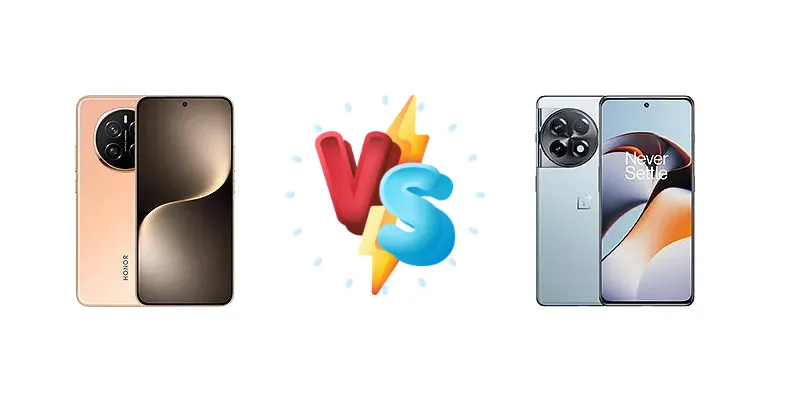
The Honor Magic7 arrives with Qualcomm’s newest Snapdragon 8 Elite, promising a leap in mobile performance. However, the OnePlus 11R, powered by the Snapdragon 8+ Gen 1, remains a compelling option, particularly as its price has fallen. This comparison dissects the key differences between these two Android contenders, focusing on where each excels and who will benefit most from their respective strengths.
🏆 Quick Verdict
For users prioritizing raw performance and future-proofing, the Honor Magic7’s Snapdragon 8 Elite is the clear winner. However, the OnePlus 11R delivers exceptional value, offering a very similar experience for a significantly lower price, making it the better choice for budget-conscious gamers and everyday users.
| Network |
|---|
| 2G bands | GSM 850 / 900 / 1800 / 1900 | GSM 850 / 900 / 1800 / 1900 |
| 3G bands | HSDPA 800 / 850 / 900 / 1700(AWS) / 1900 / 2100 | HSDPA 850 / 900 / 1700(AWS) / 2100 |
| 4G bands | LTE | 1, 3, 4, 5, 8, 28, 34, 38, 39, 40, 41 |
| 5G bands | SA/NSA | 1, 3, 5, 8, 28, 40, 41, 77, 78 SA/NSA |
| Speed | HSPA, LTE, 5G | HSPA, LTE (3CA), 5G |
| Technology | GSM / HSPA / LTE / 5G | GSM / CDMA / HSPA / LTE / 5G |
| | - | CDMA 800 |
| Launch |
|---|
| Announced | 2024, October 30 | 2023, February 07 |
| Status | Available. Released 2024, November 08 | Available. Released 2023, February 21 |
| Body |
|---|
| Build | Glass front (Giant Rhino Glass), fiber-reinforced plastic back | Glass front, glass back (Gorilla Glass 5), plastic frame |
| Dimensions | 162.1 x 75.8 x 8 mm (6.38 x 2.98 x 0.31 in) | 163.4 x 74.3 x 8.7 mm (6.43 x 2.93 x 0.34 in) |
| SIM | Nano-SIM + Nano-SIM | Nano-SIM + Nano-SIM |
| Weight | 199 g (7.02 oz) | 204 g (7.20 oz) |
| Display |
|---|
| Protection | Giant rhino glass | - |
| Resolution | 1264 x 2800 pixels (~453 ppi density) | 1240 x 2772 pixels, 20:9 ratio (~451 ppi density) |
| Size | 6.78 inches, 111.2 cm2 (~90.5% screen-to-body ratio) | 6.74 inches, 109.2 cm2 (~90.0% screen-to-body ratio) |
| Type | LTPO OLED, 1B colors, 120Hz, 4320Hz PWM, Dolby Vision, HDR, 1600 nits (HBM), 5000 nits (peak) | Fluid AMOLED, 1B colors, 120Hz, HDR10+, 1450 nits (peak) |
| Platform |
|---|
| CPU | Octa-core (2x4.32 GHz Oryon V2 Phoenix L + 6x3.53 GHz Oryon V2 Phoenix M) | Octa-core (1x3.0 GHz Cortex-X2 & 3x2.5 GHz Cortex-A710 & 4x1.80 GHz Cortex-A510) |
| Chipset | Qualcomm SM8750-AB Snapdragon 8 Elite (3 nm) | Qualcomm SM8475 Snapdragon 8+ Gen 1 (4 nm) |
| GPU | Adreno 830 | Adreno 730 |
| OS | Android 15, MagicOS 9 | Android 13, upgradable to Android 15, OxygenOS 15 |
| Memory |
|---|
| Card slot | No | No |
| Internal | 256GB 12GB RAM, 512GB 12GB RAM, 512GB 16GB RAM, 1TB 16GB RAM | 128GB 8GB RAM, 256GB 16GB RAM, 512GB 18GB RAM |
| | - | UFS 3.1 |
| Main Camera |
|---|
| Features | Laser AF, color spectrum sensor, LED flash, HDR, panorama | Color spectrum sensor, LED flash, HDR, panorama |
| Single | - | 16 MP, f/2.4, 24mm (wide), 1/3.09", 1.0µm |
| Triple | 50 MP, f/1.9, 24mm (wide), 1/1.3", 1.2µm, dual pixel PDAF
50 MP, f/2.4, 68mm (telephoto), PDAF, OIS, 3x optical zoom
50 MP, f/2.0, 12mm, 122˚ (ultrawide), 1/2.88", 0.61µm, dual pixel PDAF | 50 MP, f/1.8, 24mm (wide), 1/1.56", 1.0µm, multi-directional PDAF, OIS
8 MP, f/2.2, 120˚ (ultrawide), 1/4.0", 1.12µm
2 MP (macro) |
| Video | 4K@24/30/60fps, 1080p@24/30/60/120/240fps, gyro-EIS, OIS, HDR, 10-bit video | 4K@30/60fps, 1080p@30/60/240fps, gyro-EIS |
| Selfie camera |
|---|
| Features | - | HDR |
| Single | 50 MP, f/2.0, 22mm (wide), 1/2.93", 0.6µm | 16 MP, f/2.4, 24mm (wide), 1/3.09", 1.0µm |
| Video | 4K@30/60fps, 1080p@30/60fps, gyro-EIS | 1080p@30fps |
| Sound |
|---|
| 3.5mm jack | - | No |
| 35mm jack | No | No |
| Loudspeaker | Yes, with large amplitude stereo speakers | Yes, with stereo speakers |
| | - | 24-bit/192kHz audio |
| Comms |
|---|
| Bluetooth | 5.4, A2DP, LE, aptX HD | 5.3, A2DP, LE, aptX HD |
| Infrared port | Yes | Yes |
| NFC | Yes | Yes |
| Positioning | GPS (L1+L5), GLONASS, BDS (B1I+B1c+B2a), GALILEO (E1+E5a) | GPS (L1+L5), GLONASS (G1), BDS (B1I+B1c+B2a), GALILEO (E1+E5a), QZSS (L1+L5) |
| Radio | No | No |
| USB | USB Type-C 2.0, OTG | USB Type-C 2.0 |
| WLAN | Wi-Fi 802.11 a/b/g/n/ac/6/7, dual-band, Wi-Fi Direct | Wi-Fi 802.11 a/b/g/n/ac/6, dual-band |
| Features |
|---|
| Sensors | Fingerprint (under display, ultrasonic), accelerometer, gyro, proximity, compass | Fingerprint (under display, optical), accelerometer, gyro, proximity, compass |
| Battery |
|---|
| Charging | 100W wired
80W wireless
Reverse wireless
5W reverse wired | 100W wired |
| Type | Si/C Li-Ion 5650 mAh | Li-Po 5000 mAh |
| Misc |
|---|
| Colors | Black, White, Gray, Blue, Gold | Galactic Silver, Sonic Black, Solar Red |
| Models | PTP-AN00 | CPH2487 |
| Price | About 580 EUR | About 600 EUR |
| SAR | - | 1.16 W/kg (head) 0.61 W/kg (body) |
Honor Magic7
- Superior processing power with Snapdragon 8 Elite
- 80W wireless charging for added convenience
- Potentially better camera performance due to advanced ISP
- Likely higher price point
- Potential for software bugs with a newer device
OnePlus 11R
- Excellent value for money
- Proven Snapdragon 8+ Gen 1 performance
- 100W wired charging for fast top-ups
- Older chipset compared to the Snapdragon 8 Elite
- No wireless charging
Display Comparison
While both devices likely feature high-refresh-rate AMOLED displays (data not provided), the core difference lies in the underlying processing power driving them. The Honor Magic7’s Snapdragon 8 Elite, built on a 3nm process, will contribute to smoother animations and more responsive gaming. The OnePlus 11R’s display, while excellent, is limited by the 4nm Snapdragon 8+ Gen 1. We anticipate the Magic7 to have a slight edge in peak brightness and color accuracy due to the newer chipset’s image signal processor capabilities, though this requires direct testing.
Camera Comparison
Without specific camera specs, it’s difficult to make a definitive judgment. However, the Snapdragon 8 Elite’s advanced ISP (Image Signal Processor) within the Honor Magic7 will likely enable superior image processing, particularly in low-light conditions. The ISP’s capabilities extend to faster image capture, improved dynamic range, and more sophisticated computational photography features. The OnePlus 11R’s camera system, while capable, is limited by the older ISP. We expect the Magic7 to offer a more refined and versatile camera experience, assuming comparable sensor sizes.
Performance
The Honor Magic7’s Qualcomm SM8750-AB Snapdragon 8 Elite is the star here. Its octa-core CPU, featuring Oryon V2 Phoenix L and M cores clocked up to 4.32 GHz, represents a significant architectural upgrade over the OnePlus 11R’s Snapdragon 8+ Gen 1. The Oryon cores are designed for superior single-core and multi-core performance, translating to faster app loading, smoother multitasking, and higher frame rates in demanding games. The 3nm fabrication process further enhances efficiency, potentially leading to better thermal management and sustained performance. The 8+ Gen 1 is still a powerful chip, but the Magic7’s chipset offers a demonstrable advantage.
Battery Life
The OnePlus 11R features 100W wired charging, matching the Honor Magic7. However, the Magic7 adds 80W wireless charging and even 5W reverse wired charging, offering unparalleled versatility. While battery capacity isn’t specified, the Snapdragon 8 Elite’s 3nm efficiency could offset a potentially smaller battery size in the Magic7, providing comparable real-world battery life. The faster wireless charging on the Magic7 is a significant advantage for users who frequently top up their devices without cables.
Buying Guide
Buy the Honor Magic7 if you demand the absolute best in mobile processing power, need the fastest charging speeds available (including 80W wireless), and are willing to pay a premium for the latest technology. Buy the OnePlus 11R if you prioritize value, still want flagship-level performance for gaming and daily tasks, and prefer a more established software experience without breaking the bank.
Frequently Asked Questions
❓ Does the Snapdragon 8 Elite in the Honor Magic7 run significantly hotter than the Snapdragon 8+ Gen 1 in the OnePlus 11R during prolonged gaming sessions?
While the Snapdragon 8 Elite is more powerful, the 3nm process should improve thermal efficiency. However, sustained peak performance could still generate heat. The OnePlus 11R has a well-established thermal design. Real-world testing is needed to determine which device manages heat more effectively under heavy load, but the Magic7's efficiency gains are promising.
❓ Is the 80W wireless charging on the Honor Magic7 significantly faster than the 100W wired charging on the OnePlus 11R?
No, 100W wired charging is still faster than 80W wireless charging in terms of absolute charging speed. However, the convenience of wireless charging is a major benefit. The OnePlus 11R will reach 100% faster, but the Magic7 offers the flexibility of cable-free charging, which is ideal for quick top-ups throughout the day.
❓ Will the Honor Magic7 receive more software updates and for a longer period compared to the OnePlus 11R?
OnePlus has a generally good track record for software support, but Honor's commitment is still evolving. Historically, OnePlus has provided longer software support windows. However, Honor is investing heavily in software development, and the Magic7, being a newer device, should receive at least a few major Android updates and security patches.