
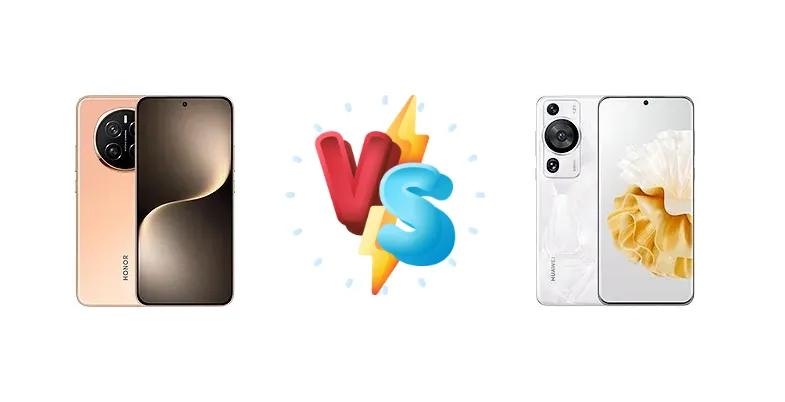
Honor Magic7 vs. Huawei P60 Pro: A Deep Dive into Flagship Performance
| Phones Images | |||||
|---|---|---|---|---|---|
|
🏆 Quick Verdict
For users prioritizing raw performance and future-proofing, the Honor Magic7 is the clear winner thanks to its Snapdragon 8 Elite. However, the Huawei P60 Pro remains a compelling option for those valuing a proven track record, excellent display quality, and a mature software experience, especially if price is a significant factor.
| PHONES | ||
|---|---|---|
| Phone Names | Honor Magic7 | Huawei P60 Pro |
| Network | ||
|---|---|---|
| 2G bands | GSM 850 / 900 / 1800 / 1900 | GSM 850 / 900 / 1800 / 1900 |
| 3G bands | HSDPA 800 / 850 / 900 / 1700(AWS) / 1900 / 2100 | HSDPA 800 / 850 / 900 / 1700(AWS) / 1900 / 2100 |
| 4G bands | LTE | 1, 2, 3, 4, 5, 7, 8, 12, 13, 17, 18, 19, 20, 26, 28, 32, 34, 38, 39, 40, 41, 66 - International |
| 5G bands | SA/NSA | - |
| Speed | HSPA, LTE, 5G | HSPA, LTE |
| Technology | GSM / HSPA / LTE / 5G | GSM / CDMA / HSPA / CDMA2000 / LTE |
| - | 1, 2, 3, 4, 5, 7, 8, 12, 17, 18, 19, 20, 26, 28, 34, 38, 39, 40, 41 - China | |
| Launch | ||
|---|---|---|
| Announced | 2024, October 30 | 2023, March 23 |
| Status | Available. Released 2024, November 08 | Available. Released 2023, March 31 |
| Body | ||
|---|---|---|
| Build | Glass front (Giant Rhino Glass), fiber-reinforced plastic back | - |
| Dimensions | 162.1 x 75.8 x 8 mm (6.38 x 2.98 x 0.31 in) | 161 x 74.5 x 8.3 mm (6.34 x 2.93 x 0.33 in) |
| SIM | Nano-SIM + Nano-SIM | · Nano-SIM· Nano-SIM + Nano-SIM |
| Weight | 199 g (7.02 oz) | 200 g (7.05 oz) |
| - | IP68 dust/water resistant (up to 1.5m for 30 min) | |
| Display | ||
|---|---|---|
| Protection | Giant rhino glass | Kunlun Glass |
| Resolution | 1264 x 2800 pixels (~453 ppi density) | 1220 x 2700 pixels (~444 ppi density) |
| Size | 6.78 inches, 111.2 cm2 (~90.5% screen-to-body ratio) | 6.67 inches, 107.7 cm2 (~89.8% screen-to-body ratio) |
| Type | LTPO OLED, 1B colors, 120Hz, 4320Hz PWM, Dolby Vision, HDR, 1600 nits (HBM), 5000 nits (peak) | LTPO OLED, 1B colors, 120Hz |
| Platform | ||
|---|---|---|
| CPU | Octa-core (2x4.32 GHz Oryon V2 Phoenix L + 6x3.53 GHz Oryon V2 Phoenix M) | Octa-core (1x3.19 GHz Cortex-X2 & 3x2.75 GHz Cortex-A710 & 4x2.0 GHz Cortex-A510) |
| Chipset | Qualcomm SM8750-AB Snapdragon 8 Elite (3 nm) | Qualcomm SM8475 Snapdragon 8+ Gen 1 4G (4 nm) |
| GPU | Adreno 830 | Adreno 730 |
| OS | Android 15, MagicOS 9 | HarmonyOS 3.1 (China), EMUI 13.1 (Europe), no Google Play Services |
| Memory | ||
|---|---|---|
| Card slot | No | Nano Memory (uses shared SIM slot) |
| Internal | 256GB 12GB RAM, 512GB 12GB RAM, 512GB 16GB RAM, 1TB 16GB RAM | 256GB 8GB RAM, 256GB 12GB RAM, 512GB 12GB RAM |
| - | UFS | |
| Main Camera | ||
|---|---|---|
| Features | Laser AF, color spectrum sensor, LED flash, HDR, panorama | Laser AF, color spectrum sensor, LED flash, HDR, panorama |
| Triple | 50 MP, f/1.9, 24mm (wide), 1/1.3", 1.2µm, dual pixel PDAF 50 MP, f/2.4, 68mm (telephoto), PDAF, OIS, 3x optical zoom 50 MP, f/2.0, 12mm, 122˚ (ultrawide), 1/2.88", 0.61µm, dual pixel PDAF | 48 MP, f/1.4-f/4.0, 25mm (wide), PDAF, OIS 48 MP, f/2.1, 90mm (telephoto), PDAF, sensor-shift OIS, 3.5x optical zoom 13 MP, f/2.2, 13mm (ultrawide), AF |
| Video | 4K@24/30/60fps, 1080p@24/30/60/120/240fps, gyro-EIS, OIS, HDR, 10-bit video | 4K@30/60fps, 1080p@30/60fps, 1080p@960fps; gyro-EIS, HDR Vivid |
| Selfie camera | ||
|---|---|---|
| Features | - | Panorama, HDR |
| Single | 50 MP, f/2.0, 22mm (wide), 1/2.93", 0.6µm | 13 MP, f/2.4, (ultrawide) |
| Video | 4K@30/60fps, 1080p@30/60fps, gyro-EIS | 4K@30/60fps, 1080p@30fps, HDR Vivid |
| Sound | ||
|---|---|---|
| 3.5mm jack | - | No |
| 35mm jack | No | No |
| Loudspeaker | Yes, with large amplitude stereo speakers | Yes, with stereo speakers |
| Comms | ||
|---|---|---|
| Bluetooth | 5.4, A2DP, LE, aptX HD | 5.2, A2DP, LE |
| Infrared port | Yes | Yes |
| NFC | Yes | Yes |
| Positioning | GPS (L1+L5), GLONASS, BDS (B1I+B1c+B2a), GALILEO (E1+E5a) | GPS (L1+L5), GLONASS (B1I+B1c+B2a), BDS (B1I+B1c+B2a), GALILEO (E1+E5a), QZSS (L1+L5), NavIC |
| Radio | No | No |
| USB | USB Type-C 2.0, OTG | USB Type-C 3.1, OTG |
| WLAN | Wi-Fi 802.11 a/b/g/n/ac/6/7, dual-band, Wi-Fi Direct | Wi-Fi 802.11 a/b/g/n/ac/6, dual-band, Wi-Fi Direct |
| Features | ||
|---|---|---|
| Sensors | Fingerprint (under display, ultrasonic), accelerometer, gyro, proximity, compass | Fingerprint (under display, optical), accelerometer, gyro, proximity, compass |
| - | BDS Satellite Message | |
| Battery | ||
|---|---|---|
| Charging | 100W wired 80W wireless Reverse wireless 5W reverse wired | 88W wired 50W wireless Reverse wireless |
| Type | Si/C Li-Ion 5650 mAh | Li-Po 4815 mAh |
| Misc | ||
|---|---|---|
| Colors | Black, White, Gray, Blue, Gold | Black, Green, Violet, Rococo Pearl |
| Models | PTP-AN00 | MNA-AL00, MNA-LX9 |
| Price | About 580 EUR | € 738.50 |
| Tests | ||
|---|---|---|
| Battery life | - | Endurance rating 96h |
| Camera | - | Photo / Video |
| Display | - | Contrast ratio: Infinite (nominal) |
| Loudspeaker | - | -27.3 LUFS (Good) |
| Performance | - | AnTuTu: 1030473 (v9) GeekBench: 4422 (v6) GFXBench: 65fps (ES 3.1 onscreen) |
Honor Magic7
- Significantly faster processor with Snapdragon 8 Elite
- Industry-leading 100W wired and 80W wireless charging
- Potential for superior thermal management due to 3nm process
- Camera specs currently unknown
- Software experience may be less refined than Huawei
Huawei P60 Pro
- Excellent display brightness and contrast
- Proven camera system with reliable performance
- Mature software experience
- Older Snapdragon 8+ Gen 1 chipset
- Slower charging speeds compared to Magic7
Display Comparison
The Huawei P60 Pro boasts a measured peak brightness of 1135 nits, ensuring excellent visibility even in direct sunlight. While the Magic7’s display specs are currently unavailable, Honor typically prioritizes high brightness in its flagships. The P60 Pro’s ‘Infinite’ contrast ratio suggests a strong OLED panel, likely with excellent black levels. Without knowing the Magic7’s panel technology (LTPO is expected), the P60 Pro currently holds an edge in display specifications, offering a known, high-quality viewing experience.
Camera Comparison
Both devices feature capable photo and video systems, but detailed sensor information is lacking for the Magic7. The P60 Pro’s camera system is known for its color science and reliable performance. Without knowing the Magic7’s sensor sizes and apertures, it’s difficult to make a direct comparison. However, the Snapdragon 8 Elite’s improved ISP (Image Signal Processor) could offer enhanced image processing capabilities, potentially surpassing the P60 Pro in low-light performance and dynamic range. We'll need to see sample images to draw definitive conclusions.
Performance
The Honor Magic7’s Qualcomm SM8750-AB Snapdragon 8 Elite, built on a 3nm process, represents a significant leap over the Huawei P60 Pro’s 4nm Snapdragon 8+ Gen 1. The Magic7’s octa-core CPU, featuring Oryon V2 Phoenix L and M cores clocked up to 4.32 GHz, promises substantially higher multi-core and single-core performance compared to the P60 Pro’s Cortex-X2 and A710 configuration. The 3nm node translates to improved thermal efficiency, potentially mitigating throttling during sustained workloads. Gamers and power users will overwhelmingly benefit from the Magic7’s superior processing power.
Battery Life
Both the Honor Magic7 and Huawei P60 Pro achieve an endurance rating of 96 hours, suggesting comparable battery life under typical usage. However, the Magic7’s charging capabilities are significantly more advanced, offering 100W wired charging, 80W wireless charging, and even 5W reverse wired charging. The P60 Pro supports 88W wired and 50W wireless charging. The Magic7’s faster charging speeds will dramatically reduce downtime, allowing for a full charge in a fraction of the time compared to the P60 Pro.
Buying Guide
Buy the Honor Magic7 if you demand the absolute best Android performance for gaming and demanding applications, and if you want the fastest charging speeds available. Buy the Huawei P60 Pro if you prioritize a well-rounded experience with a vibrant display, reliable battery life, and a camera system known for its consistent results, and if you prefer a more established brand ecosystem.