
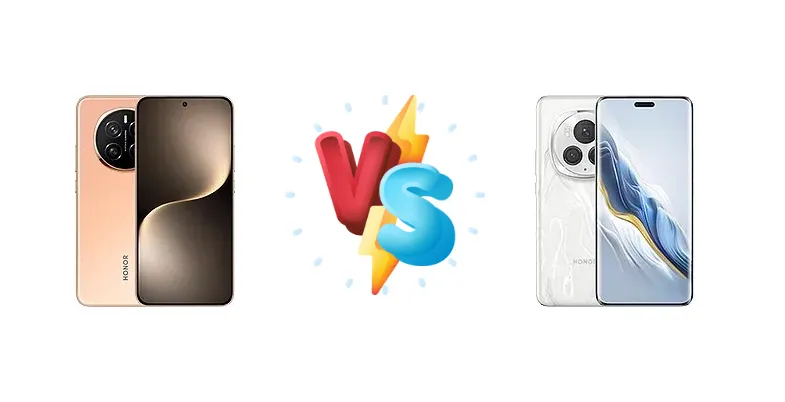
Honor Magic7 vs Magic6 Pro: Which Snapdragon Flagship Reigns Supreme?
| Phones Images | |||||
|---|---|---|---|---|---|
|
🏆 Quick Verdict
For users prioritizing raw performance and potentially faster charging speeds, the Honor Magic7 takes the lead thanks to its Snapdragon 8 Elite. However, the Magic6 Pro counters with significantly longer battery life and a brighter display, making it the better choice for everyday users and media consumers.
| PHONES | ||
|---|---|---|
| Phone Names | Honor Magic7 | Honor Magic6 Pro |
| Network | ||
|---|---|---|
| 2G bands | GSM 850 / 900 / 1800 / 1900 | GSM 850 / 900 / 1800 / 1900 |
| 3G bands | HSDPA 800 / 850 / 900 / 1700(AWS) / 1900 / 2100 | HSDPA 800 / 850 / 900 / 1700(AWS) / 1900 / 2100 |
| 4G bands | LTE | LTE |
| 5G bands | SA/NSA | SA/NSA |
| Speed | HSPA, LTE, 5G | HSPA, LTE, 5G |
| Technology | GSM / HSPA / LTE / 5G | GSM / CDMA / HSPA / CDMA2000 / LTE / 5G |
| Launch | ||
|---|---|---|
| Announced | 2024, October 30 | 2024, January 11 |
| Status | Available. Released 2024, November 08 | Available. Released 2024, January 18 |
| Body | ||
|---|---|---|
| Build | Glass front (Giant Rhino Glass), fiber-reinforced plastic back | Glass front (NanoCrystal Shield), glass back or silicone polymer back (eco leather) |
| Dimensions | 162.1 x 75.8 x 8 mm (6.38 x 2.98 x 0.31 in) | 162.5 x 75.8 x 8.9 mm (6.40 x 2.98 x 0.35 in) |
| SIM | Nano-SIM + Nano-SIM | · Nano-SIM + eSIM· Nano-SIM + Nano-SIM |
| Weight | 199 g (7.02 oz) | 225 g or 229 g (7.94 oz) |
| Display | ||
|---|---|---|
| Protection | Giant rhino glass | NanoCrystal Shield |
| Resolution | 1264 x 2800 pixels (~453 ppi density) | 1280 x 2800 pixels, 19.5:9 ratio (~453 ppi density) |
| Size | 6.78 inches, 111.2 cm2 (~90.5% screen-to-body ratio) | 6.8 inches, 112.8 cm2 (~91.6% screen-to-body ratio) |
| Type | LTPO OLED, 1B colors, 120Hz, 4320Hz PWM, Dolby Vision, HDR, 1600 nits (HBM), 5000 nits (peak) | LTPO OLED, 1B colors, 120Hz, Dolby Vision, HDR, 1600 nits (HBM), 5000 nits (peak) |
| Platform | ||
|---|---|---|
| CPU | Octa-core (2x4.32 GHz Oryon V2 Phoenix L + 6x3.53 GHz Oryon V2 Phoenix M) | Octa-core (1x3.3 GHz Cortex-X4 & 3x3.2 GHz Cortex-A720 & 2x3.0 GHz Cortex-A720 & 2x2.3 GHz Cortex-A520) |
| Chipset | Qualcomm SM8750-AB Snapdragon 8 Elite (3 nm) | Qualcomm SM8650-AB Snapdragon 8 Gen 3 (4 nm) |
| GPU | Adreno 830 | Adreno 750 |
| OS | Android 15, MagicOS 9 | Android 14, up to 4 major Android upgrades, MagicOS 8 |
| Memory | ||
|---|---|---|
| Card slot | No | No |
| Internal | 256GB 12GB RAM, 512GB 12GB RAM, 512GB 16GB RAM, 1TB 16GB RAM | 256GB 12GB RAM, 256GB 16GB RAM, 512GB 12GB RAM, 512GB 16GB RAM, 1TB 16GB RAM |
| Main Camera | ||
|---|---|---|
| Features | Laser AF, color spectrum sensor, LED flash, HDR, panorama | Laser AF, color spectrum sensor, LED flash, HDR, panorama |
| Triple | 50 MP, f/1.9, 24mm (wide), 1/1.3", 1.2µm, dual pixel PDAF 50 MP, f/2.4, 68mm (telephoto), PDAF, OIS, 3x optical zoom 50 MP, f/2.0, 12mm, 122˚ (ultrawide), 1/2.88", 0.61µm, dual pixel PDAF | 50 MP, f/1.4-2.0, 23mm (wide), 1/1.3", 1.2µm, PDAF, OIS 180 MP, f/2.6, (periscope telephoto), 1/1.49", 0.56µm, PDAF, OIS, 2.5x optical zoom 50 MP, f/2.0, 13mm, 122˚ (ultrawide), 1/2.88", 0.61µm, AF |
| Video | 4K@24/30/60fps, 1080p@24/30/60/120/240fps, gyro-EIS, OIS, HDR, 10-bit video | 4K@24/30/60fps, 1080p@30/60/120/240fps, gyro-EIS, OIS, HDR, 10-bit video |
| Selfie camera | ||
|---|---|---|
| Single | 50 MP, f/2.0, 22mm (wide), 1/2.93", 0.6µm | 50 MP, f/2.0, 22mm (wide), 1/2.93", 0.6µm, AF TOF 3D, (depth/biometrics sensor) |
| Video | 4K@30/60fps, 1080p@30/60fps, gyro-EIS | 4K@30fps, 1080p@30/60fps, gyro-EIS |
| Sound | ||
|---|---|---|
| 35mm jack | No | No |
| Loudspeaker | Yes, with large amplitude stereo speakers | Yes, with stereo speakers |
| Comms | ||
|---|---|---|
| Bluetooth | 5.4, A2DP, LE, aptX HD | 5.3, A2DP, LE, aptX HD |
| Infrared port | Yes | Yes |
| NFC | Yes | Yes |
| Positioning | GPS (L1+L5), GLONASS, BDS (B1I+B1c+B2a), GALILEO (E1+E5a) | GPS (L1+L5), GLONASS, BDS (B1I+B1c+B2a), GALILEO (E1+E5a) |
| Radio | No | No |
| USB | USB Type-C 2.0, OTG | USB Type-C 3.2, DisplayPort 1.2, OTG |
| WLAN | Wi-Fi 802.11 a/b/g/n/ac/6/7, dual-band, Wi-Fi Direct | Wi-Fi 802.11 a/b/g/n/ac/6/7, dual-band, Wi-Fi Direct |
| Features | ||
|---|---|---|
| Sensors | Fingerprint (under display, ultrasonic), accelerometer, gyro, proximity, compass | Fingerprint (under display, optical), Face ID, accelerometer, gyro, proximity, compass |
| Battery | ||
|---|---|---|
| Charging | 100W wired 80W wireless Reverse wireless 5W reverse wired | 80W wired 66W wireless Reverse wireless 5W reverse wired |
| Type | Si/C Li-Ion 5650 mAh | Si/C Li-Ion 5600 mAh |
| Misc | ||
|---|---|---|
| Colors | Black, White, Gray, Blue, Gold | Black, Green, Blue, Purple, White |
| Models | PTP-AN00 | BVL-AN16, BVL-N49 |
| Price | About 580 EUR | € 455.54 / $ 899.00 / £ 598.99 |
Honor Magic7
- Potentially faster CPU performance with Snapdragon 8 Elite and Oryon cores
- Faster wired and wireless charging speeds (100W/80W)
- Cutting-edge 3nm chipset technology
- Battery life likely shorter than Magic6 Pro
- Display brightness likely lower than Magic6 Pro
- Camera details are limited
Honor Magic6 Pro
- Exceptional battery life (14:06h active use)
- Brighter display (1578 nits peak brightness)
- Established Snapdragon 8 Gen 3 platform
- Slower charging speeds (80W/66W)
- CPU performance potentially lower than Magic7
- May exhibit more throttling under sustained load
Display Comparison
The Honor Magic6 Pro features a display capable of reaching 1578 nits of peak brightness, a substantial advantage for outdoor use compared to the Magic7 (brightness data unavailable, but expected to be lower). While the Magic7’s panel technology isn’t specified, the Magic6 Pro’s likely utilizes LTPO for adaptive refresh rates, improving efficiency. The Magic6 Pro’s brightness is a clear win for users who frequently consume content in direct sunlight.
Camera Comparison
Camera details beyond sensor size and OIS are unavailable for both devices. However, the focus should be on image processing. Honor’s image processing style typically leans towards vibrant colors and strong contrast. Without detailed sensor information, it’s difficult to declare a clear winner, but the Magic6 Pro’s likely benefits from software optimizations accumulated since the Magic7’s release. The absence of details on the Magic7’s camera system makes a definitive comparison impossible.
Performance
The core difference lies in the chipsets. The Honor Magic7’s Snapdragon 8 Elite, built on a 3nm process, utilizes Oryon V2 Phoenix CPU cores (2x4.32 GHz + 6x3.53 GHz) promising exceptional performance. The Magic6 Pro’s Snapdragon 8 Gen 3 (4nm) features a more conventional core configuration (1x3.3 GHz Cortex-X4 + 3x3.2 GHz Cortex-A720 + 2x3.0 GHz Cortex-A720 + 2x2.3 GHz Cortex-A520). While the Gen 3 is powerful, the 3nm process and Oryon architecture of the 8 Elite suggest a performance edge for the Magic7, particularly in sustained workloads. However, the 4nm process of the Gen 3 may offer better thermal efficiency, potentially mitigating throttling.
Battery Life
The Honor Magic6 Pro demonstrates a significant advantage in battery life, achieving an active use score of 14:06h. The Magic7’s battery capacity is unspecified, but its 100W wired and 80W wireless charging capabilities are faster than the Magic6 Pro’s 80W wired and 66W wireless. This means the Magic7 can replenish its battery more quickly, but the Magic6 Pro offers substantially longer usage between charges. Both devices offer 5W reverse wired charging.
Buying Guide
Buy the Honor Magic7 if you demand the absolute fastest Android performance available, frequently engage in demanding tasks like gaming or video editing, and value the convenience of 100W wired and 80W wireless charging. Buy the Honor Magic6 Pro if you prioritize all-day battery life, a stunningly bright display for outdoor visibility, and a more balanced overall experience without sacrificing flagship-level performance.