
Honor Magic7 RSR Porsche Design vs. Samsung Galaxy S24 Ultra: A Deep Dive into Flagship Power
| Phones Images | |||||
|---|---|---|---|---|---|
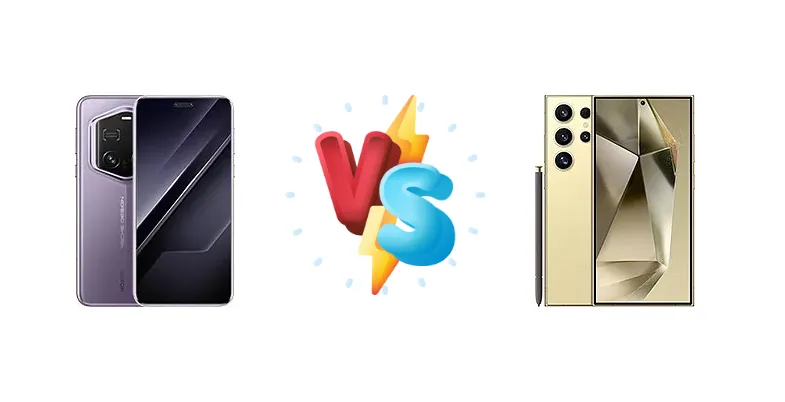
|
🏆 Quick Verdict
For the power user prioritizing raw speed and charging convenience, the Honor Magic7 RSR Porsche Design emerges as the winner. Its Snapdragon 8 Elite and 100W charging offer a tangible advantage. However, the Samsung Galaxy S24 Ultra remains a more polished, versatile package with a superior camera system and broader software support.
| PHONES | ||
|---|---|---|
| Phone Names | Honor Magic7 RSR Porsche Design | Samsung Galaxy S24 Ultra |
| Network | ||
|---|---|---|
| 2G bands | GSM 850 / 900 / 1800 / 1900 | GSM 850 / 900 / 1800 / 1900 |
| 3G bands | HSDPA 800 / 850 / 900 / 1700(AWS) / 1900 / 2100 | HSDPA 850 / 900 / 1700(AWS) / 1900 / 2100 |
| 4G bands | LTE | 1, 2, 3, 4, 5, 7, 8, 12, 13, 17, 18, 19, 20, 25, 26, 28, 32, 38, 39, 40, 41, 66 - International |
| 5G bands | SA/NSA | 1, 2, 3, 5, 7, 8, 12, 20, 25, 26, 28, 38, 40, 41, 66, 75, 77, 78 SA/NSA/Sub6 - International |
| Speed | HSPA, LTE, 5G | HSPA, LTE (up to 7CA), 5G |
| Technology | GSM / CDMA / HSPA / CDMA2000 / LTE / 5G | GSM / CDMA / HSPA / EVDO / LTE / 5G |
| Launch | ||
|---|---|---|
| Announced | 2024, December 23 | 2024, January 17 |
| Status | Available. Released 2024, December 24 | Available. Released 2024, January 24 |
| Body | ||
|---|---|---|
| Build | Glass front (NanoCrystal Shield), glass back, aluminum frame | Glass front (Corning Gorilla Armor), glass back (Corning Gorilla Armor), titanium frame (grade 2) |
| Dimensions | 162.7 x 77.1 x 8.8 mm (6.41 x 3.04 x 0.35 in) | 162.3 x 79 x 8.6 mm (6.39 x 3.11 x 0.34 in) |
| SIM | · Nano-SIM + Nano-SIM + eSIM + eSIM (max 2 at a time) - INT· Nano-SIM + Nano-SIM - CN | · Nano-SIM + Nano-SIM + eSIM + eSIM (max 2 at a time) - INT· Nano-SIM + eSIM + eSIM (max 2 at a time) - USA· Nano-SIM + Nano-SIM - CN |
| Weight | 228 g (8.04 oz) | 232 g or 233 g (8.18 oz) |
| Display | ||
|---|---|---|
| Protection | NanoCrystal Shield | Corning Gorilla Armor |
| Resolution | 1280 x 2800 pixels, 19.5:9 ratio (~453 ppi density) | 1440 x 3120 pixels, 19.5:9 ratio (~505 ppi density) |
| Size | 6.8 inches, 112.8 cm2 (~89.9% screen-to-body ratio) | 6.8 inches, 113.5 cm2 (~88.5% screen-to-body ratio) |
| Type | LTPO OLED, 1B colors, 120Hz, 4320Hz PWM, Dolby Vision, HDR, 1600 nits (HBM), 5000 nits (peak) | Dynamic LTPO AMOLED 2X, 120Hz, HDR10+, 2600 nits (peak) |
| Platform | ||
|---|---|---|
| CPU | Octa-core (2x4.32 GHz Oryon V2 Phoenix L + 6x3.53 GHz Oryon V2 Phoenix M) | 8-core (1x3.39GHz Cortex-X4 & 3x3.1GHz Cortex-A720 & 2x2.9GHz Cortex-A720 & 2x2.2GHz Cortex-A520) |
| Chipset | Qualcomm SM8750-AB Snapdragon 8 Elite (3 nm) | Qualcomm SM8650-AC Snapdragon 8 Gen 3 (4 nm) |
| GPU | Adreno 830 | Adreno 750 (1 GHz) |
| OS | Android 15, MagicOS 9 | Android 14, up to 7 major Android upgrades, One UI 8.0 |
| Memory | ||
|---|---|---|
| Card slot | No | No |
| Internal | 512GB 16GB RAM, 1TB 24GB RAM | 256GB 12GB RAM, 512GB 12GB RAM, 1TB 12GB RAM |
| Main Camera | ||
|---|---|---|
| Features | LiDAR AF, color spectrum sensor, LED flash, HDR, panorama | Laser AF, LED flash, auto-HDR, panorama |
| Quad | - | 200 MP, f/1.7, 24mm (wide), 1/1.3", 0.6µm, multi-directional PDAF, OIS 10 MP, f/2.4, 67mm (telephoto), 1/3.52", 1.12µm, PDAF, OIS, 3x optical zoom 50 MP, f/3.4, 111mm (periscope telephoto), 1/2.52", 0.7µm, PDAF, OIS, 5x optical zoom 12 MP, f/2.2, 13mm, 120˚ (ultrawide), 1/2.55", 1.4µm, dual pixel PDAF, Super Steady video |
| Triple | 50 MP, f/1.4-2.0, 23mm (wide), 1/1.3", 1.2µm, multi-directional PDAF, OIS 200 MP, f/1.9, 72mm (periscope telephoto), 1/1.4", 0.56µm, multi-directional PDAF, OIS, 3x optical zoom 50 MP, f/2.0, 13mm, 122˚ (ultrawide), 1/2.88", 0.61µm, dual pixel PDAF | - |
| Video | 4K@24/30/60fps, 1080p@30/60/120/240fps, gyro-EIS, OIS, HDR, 10-bit video | 8K@24/30fps, 4K@30/60/120fps, 1080p@30/60/120/240fps, HDR10+, stereo sound rec., gyro-EIS |
| Selfie camera | ||
|---|---|---|
| Features | - | HDR, HDR10+ |
| Single | 50 MP, f/2.0, 22mm (wide), 1/2.93", 0.6µm, AF TOF 3D, (depth/biometrics sensor) | 12 MP, f/2.2, 26mm (wide), 1/3.2", 1.12µm, dual pixel PDAF |
| Video | 4K@30/60fps, 1080p@30/60fps, gyro-EIS | 4K@30/60fps, 1080p@30fps |
| Sound | ||
|---|---|---|
| 35mm jack | No | No |
| Loudspeaker | Yes, with stereo speakers | Yes, with stereo speakers |
| Comms | ||
|---|---|---|
| Bluetooth | 5.4, A2DP, LE, aptX HD | 5.3, A2DP, LE |
| Infrared port | Yes | - |
| NFC | Yes | Yes |
| Positioning | GPS (L1+L5), GLONASS, BDS (B1I+B1c+B2a), GALILEO (E1+E5a), QZSS (L1+L5) | GPS, GLONASS, BDS, GALILEO, QZSS |
| Radio | No | No |
| USB | USB Type-C 3.2, DisplayPort 1.2, OTG | USB Type-C 3.2, DisplayPort 1.2, OTG |
| WLAN | Wi-Fi 802.11 a/b/g/n/ac/6/7, dual-band, Wi-Fi Direct | Wi-Fi 802.11 a/b/g/n/ac/6e/7, tri-band, Wi-Fi Direct |
| Features | ||
|---|---|---|
| Sensors | Fingerprint (under display, ultrasonic), Face ID, accelerometer, gyro, proximity, compass | Fingerprint (under display, ultrasonic), accelerometer, gyro, proximity, compass, barometer |
| Battery | ||
|---|---|---|
| Charging | 100W wired 80W wireless Reverse wireless 5W reverse wired | 45W wired, PD3.0, 65% in 30 min 15W wireless (Qi) 4.5W reverse wireless |
| Type | Si/C Li-Ion 5850 mAh | Li-Ion 5000 mAh |
| Misc | ||
|---|---|---|
| Colors | Provence, Agate Grey | Titanium Black, Titanium Gray, Titanium Violet, Titanium Yellow, Titanium Blue, Titanium Green, Titanium Orange |
| Models | PTP-AN20 | SM-S928B, SM-S928B/DS, SM-S928U, SM-S928U1, SM-S928W, SM-S928N, SM-S9280, SM-S928E, SM-S928E/DS |
| Price | About 1050 EUR | $ 514.94 / C$ 929.99 / £ 630.00 / € 658.53 / ₹ 84,999 |
| SAR | - | 1.26 W/kg (head) 0.62 W/kg (body) |
| SAR EU | - | 1.06 W/kg (head) 1.30 W/kg (body) |
Honor Magic7 RSR Porsche Design
- Blazing-fast 100W wired and 80W wireless charging
- Potentially superior CPU performance with Snapdragon 8 Elite
- Longer battery life in active use (15:11h)
- Camera specs are unknown, potentially lagging behind Samsung
- Brand recognition and software support may be less established than Samsung
Samsung Galaxy S24 Ultra
- Renowned camera system with advanced image processing
- Mature software ecosystem and long-term update support
- Strong brand reputation and widespread availability
- Slower charging speeds (45W wired, 15W wireless)
- Less efficient chipset (Snapdragon 8 Gen 3, 4nm)
Display Comparison
Both the Honor Magic7 RSR Porsche Design and the Samsung Galaxy S24 Ultra feature excellent displays, with measured peak brightness figures of 1510 nits and 1447 nits respectively. While the Honor edges out Samsung in peak brightness, the difference is unlikely to be noticeable in most real-world scenarios. Both likely employ LTPO technology for adaptive refresh rates, though specific refresh rate ranges aren't provided. The S24 Ultra’s display benefits from Samsung’s established color calibration expertise, while the Honor’s display aims for maximum impact with its slightly higher peak output.
Camera Comparison
The context data for the Samsung Galaxy S24 Ultra only mentions 'Photo / Video,' lacking specific sensor details. However, Samsung is renowned for its camera technology, and the S24 Ultra is expected to feature a sophisticated multi-camera system with advanced image processing. The Honor Magic7 RSR Porsche Design’s camera specs are also absent, making a direct comparison difficult. However, given the phone’s focus on performance, it’s reasonable to assume a high-quality camera system, but likely not exceeding Samsung’s established expertise in computational photography and video stabilization. The absence of sensor details for both phones makes a definitive camera winner impossible to declare without further testing.
Performance
The core difference lies in the chipsets: the Honor utilizes the Qualcomm SM8750-AB Snapdragon 8 Elite (3nm) with an octa-core CPU configuration (2x4.32 GHz Oryon V2 Phoenix L + 6x3.53 GHz Oryon V2 Phoenix M), while the Samsung employs the Snapdragon 8 Gen 3 (4nm) with an 8-core setup (1x3.39GHz Cortex-X4 & 3x3.1GHz Cortex-A720 & 2x2.9GHz Cortex-A720 & 2x2.2GHz Cortex-A520). The 3nm process of the Snapdragon 8 Elite should provide superior power efficiency and thermal performance compared to the 4nm Gen 3, potentially leading to sustained performance during extended gaming sessions. The Oryon cores in the Honor are also architecturally different, potentially offering a different performance profile. While the S24 Ultra benefits from optimized software, the Honor’s raw processing power is likely higher.
Battery Life
The Honor Magic7 RSR Porsche Design delivers a measured active use battery score of 15:11h, while the Samsung Galaxy S24 Ultra achieves 13:49h. This suggests the Honor offers superior battery endurance, likely due to the more efficient Snapdragon 8 Elite chipset. However, the charging speeds are where the Honor truly shines: 100W wired, 80W wireless, and even reverse wireless charging at 5W. The S24 Ultra offers a comparatively slower 45W wired charging (65% in 30 minutes) and 15W wireless charging. The Honor’s charging capabilities significantly reduce downtime, making it ideal for users who frequently need to top up their battery.
Buying Guide
Buy the Honor Magic7 RSR Porsche Design if you demand the absolute fastest charging speeds available, prioritize peak CPU performance for demanding tasks, and appreciate a unique, high-performance design. Buy the Samsung Galaxy S24 Ultra if you value a refined camera experience, seamless ecosystem integration, long-term software updates, and a more established brand reputation.