
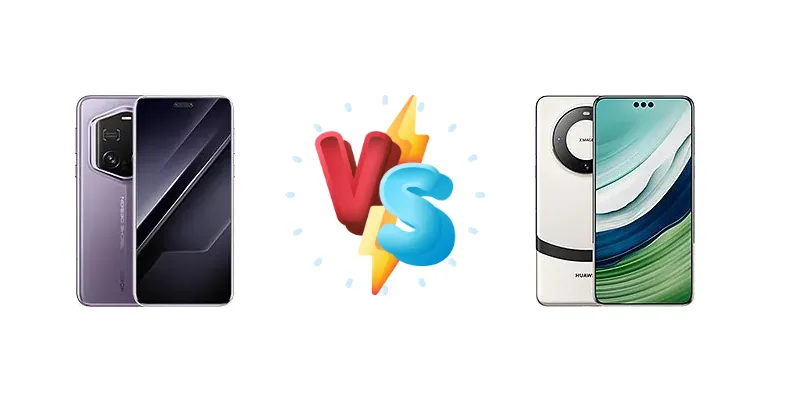
Honor Magic7 RSR Porsche Design vs. Huawei Mate 60 Pro+: A Flagship Showdown
| Phones Images | |||||
|---|---|---|---|---|---|
|
🏆 Quick Verdict
For users prioritizing raw performance and sustained gaming, the Honor Magic7 RSR Porsche Design is the clear winner, thanks to the Snapdragon 8 Elite’s superior processing power and thermal efficiency. However, the Huawei Mate 60 Pro+ offers a compelling alternative with its fast charging and potentially unique software ecosystem, appealing to users within that ecosystem.
| PHONES | ||
|---|---|---|
| Phone Names | Honor Magic7 RSR Porsche Design | Huawei Mate 60 Pro+ |
| Network | ||
|---|---|---|
| 2G bands | GSM 850 / 900 / 1800 / 1900 | GSM 850 / 900 / 1800 / 1900 |
| 3G bands | HSDPA 800 / 850 / 900 / 1700(AWS) / 1900 / 2100 | HSDPA 800 / 850 / 900 / 1700(AWS) / 1900 / 2100 |
| 4G bands | LTE | LTE |
| 5G bands | SA/NSA | SA/NSA |
| Speed | HSPA, LTE, 5G | HSPA, LTE, 5G |
| Technology | GSM / CDMA / HSPA / CDMA2000 / LTE / 5G | GSM / CDMA / HSPA / CDMA2000 / LTE / 5G |
| Launch | ||
|---|---|---|
| Announced | 2024, December 23 | 2023, September 08 |
| Status | Available. Released 2024, December 24 | Available. Released 2023, September 27 |
| Body | ||
|---|---|---|
| Build | Glass front (NanoCrystal Shield), glass back, aluminum frame | Glass front, aluminum frame, glass back |
| Dimensions | 162.7 x 77.1 x 8.8 mm (6.41 x 3.04 x 0.35 in) | 163.7 x 79 x 8.1 mm (6.44 x 3.11 x 0.32 in) |
| SIM | · Nano-SIM + Nano-SIM + eSIM + eSIM (max 2 at a time) - INT· Nano-SIM + Nano-SIM - CN | Nano-SIM + Nano-SIM |
| Weight | 228 g (8.04 oz) | 225 g (7.94 oz) |
| Display | ||
|---|---|---|
| Protection | NanoCrystal Shield | Huawei Kunlun Glass 2 |
| Resolution | 1280 x 2800 pixels, 19.5:9 ratio (~453 ppi density) | 1260 x 2720 pixels, 19.5:9 ratio (~440 ppi density) |
| Size | 6.8 inches, 112.8 cm2 (~89.9% screen-to-body ratio) | 6.82 inches, 114.4 cm2 (~88.5% screen-to-body ratio) |
| Type | LTPO OLED, 1B colors, 120Hz, 4320Hz PWM, Dolby Vision, HDR, 1600 nits (HBM), 5000 nits (peak) | LTPO OLED, 1B colors, 120Hz |
| Platform | ||
|---|---|---|
| CPU | Octa-core (2x4.32 GHz Oryon V2 Phoenix L + 6x3.53 GHz Oryon V2 Phoenix M) | Octa-core (1x2.62 GHz Taishan Big & 3x2.15 GHz Taishan Mid & 4x1.53GHz Cortex-A510) |
| Chipset | Qualcomm SM8750-AB Snapdragon 8 Elite (3 nm) | Kirin 9000S (7 nm) |
| GPU | Adreno 830 | Maleoon 910 MP4 |
| OS | Android 15, MagicOS 9 | HarmonyOS 4.0 (China) |
| Memory | ||
|---|---|---|
| Card slot | No | Nano Memory (uses shared SIM slot) |
| Internal | 512GB 16GB RAM, 1TB 24GB RAM | 512GB 16GB RAM, 1TB 16GB RAM |
| Main Camera | ||
|---|---|---|
| Features | LiDAR AF, color spectrum sensor, LED flash, HDR, panorama | Laser AF, color spectrum sensor, LED flash, panorama, HDR |
| Triple | 50 MP, f/1.4-2.0, 23mm (wide), 1/1.3", 1.2µm, multi-directional PDAF, OIS 200 MP, f/1.9, 72mm (periscope telephoto), 1/1.4", 0.56µm, multi-directional PDAF, OIS, 3x optical zoom 50 MP, f/2.0, 13mm, 122˚ (ultrawide), 1/2.88", 0.61µm, dual pixel PDAF | 48 MP, f/1.4-f/4.0, 24mm (wide), PDAF, OIS 48 MP, f/3.0, 90mm (periscope telephoto), PDAF, OIS, 3.5x optical zoom 40 MP, f/2.2, 13mm, 120˚ (ultrawide), PDAF |
| Video | 4K@24/30/60fps, 1080p@30/60/120/240fps, gyro-EIS, OIS, HDR, 10-bit video | 4K, 1080p, HDR, gyro-EIS, OIS |
| Selfie camera | ||
|---|---|---|
| Features | - | HDR, panorama |
| Single | 50 MP, f/2.0, 22mm (wide), 1/2.93", 0.6µm, AF TOF 3D, (depth/biometrics sensor) | 13 MP, f/2.4, 18mm (ultrawide) TOF 3D, (depth/biometrics sensor) |
| Video | 4K@30/60fps, 1080p@30/60fps, gyro-EIS | 4K, 1080p, HDR, gyro-EIS |
| Sound | ||
|---|---|---|
| 35mm jack | No | No |
| Loudspeaker | Yes, with stereo speakers | Yes, with stereo speakers |
| Comms | ||
|---|---|---|
| Bluetooth | 5.4, A2DP, LE, aptX HD | 5.2, A2DP, LE |
| Infrared port | Yes | Yes |
| NFC | Yes | Yes |
| Positioning | GPS (L1+L5), GLONASS, BDS (B1I+B1c+B2a), GALILEO (E1+E5a), QZSS (L1+L5) | GPS (L1+L5), GLONASS (L1), BDS (B1I+B1c+B2a+B2b), GALILEO (E1+E5a+E5b), QZSS (L1+L5), NavIC (L5) |
| Radio | No | No |
| USB | USB Type-C 3.2, DisplayPort 1.2, OTG | USB Type-C 3.1, OTG, DisplayPort 1.2 |
| WLAN | Wi-Fi 802.11 a/b/g/n/ac/6/7, dual-band, Wi-Fi Direct | Wi-Fi 802.11 a/b/g/n/ac/6, dual-band, Wi-Fi Direct |
| Features | ||
|---|---|---|
| Sensors | Fingerprint (under display, ultrasonic), Face ID, accelerometer, gyro, proximity, compass | Face ID, fingerprint (under display, optical), accelerometer, gyro, proximity, barometer, compass |
| Battery | ||
|---|---|---|
| Charging | 100W wired 80W wireless Reverse wireless 5W reverse wired | 88W wired, 100% in 30 min 50W wireless 20W reverse wireless |
| Type | Si/C Li-Ion 5850 mAh | Li-Po 5000 mAh |
| Misc | ||
|---|---|---|
| Colors | Provence, Agate Grey | Black, Light Gold |
| Models | PTP-AN20 | ALN-AL10 |
| Price | About 1050 EUR | - |
Honor Magic7 RSR Porsche Design
- Superior processing power with Snapdragon 8 Elite
- Longer battery life (15:11h active use)
- Faster charging speeds (100W wired, 80W wireless)
- Reverse wireless and wired charging
- Porsche Design branding adds to the cost
- Software experience may not appeal to all users
Huawei Mate 60 Pro+
- Fast 88W wired charging (100% in 30 min)
- Potentially unique software features within the Huawei ecosystem
- Distinctive design aesthetic
- Domestically produced Kirin 9000S chipset
- Less powerful Kirin 9000S chipset (7nm process)
- Potentially limited app availability due to geopolitical factors
Display Comparison
The Honor Magic7 RSR Porsche Design boasts a peak brightness of 1510 nits, measured, ensuring excellent visibility even in direct sunlight. While the Mate 60 Pro+’s display specifications aren’t provided, Huawei typically employs high-quality OLED panels. The Honor’s brightness advantage is significant, and the potential for LTPO technology (implied given the flagship status) would further enhance efficiency by dynamically adjusting the refresh rate. The Porsche Design’s focus on aesthetics likely prioritizes minimal bezels, potentially offering a more immersive viewing experience than the Mate 60 Pro+.
Camera Comparison
Without detailed camera specifications for both devices, a direct comparison is challenging. However, given the flagship positioning, both are expected to feature advanced camera systems. The Honor’s focus on Porsche Design suggests a potential emphasis on image quality and processing. The Mate 60 Pro+’s camera capabilities are likely centered around Huawei’s computational photography expertise. Sensor size and lens apertures will be critical differentiators, but without that data, it’s difficult to assess which device holds an advantage. We can assume both will offer excellent image stabilization (OIS).
Performance
The core difference lies in the chipsets. The Honor Magic7 RSR Porsche Design’s Qualcomm Snapdragon 8 Elite (SM8750-AB, 3nm) features an octa-core configuration with a high-clocked Oryon V2 Phoenix L (2x4.32 GHz) and M (6x3.53 GHz) setup. This architecture, built on a 3nm process, promises significant performance and efficiency gains. Conversely, the Huawei Mate 60 Pro+ utilizes the Kirin 9000S (7nm). While the Kirin 9000S’s octa-core configuration (1x2.62 GHz Taishan Big, 3x2.15 GHz Taishan Mid, 4x1.53GHz Cortex-A510) is respectable, the 7nm process inherently limits its performance and thermal efficiency compared to the Snapdragon 8 Elite. The Snapdragon’s architectural advantage will translate to faster app loading, smoother multitasking, and superior sustained performance in graphically intensive games.
Battery Life
The Honor Magic7 RSR Porsche Design achieves an impressive 15:11h of active use, indicating excellent battery optimization despite its powerful processor. The Huawei Mate 60 Pro+ offers 88W wired charging (100% in 30 min) and 50W wireless charging. The Honor counters with 100W wired, 80W wireless, and both 5W reverse wired and wireless charging. While the Mate 60 Pro+’s 30-minute full charge is appealing, the Honor’s faster wired and wireless charging speeds, combined with its longer battery life, provide a more versatile charging experience. The inclusion of reverse wireless charging on the Honor adds further convenience.
Buying Guide
Buy the Honor Magic7 RSR Porsche Design if you need uncompromising performance for demanding tasks like gaming and video editing, and value the latest Qualcomm technology. Buy the Huawei Mate 60 Pro+ if you prefer a phone with exceptionally fast charging, are invested in the Huawei ecosystem, and prioritize a distinct design aesthetic, understanding the potential limitations of the Kirin chipset.