
Honor Magic7 RSR Porsche Design vs. iPhone 15 Pro Max: A Flagship Face-Off
| Phones Images | |||||
|---|---|---|---|---|---|
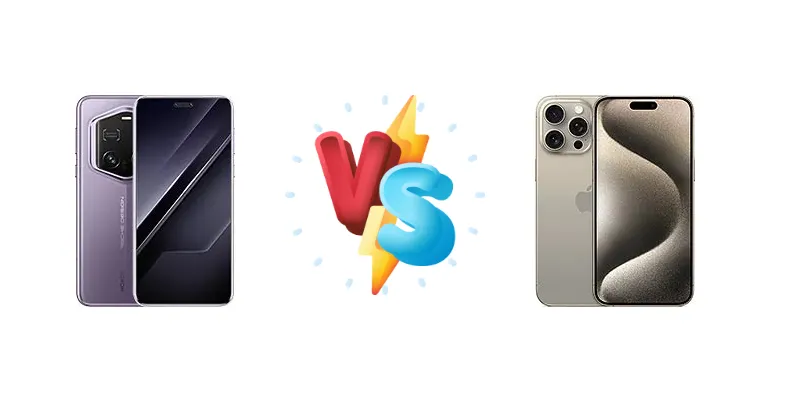
|
🏆 Quick Verdict
For the average user prioritizing all-day battery life and a refined ecosystem, the iPhone 15 Pro Max edges out the Honor Magic7 RSR Porsche Design. However, the Honor’s significantly faster charging and peak display brightness make it a strong alternative for power users and those seeking bleeding-edge technology.
| PHONES | ||
|---|---|---|
| Phone Names | Honor Magic7 RSR Porsche Design | Apple iPhone 15 Pro Max |
| Network | ||
|---|---|---|
| 2G bands | GSM 850 / 900 / 1800 / 1900 | GSM 850 / 900 / 1800 / 1900 |
| 3G bands | HSDPA 800 / 850 / 900 / 1700(AWS) / 1900 / 2100 | HSDPA 850 / 900 / 1700(AWS) / 1900 / 2100 |
| 4G bands | LTE | 1, 2, 3, 4, 5, 7, 8, 12, 13, 17, 18, 19, 20, 25, 26, 28, 30, 32, 34, 38, 39, 40, 41, 42, 46, 48, 53, 66 - A3106 |
| 5G bands | SA/NSA | 1, 2, 3, 5, 7, 8, 12, 20, 25, 26, 28, 30, 38, 40, 41, 48, 53, 66, 70, 77, 78, 79 SA/NSA/Sub6 - A3106 |
| Speed | HSPA, LTE, 5G | HSPA, LTE, 5G, EV-DO Rev.A 3.1 Mbps |
| Technology | GSM / CDMA / HSPA / CDMA2000 / LTE / 5G | GSM / CDMA / HSPA / EVDO / LTE / 5G |
| Launch | ||
|---|---|---|
| Announced | 2024, December 23 | 2023, September 12 |
| Status | Available. Released 2024, December 24 | Available. Released 2023, September 22 |
| Body | ||
|---|---|---|
| Build | Glass front (NanoCrystal Shield), glass back, aluminum frame | Glass front, glass back, titanium frame (grade 5) |
| Dimensions | 162.7 x 77.1 x 8.8 mm (6.41 x 3.04 x 0.35 in) | 159.9 x 76.7 x 8.3 mm (6.30 x 3.02 x 0.33 in) |
| SIM | · Nano-SIM + Nano-SIM + eSIM + eSIM (max 2 at a time) - INT· Nano-SIM + Nano-SIM - CN | · Nano-SIM + eSIM + eSIM (max 2 at a time; International)· eSIM + eSIM (8 or more, max 2 at a time; USA)· Nano-SIM + Nano-SIM (China) |
| Weight | 228 g (8.04 oz) | 221 g (7.80 oz) |
| Display | ||
|---|---|---|
| Protection | NanoCrystal Shield | Ceramic Shield glass |
| Resolution | 1280 x 2800 pixels, 19.5:9 ratio (~453 ppi density) | 1290 x 2796 pixels, 19.5:9 ratio (~460 ppi density) |
| Size | 6.8 inches, 112.8 cm2 (~89.9% screen-to-body ratio) | 6.7 inches, 110.2 cm2 (~89.8% screen-to-body ratio) |
| Type | LTPO OLED, 1B colors, 120Hz, 4320Hz PWM, Dolby Vision, HDR, 1600 nits (HBM), 5000 nits (peak) | LTPO Super Retina XDR OLED, 120Hz, HDR10, Dolby Vision, 1000 nits (typ), 2000 nits (HBM) |
| Platform | ||
|---|---|---|
| CPU | Octa-core (2x4.32 GHz Oryon V2 Phoenix L + 6x3.53 GHz Oryon V2 Phoenix M) | Hexa-core (2x3.78 GHz + 4x2.11 GHz) |
| Chipset | Qualcomm SM8750-AB Snapdragon 8 Elite (3 nm) | Apple A17 Pro (3 nm) |
| GPU | Adreno 830 | Apple GPU (6-core graphics) |
| OS | Android 15, MagicOS 9 | iOS 17, upgradable to iOS 26.1 |
| Memory | ||
|---|---|---|
| Card slot | No | No |
| Internal | 512GB 16GB RAM, 1TB 24GB RAM | 256GB 8GB RAM, 512GB 8GB RAM, 1TB 8GB RAM |
| Main Camera | ||
|---|---|---|
| Features | LiDAR AF, color spectrum sensor, LED flash, HDR, panorama | Dual-LED dual-tone flash, HDR (photo/panorama) |
| Triple | 50 MP, f/1.4-2.0, 23mm (wide), 1/1.3", 1.2µm, multi-directional PDAF, OIS 200 MP, f/1.9, 72mm (periscope telephoto), 1/1.4", 0.56µm, multi-directional PDAF, OIS, 3x optical zoom 50 MP, f/2.0, 13mm, 122˚ (ultrawide), 1/2.88", 0.61µm, dual pixel PDAF | 48 MP, f/1.8, 24mm (wide), 1/1.28", 1.22µm, dual pixel PDAF, sensor-shift OIS 12 MP, f/2.8, 120mm (periscope telephoto), 1/3.06", 1.12µm, dual pixel PDAF, 3D sensor‑shift OIS, 5x optical zoom 12 MP, f/2.2, 13mm, 120˚ (ultrawide), 1/2.55", 1.4µm, dual pixel PDAF TOF 3D LiDAR scanner (depth) |
| Video | 4K@24/30/60fps, 1080p@30/60/120/240fps, gyro-EIS, OIS, HDR, 10-bit video | 4K@24/25/30/60fps, 1080p@25/30/60/120/240fps, 10-bit HDR, Dolby Vision HDR (up to 60fps), ProRes, 3D (spatial) video, stereo sound rec. |
| Selfie camera | ||
|---|---|---|
| Features | - | HDR, Dolby Vision HDR |
| Single | 50 MP, f/2.0, 22mm (wide), 1/2.93", 0.6µm, AF TOF 3D, (depth/biometrics sensor) | 12 MP, f/1.9, 23mm (wide), 1/3.6", 1.0µm, PDAF, OIS SL 3D, (depth/biometrics sensor) |
| Video | 4K@30/60fps, 1080p@30/60fps, gyro-EIS | 4K@24/25/30/60fps, 1080p@25/30/60/120fps, gyro-EIS |
| Sound | ||
|---|---|---|
| 35mm jack | No | No |
| Loudspeaker | Yes, with stereo speakers | Yes, with stereo speakers |
| Comms | ||
|---|---|---|
| Bluetooth | 5.4, A2DP, LE, aptX HD | 5.3, A2DP, LE |
| Infrared port | Yes | - |
| NFC | Yes | Yes |
| Positioning | GPS (L1+L5), GLONASS, BDS (B1I+B1c+B2a), GALILEO (E1+E5a), QZSS (L1+L5) | GPS (L1+L5), GLONASS, GALILEO, BDS, QZSS, NavIC |
| Radio | No | No |
| USB | USB Type-C 3.2, DisplayPort 1.2, OTG | USB Type-C 3.2 Gen 2, DisplayPort |
| WLAN | Wi-Fi 802.11 a/b/g/n/ac/6/7, dual-band, Wi-Fi Direct | Wi-Fi 802.11 a/b/g/n/ac/6e, tri-band, hotspot |
| Features | ||
|---|---|---|
| Sensors | Fingerprint (under display, ultrasonic), Face ID, accelerometer, gyro, proximity, compass | Face ID, accelerometer, gyro, proximity, compass, barometer |
| Battery | ||
|---|---|---|
| Charging | 100W wired 80W wireless Reverse wireless 5W reverse wired | Wired, PD2.0, 50% in 30 min 15W wireless (MagSafe) 15W wireless (Qi2) - requires iOS 17.2 update 4.5W reverse wired |
| Type | Si/C Li-Ion 5850 mAh | Li-Ion 4441 mAh |
| Misc | ||
|---|---|---|
| Colors | Provence, Agate Grey | Black Titanium, White Titanium, Blue Titanium, Natural Titanium |
| Models | PTP-AN20 | A2849, A3105, A3106, A3108, iPhone16,2 |
| Price | About 1050 EUR | € 758.79 / $ 579.87 / £ 628.29 |
| SAR | - | 1.07 W/kg (head) 1.11 W/kg (body) |
| SAR EU | - | 0.98 W/kg (head) 0.98 W/kg (body) |
Honor Magic7 RSR Porsche Design
- Blazing-fast 100W wired and 80W wireless charging
- Peak display brightness of 1510 nits for excellent outdoor visibility
- Powerful Snapdragon 8 Elite chipset for demanding tasks
- Slightly shorter battery life compared to the iPhone
- Android ecosystem may not appeal to all users
Apple iPhone 15 Pro Max
- Longer battery life with 16:01h active use
- Seamless integration with the Apple ecosystem
- Exceptional camera performance and video recording capabilities
- Significantly slower charging speeds
- Less customization options compared to Android
Display Comparison
The iPhone 15 Pro Max boasts a brighter display, reaching 1787 nits compared to the Honor Magic7 RSR Porsche Design’s 1510 nits. While both offer excellent visibility, the iPhone’s higher peak brightness provides a noticeable advantage in direct sunlight. Both devices utilize advanced panel technology, though specifics like LTPO refresh rate are not provided for the Honor, the iPhone’s ProMotion technology is well-established. The iPhone’s color accuracy is renowned, while the Honor’s display, though bright, may lean towards more saturated colors, appealing to a different aesthetic preference.
Camera Comparison
Detailed camera specifications are limited for the Honor Magic7 RSR Porsche Design. However, given its positioning, it’s expected to feature a high-resolution main sensor and advanced image processing. The iPhone 15 Pro Max is known for its exceptional photo and video capabilities, leveraging computational photography and ProRes video recording. Without specific sensor sizes or aperture details for the Honor, it’s difficult to make a direct comparison. The iPhone’s strength lies in its consistent image quality across various lighting conditions and its robust video features.
Performance
The core of the performance difference lies in the chipsets: Qualcomm’s Snapdragon 8 Elite (3nm) in the Honor versus Apple’s A17 Pro (3nm) in the iPhone. The Honor utilizes an octa-core configuration (2x4.32 GHz Oryon V2 Phoenix L + 6x3.53 GHz Oryon V2 Phoenix M), while the iPhone employs a hexa-core setup (2x3.78 GHz + 4x2.11 GHz). While core count isn’t everything, the A17 Pro’s architecture and Apple’s software optimization consistently deliver superior single-core performance, crucial for responsive app launches and smooth UI navigation. The Snapdragon 8 Elite aims to close the gap with its Oryon cores, but real-world testing will be needed to fully assess its capabilities. Both utilize 3nm fabrication, suggesting comparable power efficiency, though thermal management will be key to sustained performance.
Battery Life
The iPhone 15 Pro Max demonstrates slightly superior battery endurance with an active use score of 16:01h, compared to the Honor Magic7 RSR Porsche Design’s 15:11h. However, the Honor compensates with significantly faster charging: 100W wired, 80W wireless, and even reverse wireless charging at 5W. The iPhone offers 50% charge in 30 minutes with wired charging, 15W wireless (MagSafe/Qi2), and 4.5W reverse wired charging. This charging speed disparity is a major differentiator, allowing the Honor to quickly top up its battery, mitigating the slightly shorter endurance.
Buying Guide
Buy the Honor Magic7 RSR Porsche Design if you need the absolute fastest charging speeds available on a smartphone, prioritize peak display brightness for outdoor visibility, and prefer the flexibility of the Android ecosystem. Buy the Apple iPhone 15 Pro Max if you value seamless integration with other Apple devices, a consistently optimized software experience, and slightly longer battery endurance during typical usage.