
Honor Magic7 Pro vs vivo iQOO 12 Pro: A Head-to-Head Flagship Showdown
| Phones Images | |||||
|---|---|---|---|---|---|
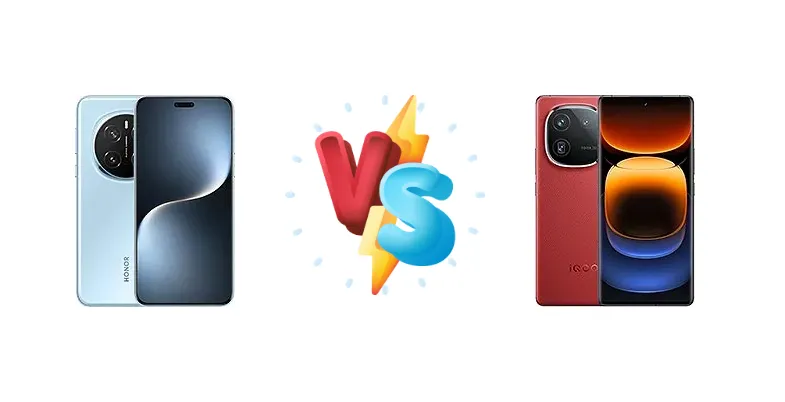
|
🏆 Quick Verdict
For the average user prioritizing longevity and a refined experience, the Honor Magic7 Pro emerges as the winner. Its exceptional 56:27h battery endurance and advanced Snapdragon 8 Elite chipset offer a compelling package. However, gamers and those constantly needing a quick power boost will find the iQOO 12 Pro’s 120W charging a significant advantage.
| PHONES | ||
|---|---|---|
| Phone Names | Honor Magic7 Pro | vivo iQOO 12 Pro |
| Network | ||
|---|---|---|
| 2G bands | GSM 850 / 900 / 1800 / 1900 | GSM 850 / 900 / 1800 / 1900 |
| 3G bands | HSDPA 800 / 850 / 900 / 1700(AWS) / 1900 / 2100 | HSDPA 800 / 850 / 900 / 1700(AWS) / 1900 / 2100 |
| 4G bands | LTE | 1, 2, 3, 4, 5, 7, 8, 12, 17, 18, 19, 20, 25, 26, 28, 34, 38, 39, 40, 41, 42, 66 |
| 5G bands | SA/NSA | 1, 2, 3, 5, 7, 8, 12, 20, 25, 26, 28, 66, 38, 40, 41, 77, 78 SA/NSA |
| Speed | HSPA, LTE, 5G | HSPA, LTE, 5G |
| Technology | GSM / HSPA / LTE / 5G | GSM / CDMA / HSPA / CDMA2000 / LTE / 5G |
| Launch | ||
|---|---|---|
| Announced | 2024, October 30 | 2023, November 07 |
| Status | Available. Released 2024, November 08 | Available. Released 2023, November 14 |
| Body | ||
|---|---|---|
| Build | Glass front (NanoCrystal Shield), glass back | - |
| Dimensions | 162.7 x 77.1 x 8.8 mm (6.41 x 3.04 x 0.35 in) | 164.6 x 75.4 x 8.6 mm or 8.8 mm |
| SIM | · Nano-SIM + eSIM· eSIM + eSIM· Nano-SIM + Nano-SIM | Nano-SIM + Nano-SIM |
| Weight | 223 g (7.87 oz) | 205 g or 210 g (7.23 oz) |
| Display | ||
|---|---|---|
| Protection | NanoCrystal Shield, Mohs level 5 | - |
| Resolution | 1280 x 2800 pixels, 19.5:9 ratio (~453 ppi density) | 1440 x 3200 pixels, 20:9 ratio (~518 ppi density) |
| Size | 6.8 inches, 112.8 cm2 (~89.9% screen-to-body ratio) | 6.78 inches, 111.0 cm2 (~89.4% screen-to-body ratio) |
| Type | LTPO OLED, 1B colors, 120Hz, 4320Hz PWM, Dolby Vision, HDR Vivid, 1600 nits (HBM), 5000 nits (peak) | LTPO AMOLED, 1B colors, 144Hz, HDR10+, 1600 nits (HBM), 3000 nits (peak) |
| Platform | ||
|---|---|---|
| CPU | Octa-core (2x4.32 GHz Oryon V2 Phoenix L + 6x3.53 GHz Oryon V2 Phoenix M) | Octa-core (1x3.3 GHz Cortex-X4 & 3x3.2 GHz Cortex-A720 & 2x3.0 GHz Cortex-A720 & 2x2.3 GHz Cortex-A520) |
| Chipset | Qualcomm SM8750-AB Snapdragon 8 Elite (3 nm) | Qualcomm SM8650-AB Snapdragon 8 Gen 3 (4 nm) |
| GPU | Adreno 830 | Adreno 750 |
| OS | Android 15, up to 7 major Android upgrades, MagicOS 9 | Android 14, up to 2 major Android upgrades, Funtouch 14 (International), OriginOS 4 (China) |
| Memory | ||
|---|---|---|
| Card slot | No | No |
| Internal | 256GB 12GB RAM, 512GB 12GB RAM, 512GB 16GB RAM, 1TB 16GB RAM | 256GB 16GB RAM, 512GB 16GB RAM, 1TB 16GB RAM |
| Main Camera | ||
|---|---|---|
| Features | Laser AF, color spectrum sensor, LED flash, HDR, panorama | Color spectrum sensor, Dual-LED flash, HDR, panorama |
| Triple | 50 MP, f/1.4-2.0, 24mm (wide), 1/1.3", 1.2µm, multi-directional PDAF, OIS 200 MP, f/2.6, 72mm (periscope telephoto), 1/1.4", 0.56µm, multi-directional PDAF, OIS, 3x optical zoom 50 MP, f/2.0, 12mm, 122˚ (ultrawide), 1/2.88", 0.61µm, dual pixel PDAF | 50 MP, f/1.7, 23mm (wide), 1/1.3", 1.2µm, ulti-directional PDAF, OIS 64 MP, f/2.6, 70mm (periscope telephoto), 1/2.0", PDAF, OIS, 3x optical zoom 50 MP, f/2.0, 15mm, 119˚ (ultrawide), AF |
| Video | 4K@24/30/60fps, 1080p@24/30/60/120/240fps, gyro-EIS, OIS, HDR, 10-bit video | 8K@30fps, 4K@24/30/60fps, 1080p@30/60/120/240fps, gyro-EIS |
| Selfie camera | ||
|---|---|---|
| Features | - | HDR |
| Single | 50 MP, f/2.0, 21mm (wide), 1/2.93", 0.6µm, PDAF TOF 3D, (depth/biometrics sensor) | 16 MP, f/2.5, (wide) |
| Video | 4K@30/60fps, 1080p@30/60fps, gyro-EIS | 1080p@30fps, gyro-EIS |
| Sound | ||
|---|---|---|
| 35mm jack | No | No |
| Loudspeaker | Yes, with large amplitude stereo speakers | Yes, with stereo speakers |
| Comms | ||
|---|---|---|
| Bluetooth | 5.4, A2DP, LE, aptX HD | 5.4, A2DP, LE, aptX HD, aptX Adaptive, aptX Lossless |
| Infrared port | Yes | Yes |
| NFC | Yes | Yes |
| Positioning | GPS (L1+L5), GLONASS, BDS (B1I+B1c+B2a), GALILEO (E1+E5a) | GPS (L1+L5), GLONASS (G1), BDS (B1I+B1c+B2a), GALILEO (E1+E5a), QZSS (L1+L5) |
| Radio | No | No |
| USB | USB Type-C 3.2, DisplayPort 1.2, OTG | USB Type-C 2.0, OTG |
| WLAN | Wi-Fi 802.11 a/b/g/n/ac/6/7, dual-band, Wi-Fi Direct | Wi-Fi 802.11 a/b/g/n/ac/6/7, tri-band, Wi-Fi Direct |
| Features | ||
|---|---|---|
| Sensors | Fingerprint (under display, ultrasonic), Face ID, accelerometer, gyro, proximity, compass | Fingerprint (under display, ultrasonic), accelerometer, gyro, proximity, compass |
| Battery | ||
|---|---|---|
| Charging | 100W wired, 100% in 33 min 80W wireless, 100% in 44 min Reverse wireless 5W reverse wired | 120W wired 50W wireless 10W reverse wireless |
| Type | Market-dependent versions:· Si/C Li-Ion 5850 mAh (Global)· Si/C Li-Ion 5270 mAh (Europe only) | 5100 mAh |
| Misc | ||
|---|---|---|
| Colors | Lunar shadow Grey, Breeze Blue, Black, White | Black, Red, White (BMW M branding) |
| Models | PTP-N49, PTP-AN10 | V2329A |
| Price | € 772.12 / $ 1,099.00 / £ 798.99 | About 650 EUR |
| EU LABEL | ||
|---|---|---|
| Battery | 56:27h endurance, 1200 cycles | - |
| Energy | Class A | - |
| Free fall | Class C (90 falls) | - |
| Repairability | Class B | - |
Honor Magic7 Pro
- Exceptional battery life (56:27h endurance)
- Cutting-edge Snapdragon 8 Elite processor
- Brighter display (1521 nits)
- Slower wired charging than iQOO 12 Pro
- Wireless charging is slower than wired
vivo iQOO 12 Pro
- Ultra-fast 120W wired charging
- Competitive Snapdragon 8 Gen 3 performance
- Potentially optimized for gaming
- Likely shorter battery life compared to Magic7 Pro
- Wireless charging slower than Honor
Display Comparison
The Honor Magic7 Pro boasts a significantly brighter display, reaching a measured 1521 nits, making it substantially more usable in direct sunlight compared to the iQOO 12 Pro (brightness data unavailable, but typically lower in this segment). While both likely employ LTPO technology for adaptive refresh rates, the Magic7 Pro’s peak brightness provides a clear advantage for outdoor viewing. The absence of detailed display specs for the iQOO 12 Pro makes a comprehensive comparison difficult, but Honor’s panel is demonstrably superior in peak luminance.
Camera Comparison
Without detailed camera specifications for either device, a direct comparison is limited. However, both phones likely feature high-end camera systems. The iQOO series often emphasizes computational photography, while Honor tends to focus on sensor quality and optical stabilization. The absence of sensor size information prevents a definitive judgment, but the iQOO 12 Pro’s brand history suggests a focus on versatile camera modes, while the Magic7 Pro may prioritize image clarity and dynamic range.
Performance
The core difference lies in the chipsets: the Honor Magic7 Pro utilizes the Qualcomm SM8750-AB Snapdragon 8 Elite (3nm), featuring a custom Oryon V2 Phoenix CPU configuration (2x4.32 GHz + 6x3.53 GHz). This 3nm process promises improved efficiency and performance compared to the iQOO 12 Pro’s Snapdragon 8 Gen 3 (4nm) with its Cortex-X4 based CPU (1x3.3 GHz + 3x3.2 GHz + 2x3.0 GHz + 2x2.3 GHz). The Oryon architecture, known for its focus on single-core performance, should translate to snappier app launches and smoother multitasking on the Magic7 Pro. While the Gen 3 is powerful, the 3nm node and Oryon cores give the Magic7 Pro a potential edge in sustained performance and thermal management.
Battery Life
The Honor Magic7 Pro truly shines in battery endurance, achieving an impressive 56:27h rating and 13:53h of active use. This is significantly higher than what’s typically seen in flagship devices. The iQOO 12 Pro compensates with faster charging: 120W wired (vs. 100W on the Magic7 Pro) and 50W wireless (vs. 80W on the Magic7 Pro). While the iQOO 12 Pro can reach 100% charge in less time, the Magic7 Pro’s superior battery life minimizes the need for frequent top-ups. The Magic7 Pro also offers 5W reverse wired charging, adding to its versatility.
Buying Guide
Buy the Honor Magic7 Pro if you need exceptional battery life, a brighter display for outdoor visibility, and a processor optimized for sustained performance. This phone is ideal for professionals, travelers, and anyone who dislikes frequent charging. Buy the vivo iQOO 12 Pro if you prioritize the fastest possible charging speeds, enjoy mobile gaming, and value a more aggressive performance profile. It’s a strong choice for power users and gamers who demand instant gratification.