
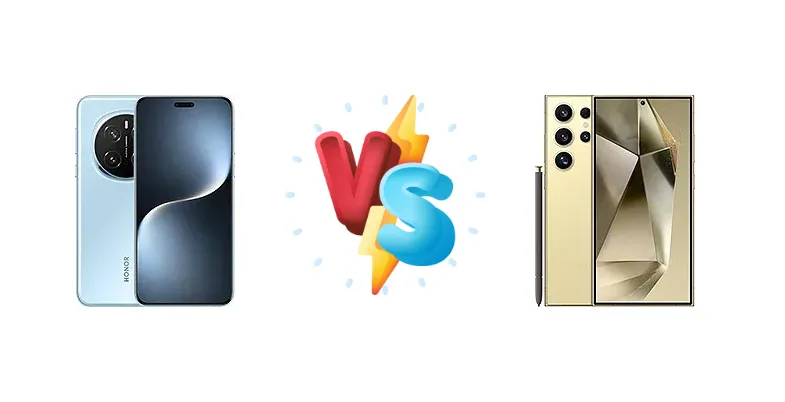
Honor Magic7 Pro vs. Samsung Galaxy S24 Ultra: A Deep Dive into Flagship Power
| Phones Images | |||||
|---|---|---|---|---|---|
|
🏆 Quick Verdict
For users prioritizing raw speed and charging convenience, the Honor Magic7 Pro emerges as the winner. Its Snapdragon 8 Elite and 100W wired/80W wireless charging significantly outperform the S24 Ultra. However, Samsung’s established software ecosystem and camera processing remain compelling advantages for many.
| PHONES | ||
|---|---|---|
| Phone Names | Honor Magic7 Pro | Samsung Galaxy S24 Ultra |
| Network | ||
|---|---|---|
| 2G bands | GSM 850 / 900 / 1800 / 1900 | GSM 850 / 900 / 1800 / 1900 |
| 3G bands | HSDPA 800 / 850 / 900 / 1700(AWS) / 1900 / 2100 | HSDPA 850 / 900 / 1700(AWS) / 1900 / 2100 |
| 4G bands | LTE | 1, 2, 3, 4, 5, 7, 8, 12, 13, 17, 18, 19, 20, 25, 26, 28, 32, 38, 39, 40, 41, 66 - International |
| 5G bands | SA/NSA | 1, 2, 3, 5, 7, 8, 12, 20, 25, 26, 28, 38, 40, 41, 66, 75, 77, 78 SA/NSA/Sub6 - International |
| Speed | HSPA, LTE, 5G | HSPA, LTE (up to 7CA), 5G |
| Technology | GSM / HSPA / LTE / 5G | GSM / CDMA / HSPA / EVDO / LTE / 5G |
| Launch | ||
|---|---|---|
| Announced | 2024, October 30 | 2024, January 17 |
| Status | Available. Released 2024, November 08 | Available. Released 2024, January 24 |
| Body | ||
|---|---|---|
| Build | Glass front (NanoCrystal Shield), glass back | Glass front (Corning Gorilla Armor), glass back (Corning Gorilla Armor), titanium frame (grade 2) |
| Dimensions | 162.7 x 77.1 x 8.8 mm (6.41 x 3.04 x 0.35 in) | 162.3 x 79 x 8.6 mm (6.39 x 3.11 x 0.34 in) |
| SIM | · Nano-SIM + eSIM· eSIM + eSIM· Nano-SIM + Nano-SIM | · Nano-SIM + Nano-SIM + eSIM + eSIM (max 2 at a time) - INT· Nano-SIM + eSIM + eSIM (max 2 at a time) - USA· Nano-SIM + Nano-SIM - CN |
| Weight | 223 g (7.87 oz) | 232 g or 233 g (8.18 oz) |
| Display | ||
|---|---|---|
| Protection | NanoCrystal Shield, Mohs level 5 | Corning Gorilla Armor |
| Resolution | 1280 x 2800 pixels, 19.5:9 ratio (~453 ppi density) | 1440 x 3120 pixels, 19.5:9 ratio (~505 ppi density) |
| Size | 6.8 inches, 112.8 cm2 (~89.9% screen-to-body ratio) | 6.8 inches, 113.5 cm2 (~88.5% screen-to-body ratio) |
| Type | LTPO OLED, 1B colors, 120Hz, 4320Hz PWM, Dolby Vision, HDR Vivid, 1600 nits (HBM), 5000 nits (peak) | Dynamic LTPO AMOLED 2X, 120Hz, HDR10+, 2600 nits (peak) |
| Platform | ||
|---|---|---|
| CPU | Octa-core (2x4.32 GHz Oryon V2 Phoenix L + 6x3.53 GHz Oryon V2 Phoenix M) | 8-core (1x3.39GHz Cortex-X4 & 3x3.1GHz Cortex-A720 & 2x2.9GHz Cortex-A720 & 2x2.2GHz Cortex-A520) |
| Chipset | Qualcomm SM8750-AB Snapdragon 8 Elite (3 nm) | Qualcomm SM8650-AC Snapdragon 8 Gen 3 (4 nm) |
| GPU | Adreno 830 | Adreno 750 (1 GHz) |
| OS | Android 15, up to 7 major Android upgrades, MagicOS 9 | Android 14, up to 7 major Android upgrades, One UI 8.0 |
| Memory | ||
|---|---|---|
| Card slot | No | No |
| Internal | 256GB 12GB RAM, 512GB 12GB RAM, 512GB 16GB RAM, 1TB 16GB RAM | 256GB 12GB RAM, 512GB 12GB RAM, 1TB 12GB RAM |
| Main Camera | ||
|---|---|---|
| Features | Laser AF, color spectrum sensor, LED flash, HDR, panorama | Laser AF, LED flash, auto-HDR, panorama |
| Quad | - | 200 MP, f/1.7, 24mm (wide), 1/1.3", 0.6µm, multi-directional PDAF, OIS 10 MP, f/2.4, 67mm (telephoto), 1/3.52", 1.12µm, PDAF, OIS, 3x optical zoom 50 MP, f/3.4, 111mm (periscope telephoto), 1/2.52", 0.7µm, PDAF, OIS, 5x optical zoom 12 MP, f/2.2, 13mm, 120˚ (ultrawide), 1/2.55", 1.4µm, dual pixel PDAF, Super Steady video |
| Triple | 50 MP, f/1.4-2.0, 24mm (wide), 1/1.3", 1.2µm, multi-directional PDAF, OIS 200 MP, f/2.6, 72mm (periscope telephoto), 1/1.4", 0.56µm, multi-directional PDAF, OIS, 3x optical zoom 50 MP, f/2.0, 12mm, 122˚ (ultrawide), 1/2.88", 0.61µm, dual pixel PDAF | - |
| Video | 4K@24/30/60fps, 1080p@24/30/60/120/240fps, gyro-EIS, OIS, HDR, 10-bit video | 8K@24/30fps, 4K@30/60/120fps, 1080p@30/60/120/240fps, HDR10+, stereo sound rec., gyro-EIS |
| Selfie camera | ||
|---|---|---|
| Features | - | HDR, HDR10+ |
| Single | 50 MP, f/2.0, 21mm (wide), 1/2.93", 0.6µm, PDAF TOF 3D, (depth/biometrics sensor) | 12 MP, f/2.2, 26mm (wide), 1/3.2", 1.12µm, dual pixel PDAF |
| Video | 4K@30/60fps, 1080p@30/60fps, gyro-EIS | 4K@30/60fps, 1080p@30fps |
| Sound | ||
|---|---|---|
| 35mm jack | No | No |
| Loudspeaker | Yes, with large amplitude stereo speakers | Yes, with stereo speakers |
| Comms | ||
|---|---|---|
| Bluetooth | 5.4, A2DP, LE, aptX HD | 5.3, A2DP, LE |
| Infrared port | Yes | - |
| NFC | Yes | Yes |
| Positioning | GPS (L1+L5), GLONASS, BDS (B1I+B1c+B2a), GALILEO (E1+E5a) | GPS, GLONASS, BDS, GALILEO, QZSS |
| Radio | No | No |
| USB | USB Type-C 3.2, DisplayPort 1.2, OTG | USB Type-C 3.2, DisplayPort 1.2, OTG |
| WLAN | Wi-Fi 802.11 a/b/g/n/ac/6/7, dual-band, Wi-Fi Direct | Wi-Fi 802.11 a/b/g/n/ac/6e/7, tri-band, Wi-Fi Direct |
| Features | ||
|---|---|---|
| Sensors | Fingerprint (under display, ultrasonic), Face ID, accelerometer, gyro, proximity, compass | Fingerprint (under display, ultrasonic), accelerometer, gyro, proximity, compass, barometer |
| Battery | ||
|---|---|---|
| Charging | 100W wired, 100% in 33 min 80W wireless, 100% in 44 min Reverse wireless 5W reverse wired | 45W wired, PD3.0, 65% in 30 min 15W wireless (Qi) 4.5W reverse wireless |
| Type | Market-dependent versions:· Si/C Li-Ion 5850 mAh (Global)· Si/C Li-Ion 5270 mAh (Europe only) | Li-Ion 5000 mAh |
| Misc | ||
|---|---|---|
| Colors | Lunar shadow Grey, Breeze Blue, Black, White | Titanium Black, Titanium Gray, Titanium Violet, Titanium Yellow, Titanium Blue, Titanium Green, Titanium Orange |
| Models | PTP-N49, PTP-AN10 | SM-S928B, SM-S928B/DS, SM-S928U, SM-S928U1, SM-S928W, SM-S928N, SM-S9280, SM-S928E, SM-S928E/DS |
| Price | € 772.12 / $ 1,099.00 / £ 798.99 | $ 514.94 / C$ 929.99 / £ 630.00 / € 658.53 / ₹ 84,999 |
| SAR | - | 1.26 W/kg (head) 0.62 W/kg (body) |
| SAR EU | - | 1.06 W/kg (head) 1.30 W/kg (body) |
| EU LABEL | ||
|---|---|---|
| Battery | 56:27h endurance, 1200 cycles | - |
| Energy | Class A | - |
| Free fall | Class C (90 falls) | - |
| Repairability | Class B | - |
Honor Magic7 Pro
- Blazing-fast 100W wired and 80W wireless charging
- Potentially superior CPU performance with Snapdragon 8 Elite
- Excellent battery endurance (56:27h)
- Camera details are currently limited
- MagicOS may not appeal to all users
Samsung Galaxy S24 Ultra
- Mature and polished software experience (One UI)
- Versatile and well-regarded camera system
- Strong ecosystem of Samsung services and accessories
- Slower charging speeds (45W wired, 15W wireless)
- Snapdragon 8 Gen 3 is less efficient than Snapdragon 8 Elite
Display Comparison
Both the Honor Magic7 Pro and Samsung Galaxy S24 Ultra feature excellent displays, with the Magic7 Pro achieving a measured peak brightness of 1521 nits compared to the S24 Ultra’s 1447 nits. While the difference is subtle, the Magic7 Pro’s slightly higher output could be beneficial in direct sunlight. Both likely employ LTPO technology for adaptive refresh rates, though specific refresh rate ranges aren’t provided. The S24 Ultra’s display benefits from Samsung’s long-standing expertise in panel calibration and color accuracy, but the Magic7 Pro holds its own with a vibrant and sharp visual experience.
Camera Comparison
The context data for the Magic7 Pro lacks detailed camera specifications, but given its flagship positioning, it’s reasonable to expect a high-resolution main sensor. The S24 Ultra’s camera system is well-documented, featuring a versatile array of lenses and advanced image processing. The S24 Ultra’s strength lies in its consistent image quality across various scenarios and its robust video recording capabilities. Without specific details on the Magic7 Pro’s sensor size, aperture, and OIS implementation, it’s difficult to make a direct comparison, but Samsung’s established camera algorithms and software features provide a significant advantage.
Performance
The core battleground is the chipset: Qualcomm’s Snapdragon 8 Elite in the Magic7 Pro versus the Snapdragon 8 Gen 3 in the S24 Ultra. The 8 Elite, built on a 3nm process, features a unique Oryon V2 Phoenix CPU architecture (2x4.32 GHz + 6x3.53 GHz) designed for superior performance. The S24 Ultra’s 8 Gen 3 (1x3.39GHz Cortex-X4 + 3x3.1GHz Cortex-A720 + 2x2.9GHz Cortex-A720 + 2x2.2GHz Cortex-A520) utilizes a more traditional ARM architecture. The 3nm node of the 8 Elite should translate to better thermal efficiency and sustained performance under heavy load, potentially minimizing throttling during extended gaming sessions. While both devices likely utilize LPDDR5x RAM, the architectural advantage of the 8 Elite gives the Magic7 Pro an edge in raw processing power.
Battery Life
The Honor Magic7 Pro boasts impressive battery endurance with 56:27h of total usage and 13:53h of active use, slightly exceeding the S24 Ultra’s 13:49h active use score. However, the real differentiator is charging speed. The Magic7 Pro supports 100W wired charging, achieving a full charge in just 33 minutes, and an astonishing 80W wireless charging, completing a full charge in 44 minutes. The S24 Ultra’s 45W wired charging (65% in 30 minutes) and 15W wireless charging pale in comparison. The Magic7 Pro also offers both 5W reverse wired and reverse wireless charging, providing added convenience.
Buying Guide
Buy the Honor Magic7 Pro if you need the absolute fastest charging speeds, prioritize peak CPU performance for demanding tasks, and are comfortable with Honor’s MagicOS. Buy the Samsung Galaxy S24 Ultra if you prefer a more polished software experience, a versatile camera system with established image processing, and the broader ecosystem of Samsung services and accessories.