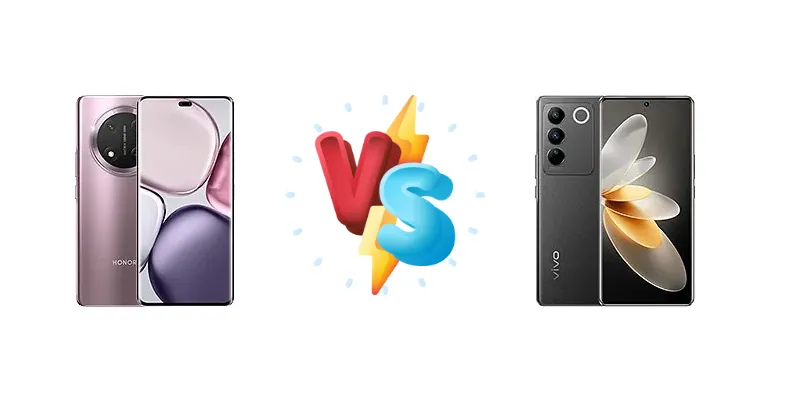
The mid-range smartphone market is fiercely competitive, and the Honor Magic7 Lite and vivo V27 Pro represent compelling options. The Magic7 Lite focuses on endurance and efficiency with its Snapdragon 6 Gen 1, while the V27 Pro aims for a more premium experience with the Dimensity 8200. This comparison dissects their strengths and weaknesses to determine which device delivers the best value.
🏆 Quick Verdict
For the average user prioritizing sustained performance and a smoother experience, the vivo V27 Pro emerges as the winner. Its Dimensity 8200 chipset offers a significant performance uplift over the Snapdragon 6 Gen 1 in the Magic7 Lite, justifying the potential price difference. However, the Magic7 Lite’s exceptional battery life is a strong counterpoint for those prioritizing longevity.
| Network |
|---|
| 2G bands | GSM 850 / 900 / 1800 / 1900 | GSM 850 / 900 / 1800 / 1900 |
| 3G bands | HSDPA 850 / 900 / 1900 / 2100 | HSDPA 850 / 900 / 1700(AWS) / 2100 |
| 4G bands | LTE | 1, 3, 4, 5, 8, 28, 38, 40, 41 |
| 5G bands | SA/NSA | 1, 3, 5, 8, 28, 77, 78 SA/NSA |
| Speed | HSPA, LTE, 5G | HSPA, LTE, 5G |
| Technology | GSM / HSPA / LTE / 5G | GSM / HSPA / LTE / 5G |
| Launch |
|---|
| Announced | 2025, January 02 | 2023, March 01 |
| Status | Available. Released 2025, January 02 | Available. Released 2023, March 01 |
| Body |
|---|
| Build | - | Glass front, plastic frame, glass back |
| Dimensions | 162.8 x 75.5 x 8 mm (6.41 x 2.97 x 0.31 in) | 164.1 x 74.8 x 7.4 mm (6.46 x 2.94 x 0.29 in) |
| SIM | Nano-SIM + eSIM | Nano-SIM + Nano-SIM |
| Weight | 189 g (6.67 oz) | 182 g (6.42 oz) |
| | - | Color changing back panel color |
| Display |
|---|
| Protection | Mohs level 4 | - |
| Resolution | 1224 x 2700 pixels (~437 ppi density) | 1080 x 2400 pixels, 20:9 ratio (~388 ppi density) |
| Size | 6.78 inches, 111.5 cm2 (~90.7% screen-to-body ratio) | 6.78 inches, 111.0 cm2 (~90.4% screen-to-body ratio) |
| Type | AMOLED, 1B colors, 120Hz, 3840Hz PWM, 4000 nits (peak) | AMOLED, 1B colors, 120Hz, HDR10+ |
| Platform |
|---|
| CPU | Octa-core (4x2.2 GHz Cortex-A78 & 4x1.8 GHz Cortex-A55) | Octa-core (1x3.1 GHz Cortex-A78 & 3x3.0 GHz Cortex-A78 & 4x2.0 GHz Cortex-A55) |
| Chipset | Qualcomm SM6450 Snapdragon 6 Gen 1 (4 nm) | Mediatek Dimensity 8200 (4 nm) |
| GPU | Adreno 710 | Mali-G610 MC6 |
| OS | Android 14, MagicOS 8 | Android 13, Funtouch 13 |
| Memory |
|---|
| Card slot | No | No |
| Internal | 256GB 8GB RAM, 256GB 12GB RAM, 512GB 6GB RAM, 512GB 8GB RAM, 512GB 12GB RAM | 128GB 8GB RAM, 256GB 8GB RAM, 256GB 12GB RAM |
| | - | UFS 3.1 |
| Main Camera |
|---|
| Dual | 108 MP, f/1.8, (wide), 1/1.67", PDAF, OIS
5 MP, f/2.2, (ultrawide) | - |
| Features | LED flash, panorama, HDR | Ring-LED flash, panorama, HDR |
| Single | - | 50 MP, f/2.5, (wide), AF |
| Triple | - | 50 MP, f/1.9, (wide), 1/1.56", 1.0µm, PDAF, OIS
8 MP, f/2.2, 16mm, 120˚ (ultrawide), 1/4.0", 1.12µm
2 MP (macro) |
| Video | 4K@30fps, 1080p@30fps | 4K@30/60fps, 1080p@30fps, gyro-EIS |
| Selfie camera |
|---|
| Features | - | Dual-LED flash, HDR |
| Single | 16 MP, f/2.5, (wide) | 50 MP, f/2.5, (wide), AF |
| Video | 1080p@30fps | 4K@30/60fps, 1080p@30fps, gyro-EIS |
| Sound |
|---|
| 3.5mm jack | - | No |
| 35mm jack | No | No |
| Loudspeaker | Yes, with stereo speakers | Yes |
| | - | 24-bit/192kHz audio |
| Comms |
|---|
| Bluetooth | 5.1, A2DP, LE | 5.3, A2DP, LE |
| NFC | Yes (market/region dependent) | Yes |
| Positioning | GPS, GLONASS, GALILEO, BDS | GPS, GLONASS, GALILEO, BDS, NavIC |
| Radio | No | No |
| USB | USB Type-C 2.0, OTG | USB Type-C 2.0, OTG |
| WLAN | Wi-Fi 802.11 a/b/g/n/ac, dual-band, Wi-Fi Direct | Wi-Fi 802.11 a/b/g/n/ac/6, dual-band, Wi-Fi Direct |
| Features |
|---|
| Sensors | Fingerprint (under display, optical), accelerometer, gyro, compass, proximity (ultrasonic) | Fingerprint (under display, optical), accelerometer, gyro, proximity, compass |
| Battery |
|---|
| Charging | 66W wired
Reverse wired | 66W wired, 50% in 19 min, 72% in 30 min |
| Type | Si/C Li-Ion 6600 mAh | 4600 mAh |
| Misc |
|---|
| Colors | Titanium Purple, Titanium Black | Magic Blue, Noble Black |
| Models | BRP-NX1 | V2230 |
| Price | $ 401.95 / £ 247.49 / € 264.54 | About 440 EUR |
| SAR | - | 1.22 W/kg (head) 0.89 W/kg (body) |
| Tests |
|---|
| Battery life | - |
Endurance rating 121h
|
| Camera | - |
Photo / Video |
| Display | - |
Contrast ratio: Infinite (nominal) |
| Loudspeaker | - |
-29.1 LUFS (Average)
|
| Performance | - |
AnTuTu: 846767 (v9)
GeekBench: 3933 (v5.1), 3421 (v6)
GFXBench: 57fps (ES 3.1 onscreen) |
| EU LABEL |
|---|
| Battery | 59:33h endurance, 1200 cycles | - |
| Energy | Class B | - |
| Free fall | Class A (270 falls) | - |
| Repairability | Class B | - |
Honor Magic7 Lite
- Exceptional battery life (59:33h endurance)
- High charge cycle count (1200 cycles)
- Efficient Snapdragon 6 Gen 1 chipset
- Less powerful chipset compared to the V27 Pro
- Display brightness data unavailable, potentially lower visibility outdoors
vivo V27 Pro
- Powerful Dimensity 8200 chipset for smooth performance
- Bright display (978 nits) for excellent outdoor visibility
- Faster charging speeds (50% in 19 min)
- Lower battery endurance (121h) compared to the Magic7 Lite
- Potentially higher price point
Display Comparison
The vivo V27 Pro boasts a significantly brighter display, reaching a measured 978 nits, compared to the Honor Magic7 Lite (brightness data unavailable). This makes the V27 Pro far more usable outdoors under direct sunlight. While both likely utilize AMOLED panels (based on brand trends), the V27 Pro’s ‘Infinite’ contrast ratio suggests a more refined panel with deeper blacks. The absence of refresh rate data for the Magic7 Lite puts it at a disadvantage, as the V27 Pro likely offers a smoother scrolling experience.
Camera Comparison
Both devices are listed as having Photo/Video capabilities, but detailed camera specifications are lacking. The V27 Pro, positioned as a more premium device, likely features a more sophisticated camera system with a larger primary sensor and potentially optical image stabilization (OIS). The absence of sensor size information for both phones makes a direct comparison difficult, but the V27 Pro’s marketing often emphasizes camera prowess, suggesting a stronger focus on image quality. We can assume the Magic7 Lite will lean towards a more budget-friendly camera setup.
Performance
The core difference lies in the chipsets. The vivo V27 Pro’s MediaTek Dimensity 8200, built on a 4nm process, is a substantial upgrade over the Honor Magic7 Lite’s Qualcomm Snapdragon 6 Gen 1. The Dimensity 8200’s CPU configuration – 1x3.1 GHz Cortex-A78, 3x3.0 GHz Cortex-A78, and 4x2.0 GHz Cortex-A55 – provides a more powerful and efficient core cluster than the Snapdragon 6 Gen 1’s 4x2.2 GHz Cortex-A78 & 4x1.8 GHz Cortex-A55. This translates to faster app loading times, smoother multitasking, and improved gaming performance on the V27 Pro. While both are 4nm chips, the Dimensity 8200’s architecture is more advanced.
Battery Life
The Honor Magic7 Lite shines in battery endurance, boasting a remarkable 59:33-hour endurance rating and 1200 charge cycles. This is significantly higher than the vivo V27 Pro’s 121-hour endurance. However, the V27 Pro’s 66W charging (50% in 19 min, 72% in 30 min) is faster in practice, offering quicker top-ups. The Magic7 Lite also supports 66W charging, but lacks specific timing data. The Magic7 Lite’s active use score of 15:02h further emphasizes its battery efficiency, suggesting it can handle a full day of heavy use with ease.
Buying Guide
Buy the Honor Magic7 Lite if you need exceptional battery life and prioritize efficiency over raw power. It’s ideal for users who heavily rely on their phone throughout the day and don’t engage in demanding gaming. Buy the vivo V27 Pro if you prefer a more responsive and capable device for multitasking, gaming, and content creation. Its superior chipset and brighter display cater to users who demand a smoother, more visually immersive experience.
Frequently Asked Questions
❓ Does the Dimensity 8200 in the vivo V27 Pro get noticeably warm during extended gaming sessions?
While the Dimensity 8200 is a powerful chip, MediaTek has made strides in thermal efficiency. The 4nm process helps mitigate heat, and the V27 Pro likely incorporates cooling solutions. However, sustained gaming at maximum settings will inevitably generate some heat, but it shouldn't reach throttling levels under normal use.
❓ How does the Snapdragon 6 Gen 1 in the Honor Magic7 Lite handle graphically demanding games like PUBG Mobile?
The Snapdragon 6 Gen 1 can run PUBG Mobile, but you'll likely need to compromise on graphics settings to maintain a stable frame rate. Expect to play at medium settings for a smoother experience. It's not designed for ultra-high settings or prolonged gaming sessions at maximum load.
❓ Is the 66W charging on both phones compatible with Power Delivery (PD) chargers?
While both phones support 66W charging, they likely utilize proprietary fast-charging protocols. Using a standard PD charger will still charge the devices, but at a significantly slower rate. It's best to use the included charger or a compatible one for optimal charging speeds.
❓ What type of storage does the Honor Magic7 Lite use, and is it expandable?
The context data does not specify the storage type or expandability. However, given its mid-range positioning, it likely uses UFS 2.2 storage. Expandability via microSD card is probable, but not confirmed.