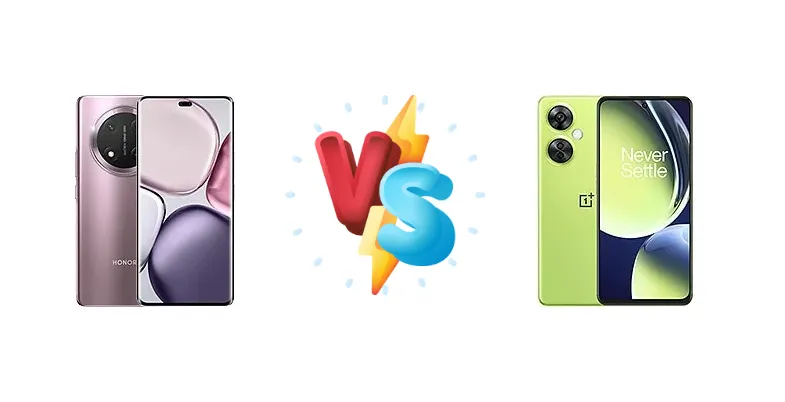
The sub-$300 smartphone market is fiercely competitive, and the Honor Magic7 Lite and OnePlus Nord CE 3 Lite are two strong contenders vying for your attention. Both offer 5G connectivity and fast charging, but they diverge significantly in their underlying chipsets and battery endurance, making the choice less straightforward than it appears. This comparison will dissect the key differences to help you determine which device best suits your needs.
🏆 Quick Verdict
For the average user prioritizing all-day battery life and sustained performance, the Honor Magic7 Lite emerges as the winner. Its Snapdragon 6 Gen 1, built on a more efficient 4nm process, coupled with exceptional 59:33h endurance, provides a more reliable experience than the OnePlus Nord CE 3 Lite's Snapdragon 695.
| Network |
|---|
| 2G bands | GSM 850 / 900 / 1800 / 1900 | GSM 850 / 900 / 1800 / 1900 |
| 3G bands | HSDPA 850 / 900 / 1900 / 2100 | HSDPA 800 / 850 / 900 / 1700(AWS) / 1900 / 2100 - International |
| 4G bands | LTE | 1, 2, 3, 4, 5, 7, 8, 12, 13, 17, 18, 19, 20, 26, 28, 32, 38, 39, 40, 41, 66 - International |
| 5G bands | SA/NSA | 1, 3, 5, 7, 8, 20, 28, 38, 40, 41, 66, 77, 78 SA/NSA - International |
| Speed | HSPA, LTE, 5G | HSPA, LTE, 5G |
| Technology | GSM / HSPA / LTE / 5G | GSM / HSPA / LTE / 5G |
| | - | 1, 3, 5, 8, 28, 40, 41, 77, 78 SA/NSA - India |
| Launch |
|---|
| Announced | 2025, January 02 | 2023, April 04 |
| Status | Available. Released 2025, January 02 | Available. Released 2023, April 11 |
| Body |
|---|
| Build | - | Glass front, plastic frame, plastic back |
| Dimensions | 162.8 x 75.5 x 8 mm (6.41 x 2.97 x 0.31 in) | 165.5 x 76 x 8.3 mm (6.52 x 2.99 x 0.33 in) |
| SIM | Nano-SIM + eSIM | Nano-SIM + Nano-SIM |
| Weight | 189 g (6.67 oz) | 195 g (6.88 oz) |
| Display |
|---|
| Protection | Mohs level 4 | Corning Gorilla Glass |
| Resolution | 1224 x 2700 pixels (~437 ppi density) | 1080 x 2400 pixels, 20:9 ratio (~391 ppi density) |
| Size | 6.78 inches, 111.5 cm2 (~90.7% screen-to-body ratio) | 6.72 inches, 109.6 cm2 (~87.1% screen-to-body ratio) |
| Type | AMOLED, 1B colors, 120Hz, 3840Hz PWM, 4000 nits (peak) | IPS LCD, 120Hz, 550 nits (typ), 680 nits (peak) |
| Platform |
|---|
| CPU | Octa-core (4x2.2 GHz Cortex-A78 & 4x1.8 GHz Cortex-A55) | Octa-core (2x2.2 GHz Kryo 660 Gold & 6x1.7 GHz Kryo 660 Silver) |
| Chipset | Qualcomm SM6450 Snapdragon 6 Gen 1 (4 nm) | Qualcomm SM6375 Snapdragon 695 5G (6 nm) |
| GPU | Adreno 710 | Adreno 619 |
| OS | Android 14, MagicOS 8 | Android 13, OxygenOS 13.1 |
| Memory |
|---|
| Card slot | No | microSDXC (uses shared SIM slot) |
| Internal | 256GB 8GB RAM, 256GB 12GB RAM, 512GB 6GB RAM, 512GB 8GB RAM, 512GB 12GB RAM | 128GB 8GB RAM, 256GB 8GB RAM |
| | - | UFS 2.2 |
| Main Camera |
|---|
| Dual | 108 MP, f/1.8, (wide), 1/1.67", PDAF, OIS
5 MP, f/2.2, (ultrawide) | - |
| Features | LED flash, panorama, HDR | LED flash, HDR, panorama |
| Triple | - | 108 MP, f/1.8, (wide), 1/1.67", 0.64µm, PDAF
2 MP (macro)
Auxiliary lens |
| Video | 4K@30fps, 1080p@30fps | 1080p@30fps |
| Selfie camera |
|---|
| Features | - | HDR, panorama |
| Single | 16 MP, f/2.5, (wide) | 16 MP, f/2.4, (wide), 1.0µm |
| Video | 1080p@30fps | 1080p@30fps |
| Sound |
|---|
| 3.5mm jack | - | Yes |
| 35mm jack | No | Yes |
| Loudspeaker | Yes, with stereo speakers | Yes, with stereo speakers |
| Comms |
|---|
| Bluetooth | 5.1, A2DP, LE | 5.1, A2DP, LE, aptX HD |
| NFC | Yes (market/region dependent) | Yes (market/region dependent) |
| Positioning | GPS, GLONASS, GALILEO, BDS | GPS, GALILEO, GLONASS, BDS, QZSS |
| Radio | No | No |
| USB | USB Type-C 2.0, OTG | USB Type-C 2.0, OTG |
| WLAN | Wi-Fi 802.11 a/b/g/n/ac, dual-band, Wi-Fi Direct | Wi-Fi 802.11 a/b/g/n/ac, dual-band |
| Features |
|---|
| Sensors | Fingerprint (under display, optical), accelerometer, gyro, compass, proximity (ultrasonic) | Fingerprint (side-mounted), accelerometer, gyro, proximity, compass |
| Battery |
|---|
| Charging | 66W wired
Reverse wired | 67W wired, 80% in 30 min |
| Type | Si/C Li-Ion 6600 mAh | Li-Po 5000 mAh |
| Misc |
|---|
| Colors | Titanium Purple, Titanium Black | Pastel Lime, Chromatic Gray |
| Models | BRP-NX1 | CPH2467, CPH2465 |
| Price | $ 401.95 / £ 247.49 / € 264.54 | £ 169.98 / € 209.99 |
| SAR | - | 1.17 W/kg (head) 0.70 W/kg (body) |
| Tests |
|---|
| Performance | - |
AnTuTu: 412006 (v9)
GeekBench: 2052 (v5)
GFXBench: 17fps (ES 3.1 onscreen) |
| EU LABEL |
|---|
| Battery | 59:33h endurance, 1200 cycles | - |
| Energy | Class B | - |
| Free fall | Class A (270 falls) | - |
| Repairability | Class B | - |
Honor Magic7 Lite
- Exceptional battery life (59:33h endurance)
- More efficient Snapdragon 6 Gen 1 (4nm)
- Reverse wired charging capability
- Camera specifications unknown
- Display details unavailable
OnePlus Nord CE 3 Lite
- Extremely fast 67W charging (80% in 30 min)
- 5G connectivity
- Potentially better software support within the OnePlus ecosystem
- Lower battery endurance compared to Honor
- Less efficient Snapdragon 695 (6nm)
Display Comparison
Display specifications are not provided in the context data. However, given the price bracket, both devices likely feature LCD panels with FHD+ resolution. The key differentiator will be color accuracy and peak brightness, which would require direct testing. We can infer that neither device will offer the high refresh rates or LTPO technology found in higher-end models.
Camera Comparison
Camera details are limited. Without sensor size or aperture information, a direct comparison is difficult. However, the focus should be on real-world image quality, which is heavily influenced by image processing. Given the price point, both phones likely employ similar camera setups, with the main sensor being the most critical component. The absence of details suggests neither phone will excel in low-light photography or offer advanced features like optical image stabilization (OIS).
Performance
The core of the difference lies in the chipsets. The Honor Magic7 Lite boasts the Qualcomm SM6450 Snapdragon 6 Gen 1 (4nm), while the OnePlus Nord CE 3 Lite utilizes the SM6375 Snapdragon 695 5G (6nm). The 4nm fabrication process of the Snapdragon 6 Gen 1 is a significant advantage, offering improved thermal efficiency and power consumption compared to the 6nm Snapdragon 695. The Magic7 Lite’s CPU, with its Cortex-A78 cores clocked at 2.2 GHz, provides a performance edge over the Nord CE 3 Lite’s Kryo 660 Gold cores at the same clock speed. This translates to snappier app launches and smoother multitasking. While both are capable of handling everyday tasks, the Magic7 Lite is better equipped for more demanding applications.
Battery Life
Battery life is where the Honor Magic7 Lite truly shines. Its reported endurance of 59:33 hours is exceptional for a smartphone in this price range, and the 15:02-hour active use score confirms its stamina. The OnePlus Nord CE 3 Lite, while offering a respectable battery capacity, cannot match this level of endurance. The Nord CE 3 Lite compensates with 67W wired charging, capable of reaching 80% charge in just 30 minutes, a significant advantage for users who prioritize quick top-ups. The Magic7 Lite also offers 66W charging and reverse wired charging, adding to its versatility.
Buying Guide
Buy the Honor Magic7 Lite if you need exceptional battery life, prioritize consistent performance during extended use, and value a more power-efficient chipset. Buy the OnePlus Nord CE 3 Lite if you prioritize extremely fast charging – reaching 80% in just 30 minutes – and are willing to trade some battery endurance for that convenience. The Nord CE 3 Lite is also a better fit for users heavily invested in the OnePlus ecosystem.
Frequently Asked Questions
❓ Will the Snapdragon 6 Gen 1 in the Honor Magic7 Lite handle demanding games like PUBG Mobile?
The Snapdragon 6 Gen 1 is capable of running PUBG Mobile, but you'll likely need to lower the graphics settings to achieve a consistently smooth frame rate. It's not a gaming powerhouse, but it offers a playable experience for casual gamers. The 6nm Snapdragon 695 in the Nord CE 3 Lite will offer similar performance.
❓ How does the 67W charging on the OnePlus Nord CE 3 Lite compare to the 66W charging on the Honor Magic7 Lite in real-world use?
While both offer fast charging, the OnePlus Nord CE 3 Lite claims to reach 80% charge in 30 minutes. The Honor Magic7 Lite's 66W charging is also fast, but likely won't match that specific 30-minute claim. The difference is primarily in the charging curve optimization.
❓ Does the Honor Magic7 Lite support 5G connectivity?
While not explicitly stated in the provided data, given the chipset (Snapdragon 6 Gen 1) and market positioning, it is highly probable that the Honor Magic7 Lite supports 5G connectivity. The OnePlus Nord CE 3 Lite also supports 5G due to its Snapdragon 695 chipset.