
Honor Magic6 vs. Xiaomi 14 Pro: Which Snapdragon 8 Gen 3 Flagship Reigns Supreme?
| Phones Images | |||||
|---|---|---|---|---|---|
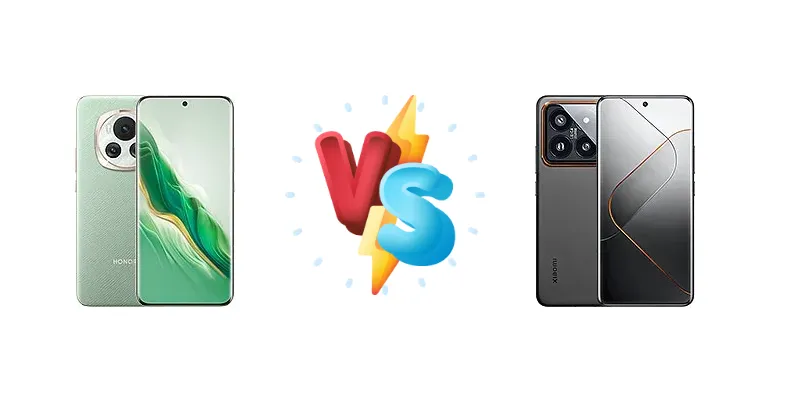
|
🏆 Quick Verdict
For the average user prioritizing speed and convenience, the Xiaomi 14 Pro is the clear winner. Its 120W wired charging dramatically reduces downtime, and while both phones share the same processor, the Xiaomi’s charging advantage and potentially more refined software experience give it an edge.
| PHONES | ||
|---|---|---|
| Phone Names | Honor Magic6 | Xiaomi 14 Pro |
| Network | ||
|---|---|---|
| 2G bands | GSM 850 / 900 / 1800 / 1900 | GSM 850 / 900 / 1800 / 1900 |
| 3G bands | HSDPA 800 / 850 / 900 / 1700(AWS) / 1900 / 2100 | HSDPA 800 / 850 / 900 / 1700(AWS) / 1900 / 2100 |
| 4G bands | LTE | 1, 3, 4, 5, 7, 8, 18, 19, 26, 28, 34, 38, 39, 40, 41, 42, 48, 66 |
| 5G bands | SA/NSA | 1, 3, 5, 7, 8, 28, 38, 40, 41, 48, 66, 77, 78, 79 SA/NSA |
| Speed | HSPA, LTE, 5G | HSPA, LTE, 5G |
| Technology | GSM / CDMA / HSPA / CDMA2000 / LTE / 5G | GSM / CDMA / HSPA / CDMA2000 / LTE / 5G |
| Launch | ||
|---|---|---|
| Announced | 2024, January 11 | 2023, October 26 |
| Status | Available. Released 2024, January 18 | Available. Released 2023, November 01 |
| Body | ||
|---|---|---|
| Build | Glass front, glass back or silicone polymer back (eco leather) | Glass front, aluminum frame or titanium frame, glass back |
| Dimensions | 161.8 x 75.4 x 8.1 mm (6.37 x 2.97 x 0.32 in) | 161.4 x 75.3 x 8.5 mm |
| SIM | Nano-SIM + Nano-SIM | Nano-SIM + Nano-SIM |
| Weight | 199 g or 206 g (7.02 oz) | 223 g or 230 g (7.87 oz) |
| Display | ||
|---|---|---|
| Protection | Jurhino glass | Shatterproof glass |
| Resolution | 1264 x 2800 pixels (~453 ppi density) | 1440 x 3200 pixels, 20:9 ratio (~522 ppi density) |
| Size | 6.78 inches, 111.2 cm2 (~91.2% screen-to-body ratio) | 6.73 inches, 108.9 cm2 (~89.6% screen-to-body ratio) |
| Type | LTPO OLED, 1B colors, 120Hz, HDR, 1600 nits (HBM), 5000 nits (peak) | LTPO AMOLED, 68B colors, 120Hz, Dolby Vision, HDR10+, 3000 nits (peak) |
| Platform | ||
|---|---|---|
| CPU | Octa-core (1x3.3 GHz Cortex-X4 & 3x3.2 GHz Cortex-A720 & 2x3.0 GHz Cortex-A720 & 2x2.3 GHz Cortex-A520) | Octa-core (1x3.3 GHz Cortex-X4 & 3x3.2 GHz Cortex-A720 & 2x3.0 GHz Cortex-A720 & 2x2.3 GHz Cortex-A520) |
| Chipset | Qualcomm SM8650-AB Snapdragon 8 Gen 3 (4 nm) | Qualcomm SM8650-AB Snapdragon 8 Gen 3 (4 nm) |
| GPU | Adreno 750 | Adreno 750 |
| OS | Android 14, MagicOS 8 | Android 14, HyperOS |
| Memory | ||
|---|---|---|
| Card slot | No | No |
| Internal | 256GB 12GB RAM, 256GB 16GB RAM, 512GB 16GB RAM | 256GB 12GB RAM, 512GB 16GB RAM, 1TB 16GB RAM |
| Main Camera | ||
|---|---|---|
| Features | Laser AF, color spectrum sensor, LED flash, HDR, panorama | Laser AF, color spectrum sensor, Leica lens, Dual-LED dual-tone flash, HDR, panorama |
| Triple | 50 MP, f/1.9, (wide), 1/1.3", PDAF, OIS 32 MP, f/2.4, (telephoto), PDAF, OIS, 2.5x optical zoom 50 MP, f/2.0, 13mm, 122˚ (ultrawide), 1/2.88", AF | 50 MP, f/1.4-f/4.0, 23mm (wide), 1/1.31", 1.2µm, dual pixel PDAF, OIS 50 MP, f/2.0, 75mm (telephoto), PDAF (10cm - ∞), OIS, 3.2x optical zoom 50 MP, f/2.2, 14mm, 115˚ (ultrawide), AF |
| Video | 4K@30/60fps, 1080p@30/60/120/240fps, gyro-EIS, HDR, 10-bit video | 8K@24fps (HDR), 4K@24/30/60fps (HDR10+, 10-bit Dolby Vision HDR, 10-bit LOG), 1080p@30/60/120/240/960fps, 720p@1920fps, gyro-EIS |
| Selfie camera | ||
|---|---|---|
| Features | - | HDR, panorama |
| Single | 50 MP, f/2.0, 22mm (wide), 1/2.93", AF | 32 MP, f/2.0, 22mm (wide), 0.7µm |
| Video | 4K@30fps, 1080p@30/60fps, gyro-EIS | 4K@30/60fps, 1080p@30/60fps, gyro-EIS |
| Sound | ||
|---|---|---|
| 35mm jack | No | No |
| Loudspeaker | Yes, with stereo speakers | Yes, with stereo speakers |
| Comms | ||
|---|---|---|
| Bluetooth | 5.3, A2DP, LE, aptX HD | 5.4, A2DP, LE, aptX HD, aptX Adaptive |
| Infrared port | Yes | Yes |
| NFC | Yes | Yes |
| Positioning | GPS (L1+L5), GLONASS, BDS (B1I+B1c+B2a), GALILEO (E1+E5a) | GPS (L1+L5), GLONASS (G1), BDS (B1I+B1c+B2a), GALILEO (E1+E5a), QZSS (L1+L5), NavIC (L5) |
| Radio | No | No |
| USB | USB Type-C 2.0, OTG | USB Type-C 3.2 Gen 2, OTG |
| WLAN | Wi-Fi 802.11 a/b/g/n/ac/6/7, dual-band, Wi-Fi Direct | Wi-Fi 802.11 a/b/g/n/ac/6e/7, dual-band, Wi-Fi Direct |
| Features | ||
|---|---|---|
| Sensors | Fingerprint (under display, optical), Face ID, accelerometer, gyro, proximity, compass | Fingerprint (under display, optical), accelerometer, proximity, gyro, compass, barometer |
| Battery | ||
|---|---|---|
| Charging | 66W wired 50W wireless Reverse wireless 5W reverse wired | 120W wired, PD3.0, QC4, 100% in 18 min 50W wireless, 100% in 40 min 10W reverse wireless |
| Type | Li-Po 5450 mAh | Li-Po 4880 mAh |
| Misc | ||
|---|---|---|
| Colors | Black, Green, Blue, Purple, White | Black, Silver, Titanium, Green |
| Models | BVL-AN00 | 23116PN5BC |
| Price | About 570 EUR | About 650 EUR |
Honor Magic6
- Balanced charging options (wired & wireless)
- Potentially more refined software experience (depending on user preference)
- Strong brand reputation for durability
- Slower wired charging compared to Xiaomi 14 Pro
- Lower reverse wired charging speed
Xiaomi 14 Pro
- Industry-leading 120W wired charging
- Faster wireless charging than some competitors
- Potentially more aggressive software features
- MIUI software can be polarizing
- Faster charging may generate more heat
Display Comparison
While both devices are expected to feature high-quality displays, specific details like peak brightness and panel type are missing. However, given the flagship positioning, both will likely employ LTPO AMOLED technology for adaptive refresh rates, maximizing battery efficiency. The absence of display specs makes a direct comparison impossible, but both brands have a history of delivering vibrant and color-accurate panels. Bezels are expected to be minimal on both, contributing to an immersive viewing experience.
Camera Comparison
Without detailed camera specifications, a comprehensive comparison is limited. However, both manufacturers are known for their camera prowess. The focus will likely be on computational photography and image processing algorithms. The absence of sensor size information prevents a direct assessment of low-light performance. We can assume both will feature advanced features like optical image stabilization (OIS) on the main sensor. Ignoring the typical inclusion of low-resolution macro lenses, the quality of the primary camera and ultrawide lens will be the key differentiators.
Performance
Both the Honor Magic6 and Xiaomi 14 Pro utilize the Qualcomm SM8650-AB Snapdragon 8 Gen 3 (4 nm) chipset, featuring an identical CPU configuration: 1x3.3 GHz Cortex-X4, 3x3.2 GHz Cortex-A720, 2x3.0 GHz Cortex-A720, and 2x2.3 GHz Cortex-A520. This means raw processing power will be virtually indistinguishable between the two. Performance will largely depend on thermal management and software optimization. Both devices will likely utilize LPDDR5x RAM, further minimizing performance bottlenecks. The 4nm process node ensures excellent power efficiency, reducing the likelihood of significant throttling during sustained workloads.
Battery Life
The Honor Magic6 offers 66W wired charging, 50W wireless charging, and 5W reverse wired charging. The Xiaomi 14 Pro, however, boasts a significantly faster 120W wired charging capability, achieving a full charge in a claimed 18 minutes. Wireless charging is identical at 50W (40 minutes to full). While the battery capacity isn't specified, the Xiaomi 14 Pro’s charging speed is a substantial advantage for users who frequently need to top up their device quickly. The 10W reverse wireless charging on the Xiaomi 14 Pro also offers slightly more utility than the Honor’s 5W offering.
Buying Guide
Buy the Honor Magic6 if you value a balanced approach to charging, with both fast wired and wireless options, and potentially prefer Honor’s software skin. Buy the Xiaomi 14 Pro if you absolutely need the fastest possible charging speeds and are comfortable with Xiaomi’s MIUI software, prioritizing minimizing time tethered to a wall outlet.