
Honor Magic6 vs vivo X100 Pro: A Deep Dive into Flagship Android Power
| Phones Images | |||||
|---|---|---|---|---|---|
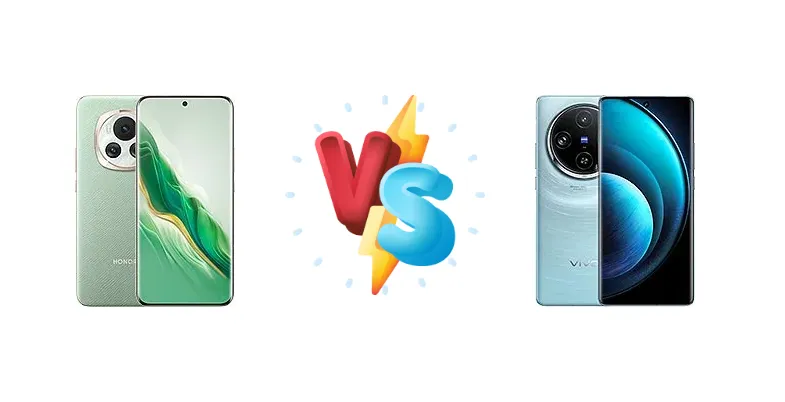
|
🏆 Quick Verdict
For the average user prioritizing sustained performance and a balanced feature set, the Honor Magic6 emerges as the winner. Its Snapdragon 8 Gen 3 offers a proven track record of stability and efficiency, coupled with respectable 66W charging. While the vivo X100 Pro boasts faster 100W charging and impressive battery life, the Dimensity 9300’s thermal profile remains a question mark for extended, intensive tasks.
| PHONES | ||
|---|---|---|
| Phone Names | Honor Magic6 | vivo X100 Pro |
| Network | ||
|---|---|---|
| 2G bands | GSM 850 / 900 / 1800 / 1900 | GSM 850 / 900 / 1800 / 1900 |
| 3G bands | HSDPA 800 / 850 / 900 / 1700(AWS) / 1900 / 2100 | HSDPA 800 / 850 / 900 / 1700(AWS) / 1900 / 2100 |
| 4G bands | LTE | 1, 2, 3, 4, 5, 7, 8, 12, 17, 18, 19, 20, 26, 28, 32, 38, 39, 40, 41, 42, 66 - International |
| 5G bands | SA/NSA | 1, 3, 5, 7, 8, 20, 28, 38, 40, 41, 66, 75, 77, 78, 79 SA/NSA - International |
| Speed | HSPA, LTE, 5G | HSPA, LTE, 5G |
| Technology | GSM / CDMA / HSPA / CDMA2000 / LTE / 5G | GSM / CDMA / HSPA / LTE / 5G |
| Launch | ||
|---|---|---|
| Announced | 2024, January 11 | 2023, November 13 |
| Status | Available. Released 2024, January 18 | Available. Released 2023, November 21 |
| Body | ||
|---|---|---|
| Build | Glass front, glass back or silicone polymer back (eco leather) | Glass front, aluminum frame, glass back |
| Dimensions | 161.8 x 75.4 x 8.1 mm (6.37 x 2.97 x 0.32 in) | 164.1 x 75.3 x 8.9 mm or 9.1 mm |
| SIM | Nano-SIM + Nano-SIM | · Nano-SIM + eSIM· Nano-SIM + Nano-SIM |
| Weight | 199 g or 206 g (7.02 oz) | 221 g or 225 g (7.80 oz) |
| Display | ||
|---|---|---|
| Protection | Jurhino glass | - |
| Resolution | 1264 x 2800 pixels (~453 ppi density) | 1260 x 2800 pixels, 20:9 ratio (~452 ppi density) |
| Size | 6.78 inches, 111.2 cm2 (~91.2% screen-to-body ratio) | 6.78 inches, 111.5 cm2 (~90.2% screen-to-body ratio) |
| Type | LTPO OLED, 1B colors, 120Hz, HDR, 1600 nits (HBM), 5000 nits (peak) | LTPO AMOLED, 1B colors, 120Hz, HDR10+, 3000 nits (peak) |
| Platform | ||
|---|---|---|
| CPU | Octa-core (1x3.3 GHz Cortex-X4 & 3x3.2 GHz Cortex-A720 & 2x3.0 GHz Cortex-A720 & 2x2.3 GHz Cortex-A520) | Octa-core (1x3.25 GHz Cortex-X4 & 3x2.85 GHz Cortex-X4 & 4x2.0 GHz Cortex-A720) |
| Chipset | Qualcomm SM8650-AB Snapdragon 8 Gen 3 (4 nm) | Mediatek Dimensity 9300 (4 nm) |
| GPU | Adreno 750 | Immortalis-G720 MC12 |
| OS | Android 14, MagicOS 8 | Android 14, upgradable to Android 15, Funtouch 15 (International), OriginOS 4 (China) |
| Memory | ||
|---|---|---|
| Card slot | No | No |
| Internal | 256GB 12GB RAM, 256GB 16GB RAM, 512GB 16GB RAM | 256GB 12GB RAM, 256GB 16GB RAM, 512GB 16GB RAM, 1TB 16GB RAM |
| Main Camera | ||
|---|---|---|
| Features | Laser AF, color spectrum sensor, LED flash, HDR, panorama | Laser AF, color spectrum sensor, Zeiss optics, Zeiss T* lens coating, LED flash, panorama, HDR, 3D LUT import |
| Triple | 50 MP, f/1.9, (wide), 1/1.3", PDAF, OIS 32 MP, f/2.4, (telephoto), PDAF, OIS, 2.5x optical zoom 50 MP, f/2.0, 13mm, 122˚ (ultrawide), 1/2.88", AF | 50 MP, f/1.8, 23mm (wide), 1/0.98", 1.6µm, dual pixel PDAF, OIS 50 MP, f/2.5, 100mm (periscope telephoto), 1/2.51", 0.7µm, PDAF (18cm - ∞), OIS, 4.3x optical zoom 50 MP, f/2.0, 15mm, 119˚ (ultrawide), 1/2.76", 0.64µm, AF |
| Video | 4K@30/60fps, 1080p@30/60/120/240fps, gyro-EIS, HDR, 10-bit video | 8K@30fps, 4K@30/60fps, 1080p, gyro-EIS |
| Selfie camera | ||
|---|---|---|
| Features | - | HDR |
| Single | 50 MP, f/2.0, 22mm (wide), 1/2.93", AF | 32 MP, f/2.0, 20mm (ultrawide) |
| Video | 4K@30fps, 1080p@30/60fps, gyro-EIS | 4K@30/60fps, 1080p@30/60fps |
| Sound | ||
|---|---|---|
| 35mm jack | No | No |
| Loudspeaker | Yes, with stereo speakers | Yes, with stereo speakers |
| Comms | ||
|---|---|---|
| Bluetooth | 5.3, A2DP, LE, aptX HD | 5.4, A2DP, LE, aptX HD, LHDC |
| Infrared port | Yes | Yes |
| NFC | Yes | Yes |
| Positioning | GPS (L1+L5), GLONASS, BDS (B1I+B1c+B2a), GALILEO (E1+E5a) | GPS (L1+L5), GLONASS (L1), BDS (B1I+B1c+B2a+B2b), GALILEO (E1+E5a+E5b), QZSS (L1+L5), NavIC (L5) |
| Radio | No | No |
| USB | USB Type-C 2.0, OTG | USB Type-C 3.2, OTG |
| WLAN | Wi-Fi 802.11 a/b/g/n/ac/6/7, dual-band, Wi-Fi Direct | Wi-Fi 802.11 a/b/g/n/ac/6/7, tri-band, Wi-Fi Direct |
| Features | ||
|---|---|---|
| Sensors | Fingerprint (under display, optical), Face ID, accelerometer, gyro, proximity, compass | Fingerprint (under display, optical), accelerometer, gyro, proximity, compass |
| Battery | ||
|---|---|---|
| Charging | 66W wired 50W wireless Reverse wireless 5W reverse wired | 100W wired, 50% in 14 min 50W wireless Reverse wired |
| Type | Li-Po 5450 mAh | Li-Ion 5400 mAh |
| Misc | ||
|---|---|---|
| Colors | Black, Green, Blue, Purple, White | Startrail Blue, Asteroid Black, Sunset Orange, White |
| Models | BVL-AN00 | V2324A, V2309 |
| Price | About 570 EUR | ₹ 59,999 |
| SAR EU | - | 0.99 W/kg (head) 1.19 W/kg (body) |
Honor Magic6
- Proven Snapdragon 8 Gen 3 performance
- Potentially better thermal management
- Qualcomm Adreno GPU for gaming
- Slower 66W charging
- Missing display brightness data
vivo X100 Pro
- Ultra-fast 100W charging
- Excellent battery life (13:53h active use)
- High peak display brightness (1472 nits)
- Dimensity 9300 thermal concerns
- Potential for throttling under sustained load
Display Comparison
The vivo X100 Pro immediately stands out with its measured peak brightness of 1472 nits, suggesting superior visibility in direct sunlight compared to the Honor Magic6 (brightness data unavailable). Both devices likely employ LTPO panels for adaptive refresh rates, conserving battery life. Without specific refresh rate data for the Magic6, it’s difficult to assess the smoothness of scrolling and animations. Color accuracy and calibration will be crucial differentiators, requiring in-depth testing beyond the provided specs.
Camera Comparison
Detailed camera specs are missing, but the focus should be on the main sensor and image processing. The vivo X100 Pro’s camera is highlighted, suggesting a strong emphasis on photographic capabilities. Sensor size, aperture, and Optical Image Stabilization (OIS) are critical factors. Without knowing these details, it’s impossible to definitively declare a winner. However, the X100 Pro’s marketing suggests a focus on computational photography and low-light performance. The Honor Magic6’s camera system remains largely unknown, making a direct comparison challenging. We can safely assume both will offer a range of shooting modes, but image quality will ultimately depend on the sensor and software tuning.
Performance
The core battle lies between the Qualcomm Snapdragon 8 Gen 3 in the Honor Magic6 and the MediaTek Dimensity 9300 in the vivo X100 Pro. Both are fabricated on a 4nm process, but their architectural differences are significant. The Snapdragon 8 Gen 3 utilizes a 1+3+2+2 core configuration, with a prime Cortex-X4 clocked at 3.3 GHz, while the Dimensity 9300 employs a 1+3+4 configuration, featuring *three* Cortex-X4 cores at 2.85 GHz. This suggests the Dimensity 9300 may excel in multi-threaded workloads, but the Snapdragon’s more efficient core arrangement could provide better sustained performance. The Magic6’s Snapdragon benefits from Qualcomm’s Adreno GPU, a known quantity for gaming, while the Dimensity 9300’s Immortalis-G720 MP12 GPU is newer and its real-world performance is still being evaluated. Thermal management will be key; the Dimensity 9300’s higher core count could lead to increased heat generation.
Battery Life
The vivo X100 Pro boasts a significant advantage in charging speed with its 100W wired charging, capable of reaching 50% charge in just 14 minutes. The Honor Magic6’s 66W charging is considerably slower. Both support 50W wireless charging and reverse wireless/wired charging. The X100 Pro’s active use score of 13:53h indicates excellent battery life, suggesting efficient power management. While the Magic6’s battery capacity is unknown, the Snapdragon 8 Gen 3’s efficiency could help it compete, but the X100 Pro’s faster charging and proven endurance give it a clear edge.
Buying Guide
Buy the Honor Magic6 if you need a consistently powerful device for gaming, demanding applications, and value a well-rounded experience with a focus on thermal management. Buy the vivo X100 Pro if you prioritize exceptional battery life, the fastest possible charging speeds, and are willing to potentially manage thermal throttling during prolonged heavy use. The X100 Pro also appeals to users heavily invested in the vivo ecosystem.