
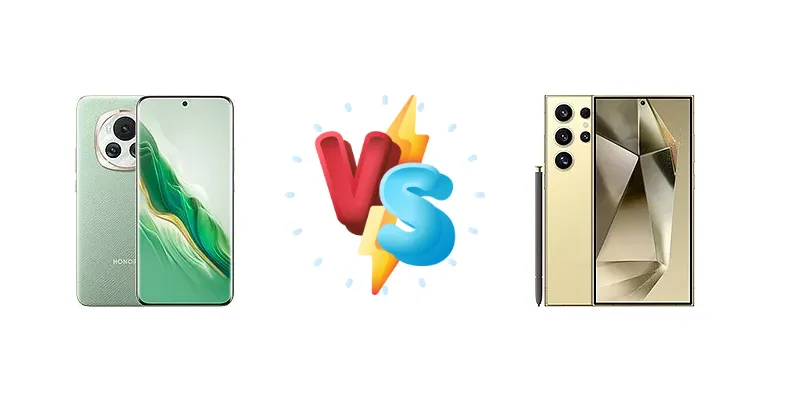
Honor Magic6 vs Samsung Galaxy S24 Ultra: A Deep Dive into Flagship Performance
| Phones Images | |||||
|---|---|---|---|---|---|
|
🏆 Quick Verdict
For the average user prioritizing all-around excellence, the Samsung Galaxy S24 Ultra emerges as the stronger contender. Its superior battery life, brighter display, and refined software experience outweigh the Honor Magic6’s faster charging capabilities. However, the Magic6 presents a compelling alternative for those prioritizing rapid power-ups.
| PHONES | ||
|---|---|---|
| Phone Names | Honor Magic6 | Samsung Galaxy S24 Ultra |
| Network | ||
|---|---|---|
| 2G bands | GSM 850 / 900 / 1800 / 1900 | GSM 850 / 900 / 1800 / 1900 |
| 3G bands | HSDPA 800 / 850 / 900 / 1700(AWS) / 1900 / 2100 | HSDPA 850 / 900 / 1700(AWS) / 1900 / 2100 |
| 4G bands | LTE | 1, 2, 3, 4, 5, 7, 8, 12, 13, 17, 18, 19, 20, 25, 26, 28, 32, 38, 39, 40, 41, 66 - International |
| 5G bands | SA/NSA | 1, 2, 3, 5, 7, 8, 12, 20, 25, 26, 28, 38, 40, 41, 66, 75, 77, 78 SA/NSA/Sub6 - International |
| Speed | HSPA, LTE, 5G | HSPA, LTE (up to 7CA), 5G |
| Technology | GSM / CDMA / HSPA / CDMA2000 / LTE / 5G | GSM / CDMA / HSPA / EVDO / LTE / 5G |
| Launch | ||
|---|---|---|
| Announced | 2024, January 11 | 2024, January 17 |
| Status | Available. Released 2024, January 18 | Available. Released 2024, January 24 |
| Body | ||
|---|---|---|
| Build | Glass front, glass back or silicone polymer back (eco leather) | Glass front (Corning Gorilla Armor), glass back (Corning Gorilla Armor), titanium frame (grade 2) |
| Dimensions | 161.8 x 75.4 x 8.1 mm (6.37 x 2.97 x 0.32 in) | 162.3 x 79 x 8.6 mm (6.39 x 3.11 x 0.34 in) |
| SIM | Nano-SIM + Nano-SIM | · Nano-SIM + Nano-SIM + eSIM + eSIM (max 2 at a time) - INT· Nano-SIM + eSIM + eSIM (max 2 at a time) - USA· Nano-SIM + Nano-SIM - CN |
| Weight | 199 g or 206 g (7.02 oz) | 232 g or 233 g (8.18 oz) |
| Display | ||
|---|---|---|
| Protection | Jurhino glass | Corning Gorilla Armor |
| Resolution | 1264 x 2800 pixels (~453 ppi density) | 1440 x 3120 pixels, 19.5:9 ratio (~505 ppi density) |
| Size | 6.78 inches, 111.2 cm2 (~91.2% screen-to-body ratio) | 6.8 inches, 113.5 cm2 (~88.5% screen-to-body ratio) |
| Type | LTPO OLED, 1B colors, 120Hz, HDR, 1600 nits (HBM), 5000 nits (peak) | Dynamic LTPO AMOLED 2X, 120Hz, HDR10+, 2600 nits (peak) |
| Platform | ||
|---|---|---|
| CPU | Octa-core (1x3.3 GHz Cortex-X4 & 3x3.2 GHz Cortex-A720 & 2x3.0 GHz Cortex-A720 & 2x2.3 GHz Cortex-A520) | 8-core (1x3.39GHz Cortex-X4 & 3x3.1GHz Cortex-A720 & 2x2.9GHz Cortex-A720 & 2x2.2GHz Cortex-A520) |
| Chipset | Qualcomm SM8650-AB Snapdragon 8 Gen 3 (4 nm) | Qualcomm SM8650-AC Snapdragon 8 Gen 3 (4 nm) |
| GPU | Adreno 750 | Adreno 750 (1 GHz) |
| OS | Android 14, MagicOS 8 | Android 14, up to 7 major Android upgrades, One UI 8.0 |
| Memory | ||
|---|---|---|
| Card slot | No | No |
| Internal | 256GB 12GB RAM, 256GB 16GB RAM, 512GB 16GB RAM | 256GB 12GB RAM, 512GB 12GB RAM, 1TB 12GB RAM |
| Main Camera | ||
|---|---|---|
| Features | Laser AF, color spectrum sensor, LED flash, HDR, panorama | Laser AF, LED flash, auto-HDR, panorama |
| Quad | - | 200 MP, f/1.7, 24mm (wide), 1/1.3", 0.6µm, multi-directional PDAF, OIS 10 MP, f/2.4, 67mm (telephoto), 1/3.52", 1.12µm, PDAF, OIS, 3x optical zoom 50 MP, f/3.4, 111mm (periscope telephoto), 1/2.52", 0.7µm, PDAF, OIS, 5x optical zoom 12 MP, f/2.2, 13mm, 120˚ (ultrawide), 1/2.55", 1.4µm, dual pixel PDAF, Super Steady video |
| Triple | 50 MP, f/1.9, (wide), 1/1.3", PDAF, OIS 32 MP, f/2.4, (telephoto), PDAF, OIS, 2.5x optical zoom 50 MP, f/2.0, 13mm, 122˚ (ultrawide), 1/2.88", AF | - |
| Video | 4K@30/60fps, 1080p@30/60/120/240fps, gyro-EIS, HDR, 10-bit video | 8K@24/30fps, 4K@30/60/120fps, 1080p@30/60/120/240fps, HDR10+, stereo sound rec., gyro-EIS |
| Selfie camera | ||
|---|---|---|
| Features | - | HDR, HDR10+ |
| Single | 50 MP, f/2.0, 22mm (wide), 1/2.93", AF | 12 MP, f/2.2, 26mm (wide), 1/3.2", 1.12µm, dual pixel PDAF |
| Video | 4K@30fps, 1080p@30/60fps, gyro-EIS | 4K@30/60fps, 1080p@30fps |
| Sound | ||
|---|---|---|
| 35mm jack | No | No |
| Loudspeaker | Yes, with stereo speakers | Yes, with stereo speakers |
| Comms | ||
|---|---|---|
| Bluetooth | 5.3, A2DP, LE, aptX HD | 5.3, A2DP, LE |
| Infrared port | Yes | - |
| NFC | Yes | Yes |
| Positioning | GPS (L1+L5), GLONASS, BDS (B1I+B1c+B2a), GALILEO (E1+E5a) | GPS, GLONASS, BDS, GALILEO, QZSS |
| Radio | No | No |
| USB | USB Type-C 2.0, OTG | USB Type-C 3.2, DisplayPort 1.2, OTG |
| WLAN | Wi-Fi 802.11 a/b/g/n/ac/6/7, dual-band, Wi-Fi Direct | Wi-Fi 802.11 a/b/g/n/ac/6e/7, tri-band, Wi-Fi Direct |
| Features | ||
|---|---|---|
| Sensors | Fingerprint (under display, optical), Face ID, accelerometer, gyro, proximity, compass | Fingerprint (under display, ultrasonic), accelerometer, gyro, proximity, compass, barometer |
| Battery | ||
|---|---|---|
| Charging | 66W wired 50W wireless Reverse wireless 5W reverse wired | 45W wired, PD3.0, 65% in 30 min 15W wireless (Qi) 4.5W reverse wireless |
| Type | Li-Po 5450 mAh | Li-Ion 5000 mAh |
| Misc | ||
|---|---|---|
| Colors | Black, Green, Blue, Purple, White | Titanium Black, Titanium Gray, Titanium Violet, Titanium Yellow, Titanium Blue, Titanium Green, Titanium Orange |
| Models | BVL-AN00 | SM-S928B, SM-S928B/DS, SM-S928U, SM-S928U1, SM-S928W, SM-S928N, SM-S9280, SM-S928E, SM-S928E/DS |
| Price | About 570 EUR | $ 514.94 / C$ 929.99 / £ 630.00 / € 658.53 / ₹ 84,999 |
| SAR | - | 1.26 W/kg (head) 0.62 W/kg (body) |
| SAR EU | - | 1.06 W/kg (head) 1.30 W/kg (body) |
Honor Magic6
- Significantly faster 66W wired charging
- Faster 50W wireless charging
- Potential for more aggressive pricing
- Battery life is unknown and likely less than S24 Ultra
- Camera details are limited, making a direct comparison difficult
Samsung Galaxy S24 Ultra
- Exceptional 13:49h battery life
- Brighter and more color-accurate display (1447 nits)
- Refined software experience and feature set
- Slower 45W wired charging
- Slower 15W wireless charging
Display Comparison
The Samsung Galaxy S24 Ultra boasts a significantly brighter display, reaching a measured 1447 nits, compared to an unstated peak brightness for the Honor Magic6. While both likely utilize LTPO technology for adaptive refresh rates, Samsung’s panel offers superior visibility in direct sunlight. The S24 Ultra’s display is also known for its excellent color accuracy, crucial for photo and video editing. The Honor Magic6’s display quality, while likely very good, remains less defined without specific brightness and color gamut data.
Camera Comparison
Detailed camera analysis is hampered by a lack of specific sensor information for the Honor Magic6. The Galaxy S24 Ultra is renowned for its versatile camera system, featuring a high-resolution main sensor and advanced image processing. While the Magic6 likely offers a competitive camera experience, Samsung’s established expertise in computational photography and video stabilization gives it an edge. The absence of details regarding the Magic6’s OIS and lens apertures makes a direct comparison difficult, but the S24 Ultra’s system is known for its exceptional low-light performance and dynamic range.
Performance
Both devices are equipped with the Qualcomm Snapdragon 8 Gen 3 (4nm), but subtle CPU clock speed differences exist. The S24 Ultra’s CPU peaks at 3.39 GHz, slightly higher than the Magic6’s 3.3 GHz. While this difference is unlikely to be noticeable in most everyday tasks, it could translate to marginal gains in sustained performance during demanding workloads. Both utilize a similar core configuration (1x Cortex-X4, 3x Cortex-A720, 2x Cortex-A720, 2x Cortex-A520). Thermal management will be key; the S24 Ultra’s larger chassis may offer better heat dissipation, potentially mitigating throttling during extended gaming sessions.
Battery Life
The Samsung Galaxy S24 Ultra demonstrates a clear advantage in battery endurance, achieving 13 hours and 49 minutes of active use. The Honor Magic6’s battery capacity is not specified, but its 66W wired charging significantly outpaces the S24 Ultra’s 45W charging. The Magic6 also offers 50W wireless charging, compared to the S24 Ultra’s 15W wireless charging. While the S24 Ultra’s battery lasts longer, the Magic6 can replenish its battery much faster, offering a different trade-off for users with varying priorities. The Magic6 also offers 5W reverse wired charging, a feature not present on the S24 Ultra.
Buying Guide
Buy the Honor Magic6 if you absolutely need the fastest charging speeds available and value a potentially more aggressive price point. It’s ideal for users constantly on the move who can’t afford downtime. Buy the Samsung Galaxy S24 Ultra if you prioritize long-lasting battery life, a brighter and more color-accurate display, and a more polished, feature-rich software ecosystem. It’s the better choice for power users and content creators.