
Honor Magic6 vs Oppo Find X7 Ultra: A Deep Dive into Snapdragon 8 Gen 3 Flagships
| Phones Images | |||||
|---|---|---|---|---|---|
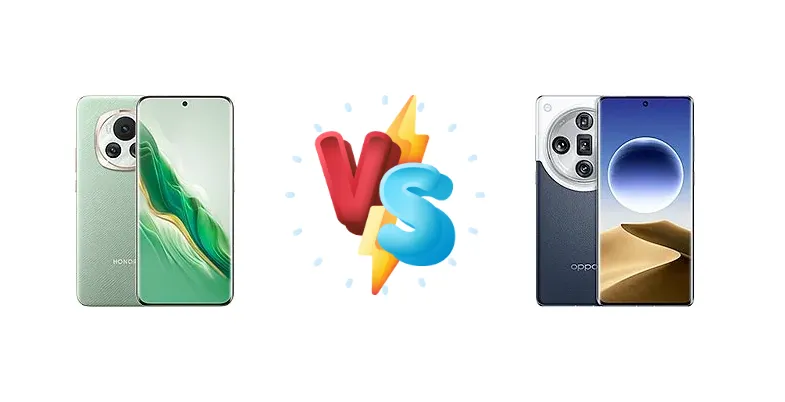
|
🏆 Quick Verdict
For users prioritizing the fastest possible charging and a slightly longer active use battery life, the Oppo Find X7 Ultra is the clear winner. Its 100W wired charging significantly outperforms the Honor Magic6’s 66W, and the 12:47h active use score demonstrates superior endurance.
| PHONES | ||
|---|---|---|
| Phone Names | Honor Magic6 | Oppo Find X7 Ultra |
| Network | ||
|---|---|---|
| 2G bands | GSM 850 / 900 / 1800 / 1900 | GSM 850 / 900 / 1800 / 1900 |
| 3G bands | HSDPA 800 / 850 / 900 / 1700(AWS) / 1900 / 2100 | HSDPA 800 / 850 / 900 / 1700(AWS) / 1900 / 2100 |
| 4G bands | LTE | 1, 2, 3, 4, 5, 7, 8, 12, 17, 18, 19, 20, 26, 28, 34, 38, 39, 40, 41, 66 |
| 5G bands | SA/NSA | 1, 2, 3, 5, 7, 8, 20, 28, 38, 40, 41, 66, 77, 78, 79 SA/NSA |
| Speed | HSPA, LTE, 5G | HSPA, LTE, 5G |
| Technology | GSM / CDMA / HSPA / CDMA2000 / LTE / 5G | GSM / CDMA / HSPA / CDMA2000 / LTE / 5G |
| Launch | ||
|---|---|---|
| Announced | 2024, January 11 | 2024, January 08 |
| Status | Available. Released 2024, January 18 | Available. Released 2024, January 12 |
| Body | ||
|---|---|---|
| Build | Glass front, glass back or silicone polymer back (eco leather) | Glass front (Gorilla Glass Victus 2), glass back (Gorilla Glass) or eco leather back, aluminum frame |
| Dimensions | 161.8 x 75.4 x 8.1 mm (6.37 x 2.97 x 0.32 in) | 164.3 x 76.2 x 9.5 mm (6.47 x 3.00 x 0.37 in) |
| SIM | Nano-SIM + Nano-SIM | Nano-SIM + Nano-SIM |
| Weight | 199 g or 206 g (7.02 oz) | 221 g (7.80 oz) |
| Display | ||
|---|---|---|
| Protection | Jurhino glass | Corning Gorilla Glass Victus 2 |
| Resolution | 1264 x 2800 pixels (~453 ppi density) | 1440 x 3168 pixels (~510 ppi density) |
| Size | 6.78 inches, 111.2 cm2 (~91.2% screen-to-body ratio) | 6.82 inches, 113.0 cm2 (~90.3% screen-to-body ratio) |
| Type | LTPO OLED, 1B colors, 120Hz, HDR, 1600 nits (HBM), 5000 nits (peak) | LTPO AMOLED, 1B colors, 120Hz, Dolby Vision, HDR10+, 1600 nits (typ), 2600 nits (HBM), 4500 nits (peak) |
| Platform | ||
|---|---|---|
| CPU | Octa-core (1x3.3 GHz Cortex-X4 & 3x3.2 GHz Cortex-A720 & 2x3.0 GHz Cortex-A720 & 2x2.3 GHz Cortex-A520) | Octa-core (1x3.3 GHz Cortex-X4 & 3x3.2 GHz Cortex-A720 & 2x3.0 GHz Cortex-A720 & 2x2.3 GHz Cortex-A520) |
| Chipset | Qualcomm SM8650-AB Snapdragon 8 Gen 3 (4 nm) | Qualcomm SM8650-AB Snapdragon 8 Gen 3 (4 nm) |
| GPU | Adreno 750 | Adreno 750 |
| OS | Android 14, MagicOS 8 | Android 14, up to 4 major Android upgrades, ColorOS 14 |
| Memory | ||
|---|---|---|
| Card slot | No | No |
| Internal | 256GB 12GB RAM, 256GB 16GB RAM, 512GB 16GB RAM | 256GB 12GB RAM, 256GB 16GB RAM, 512GB 16GB RAM |
| Main Camera | ||
|---|---|---|
| Features | Laser AF, color spectrum sensor, LED flash, HDR, panorama | Laser AF, color spectrum sensor, Hasselblad Color Calibration, LED flash, HDR, panorama |
| Quad | - | 50 MP, f/1.8, 23mm (wide), 1.0"-type, 1.6µm, dual pixel PDAF, OIS 50 MP, f/2.6, 65mm (periscope telephoto), 1/1.56", 1.0µm, 2.8x optical zoom, multi-directional PDAF (25cm - ∞), OIS 50 MP, f/4.3, 135mm (periscope telephoto), 1/2.51", 0.7µm, 6x optical zoom, dual pixel PDAF (35cm - ∞), OIS 50 MP, f/2.0, 14mm, 123˚ (ultrawide), 1/1.95", 1.0µm, PDAF |
| Triple | 50 MP, f/1.9, (wide), 1/1.3", PDAF, OIS 32 MP, f/2.4, (telephoto), PDAF, OIS, 2.5x optical zoom 50 MP, f/2.0, 13mm, 122˚ (ultrawide), 1/2.88", AF | - |
| Video | 4K@30/60fps, 1080p@30/60/120/240fps, gyro-EIS, HDR, 10-bit video | 4K@30/60fps, 1080p@30/60/240fps; gyro-EIS; HDR, 10‑bit video, Dolby Vision |
| Selfie camera | ||
|---|---|---|
| Features | - | Panorama |
| Single | 50 MP, f/2.0, 22mm (wide), 1/2.93", AF | 32 MP, f/2.4, 21mm (wide), 1/2.74", 0.8µm, PDAF |
| Video | 4K@30fps, 1080p@30/60fps, gyro-EIS | 4K@30/60fps, 1080p@30fps, gyro-EIS |
| Sound | ||
|---|---|---|
| 35mm jack | No | No |
| Loudspeaker | Yes, with stereo speakers | Yes, with stereo speakers |
| Comms | ||
|---|---|---|
| Bluetooth | 5.3, A2DP, LE, aptX HD | 5.4, A2DP, LE, aptX HD, LHDC |
| Infrared port | Yes | Yes |
| NFC | Yes | Yes |
| Positioning | GPS (L1+L5), GLONASS, BDS (B1I+B1c+B2a), GALILEO (E1+E5a) | GPS (L1+L5), BDS (B1I+B1c+B2a), GALILEO (E1+E5a), QZSS (L1+L5), GLONASS |
| Radio | No | No |
| USB | USB Type-C 2.0, OTG | USB Type-C 3.2, OTG |
| WLAN | Wi-Fi 802.11 a/b/g/n/ac/6/7, dual-band, Wi-Fi Direct | Wi-Fi 802.11 a/b/g/n/ac/6e/7, dual-band, Wi-Fi Direct |
| Features | ||
|---|---|---|
| Sensors | Fingerprint (under display, optical), Face ID, accelerometer, gyro, proximity, compass | Fingerprint (under display, optical), accelerometer, gyro, proximity, compass |
| Battery | ||
|---|---|---|
| Charging | 66W wired 50W wireless Reverse wireless 5W reverse wired | 100W wired, PD, 50% in 10 min, 100% in 26 min 50W wireless 10W reverse wireless |
| Type | Li-Po 5450 mAh | 5000 mAh |
| Misc | ||
|---|---|---|
| Colors | Black, Green, Blue, Purple, White | Black, Dark Blue, Light Brown |
| Models | BVL-AN00 | PHY110, PHY120 |
| Price | About 570 EUR | $ 546.64 |
Honor Magic6
- Potentially more affordable price point (speculation)
- Snapdragon 8 Gen 3 performance
- Robust feature set (anticipated)
- Slower 66W wired charging
- Unknown battery life performance
- Limited camera information available
Oppo Find X7 Ultra
- 100W SuperVOOC charging for rapid top-ups
- Excellent 12:47h active use battery life
- High peak brightness display (1165 nits)
- Likely higher price tag
- Potential for software bloat (Oppo's history)
- Camera details still emerging
Display Comparison
While both devices utilize high-end displays, the Oppo Find X7 Ultra boasts a measured peak brightness of 1165 nits, suggesting a more vibrant and readable experience in direct sunlight. The Honor Magic6’s display specifications are currently unavailable, making a direct comparison difficult. However, given Oppo’s focus on display technology, the X7 Ultra likely offers a slight advantage in visual clarity and outdoor visibility. We anticipate both will feature high refresh rate panels, but the X7 Ultra’s brightness is a quantifiable advantage.
Camera Comparison
Camera details for the Honor Magic6 are currently unavailable. The Oppo Find X7 Ultra is expected to feature a sophisticated camera system, though specific sensor details are lacking. Without knowing the sensor sizes, apertures, and image processing algorithms of the Magic6, it’s impossible to make a definitive camera comparison. However, Oppo’s history suggests a focus on computational photography and high-resolution sensors, potentially giving the X7 Ultra an edge in image quality and versatility. We will need to see detailed camera samples from the Magic6 to assess its capabilities.
Performance
Both the Honor Magic6 and Oppo Find X7 Ultra are equipped with the Qualcomm SM8650-AB Snapdragon 8 Gen 3 (4 nm) chipset, featuring an identical CPU configuration: 1x3.3 GHz Cortex-X4, 3x3.2 GHz Cortex-A720, 2x3.0 GHz Cortex-A720, and 2x2.3 GHz Cortex-A520. This means raw processing power will be nearly indistinguishable between the two. Performance differences will likely stem from thermal management and software optimization. The 4nm process node ensures efficient power consumption, minimizing throttling during sustained workloads. RAM specifications are currently unknown for both devices, but LPDDR5x is expected, further enhancing performance.
Battery Life
The Oppo Find X7 Ultra demonstrates a clear advantage in battery performance, achieving an active use score of 12:47h. The Honor Magic6’s battery capacity and active use score are currently unknown. However, the X7 Ultra’s charging capabilities are significantly superior, offering 100W wired charging (0-100% in 26 minutes) compared to the Magic6’s 66W. Both support 50W wireless charging, but the X7 Ultra’s faster wired charging provides a more convenient and rapid power-up option. The 10W reverse wireless charging on the X7 Ultra also slightly exceeds the Magic6’s 5W offering.
Buying Guide
Buy the Honor Magic6 if you value a balanced package with competitive performance and a robust feature set, and aren't overly concerned with having the absolute fastest charging speeds. Buy the Oppo Find X7 Ultra if you are a power user who demands the quickest top-ups and extended battery life, and are willing to pay a premium for that convenience. The X7 Ultra caters to those who frequently find themselves needing to rapidly replenish their battery throughout the day.