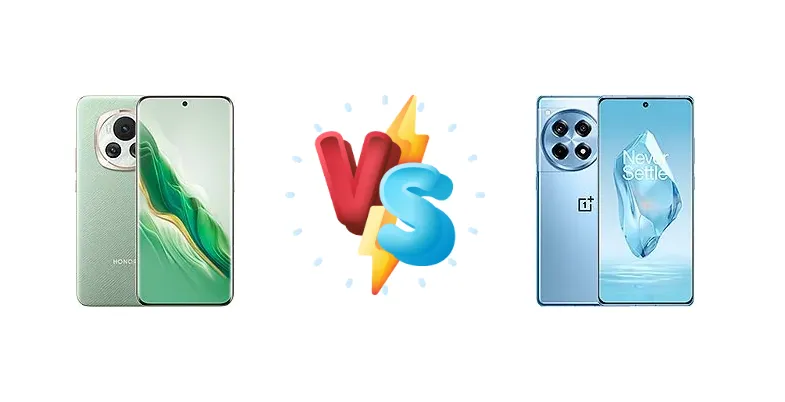
The Honor Magic6 arrives with the cutting-edge Snapdragon 8 Gen 3, aiming to redefine the flagship experience. However, the OnePlus 12R, powered by the still-potent Snapdragon 8 Gen 2 and boasting incredibly fast 100W charging, presents a strong challenge. This comparison dissects the key differences to determine which phone delivers the best value and performance for your needs.
🏆 Quick Verdict
For users prioritizing raw processing power and future-proofing, the Honor Magic6 is the clear winner thanks to its Snapdragon 8 Gen 3. However, the OnePlus 12R offers a remarkably balanced package with excellent battery life, blazing-fast charging, and strong performance at a potentially lower price point, making it the better choice for most users.
| Network |
|---|
| 2G bands | GSM 850 / 900 / 1800 / 1900 | GSM 850 / 900 / 1800 / 1900 |
| 3G bands | HSDPA 800 / 850 / 900 / 1700(AWS) / 1900 / 2100 | HSDPA 850 / 900 / 1700(AWS) / 1900 / 2100 |
| 4G bands | LTE | 1, 2, 3, 4, 5, 7, 8, 12, 17, 18, 19, 20, 26, 28, 32, 38, 39, 40, 41, 66 |
| 5G bands | SA/NSA | 1, 2, 3, 5, 7, 8, 12, 20, 28, 38, 40, 41, 66, 77, 78 SA/NSA |
| Speed | HSPA, LTE, 5G | HSPA, LTE, 5G |
| Technology | GSM / CDMA / HSPA / CDMA2000 / LTE / 5G | GSM / CDMA / HSPA / LTE / 5G |
| Launch |
|---|
| Announced | 2024, January 11 | 2024, January 23 |
| Status | Available. Released 2024, January 18 | Available. Released 2024, February 06 |
| Body |
|---|
| Build | Glass front, glass back or silicone polymer back (eco leather) | Glass front (Gorilla Glass Victus 2), aluminum frame, glass back |
| Dimensions | 161.8 x 75.4 x 8.1 mm (6.37 x 2.97 x 0.32 in) | 163.3 x 75.3 x 8.8 mm (6.43 x 2.96 x 0.35 in) |
| SIM | Nano-SIM + Nano-SIM | · Nano-SIM + Nano-SIM + eSIM (max 2 at a time)· Nano-SIM + Nano-SIM |
| Weight | 199 g or 206 g (7.02 oz) | 207 g (7.30 oz) |
| Display |
|---|
| Protection | Jurhino glass | Corning Gorilla Glass Victus 2 |
| Resolution | 1264 x 2800 pixels (~453 ppi density) | 1264 x 2780 pixels (~450 ppi density) |
| Size | 6.78 inches, 111.2 cm2 (~91.2% screen-to-body ratio) | 6.78 inches, 111.7 cm2 (~90.9% screen-to-body ratio) |
| Type | LTPO OLED, 1B colors, 120Hz, HDR, 1600 nits (HBM), 5000 nits (peak) | LTPO4 AMOLED, 1B colors, 120Hz, HDR10+, Dolby Vision, 1600 nits (HBM), 4500 nits (peak) |
| Platform |
|---|
| CPU | Octa-core (1x3.3 GHz Cortex-X4 & 3x3.2 GHz Cortex-A720 & 2x3.0 GHz Cortex-A720 & 2x2.3 GHz Cortex-A520) | Octa-core (1x3.2 GHz Cortex-X3 & 2x2.8 GHz Cortex-A715 & 2x2.8 GHz Cortex-A710 & 3x2.0 GHz Cortex-A510) |
| Chipset | Qualcomm SM8650-AB Snapdragon 8 Gen 3 (4 nm) | Qualcomm SM8550-AB Snapdragon 8 Gen 2 (4 nm) |
| GPU | Adreno 750 | Adreno 740 |
| OS | Android 14, MagicOS 8 | Android 14, up to 3 major Android upgrades, OxygenOS 15 |
| Memory |
|---|
| Card slot | No | No |
| Internal | 256GB 12GB RAM, 256GB 16GB RAM, 512GB 16GB RAM | 128GB 8GB RAM, 256GB 8GB RAM, 256GB 12GB RAM, 256GB 16GB RAM |
| Main Camera |
|---|
| Features | Laser AF, color spectrum sensor, LED flash, HDR, panorama | Laser AF, color spectrum sensor, LED flash, HDR, panorama |
| Triple | 50 MP, f/1.9, (wide), 1/1.3", PDAF, OIS
32 MP, f/2.4, (telephoto), PDAF, OIS, 2.5x optical zoom
50 MP, f/2.0, 13mm, 122˚ (ultrawide), 1/2.88", AF | 50 MP, f/1.8, 24mm (wide), 1/1.56", 1.0µm, multi-directional PDAF, OIS
8 MP, f/2.2, 16mm, 112˚ (ultrawide), 1/4.0", 1.12µm
2 MP (macro) |
| Video | 4K@30/60fps, 1080p@30/60/120/240fps, gyro-EIS, HDR, 10-bit video | 4K@30/60fps, 1080p@30/60/120/240fps, gyro-EIS, OIS |
| Selfie camera |
|---|
| Features | - | HDR, panorama |
| Single | 50 MP, f/2.0, 22mm (wide), 1/2.93", AF | 16 MP, f/2.4, 26mm (wide), 1/3", 1.0µm |
| Video | 4K@30fps, 1080p@30/60fps, gyro-EIS | 1080p@30fps, gyro-EIS |
| Sound |
|---|
| 35mm jack | No | No |
| Loudspeaker | Yes, with stereo speakers | Yes, with stereo speakers |
| Comms |
|---|
| Bluetooth | 5.3, A2DP, LE, aptX HD | 5.3, A2DP, LE, aptX HD |
| Infrared port | Yes | Yes |
| NFC | Yes | Yes |
| Positioning | GPS (L1+L5), GLONASS, BDS (B1I+B1c+B2a), GALILEO (E1+E5a) | GPS, GALILEO, GLONASS, BDS, QZSS |
| Radio | No | No |
| USB | USB Type-C 2.0, OTG | USB Type-C 2.0 |
| WLAN | Wi-Fi 802.11 a/b/g/n/ac/6/7, dual-band, Wi-Fi Direct | Wi-Fi 802.11 a/b/g/n/ac/6/7, dual-band |
| Features |
|---|
| Sensors | Fingerprint (under display, optical), Face ID, accelerometer, gyro, proximity, compass | Fingerprint (under display, optical), accelerometer, gyro, proximity, compass |
| Battery |
|---|
| Charging | 66W wired
50W wireless
Reverse wireless
5W reverse wired | 100W wired, 100% in 26 min |
| Type | Li-Po 5450 mAh | Li-Ion 5500 mAh |
| Misc |
|---|
| Colors | Black, Green, Blue, Purple, White | Iron Gray, Cool Blue, Electric Violet, Sunset Dune |
| Models | BVL-AN00 | CPH2609, CPH2585, CPH2611 |
| Price | About 570 EUR | € 410.84 / $ 399.95 / £ 649.00 |
| SAR | - | 1.19 W/kg (head) 0.82 W/kg (body) |
Honor Magic6
- Latest Snapdragon 8 Gen 3 processor for top-tier performance
- 50W Wireless Charging for convenient power-ups
- Potential for advanced camera features (pending details)
- Slower 66W wired charging compared to the OnePlus 12R
- Limited information available on display and camera specs
OnePlus 12R
- Blazing-fast 100W wired charging (0-100% in 26 minutes)
- Excellent battery life (14:32h active use)
- Proven Snapdragon 8 Gen 2 performance
- Less powerful processor than the Snapdragon 8 Gen 3
- No wireless charging support
Display Comparison
While both devices utilize 4nm chipsets, display details are limited for the Magic6. The OnePlus 12R features a display capable of reaching 1181 nits of peak brightness, ensuring excellent visibility even in direct sunlight. The absence of LTPO technology in the 12R means the refresh rate isn't dynamically adjustable for power saving, but the high brightness is a significant advantage. Without comparable display specs for the Magic6, it's difficult to assess its color accuracy or viewing angles, but Honor typically focuses on color science.
Camera Comparison
Camera details for the Magic6 are currently unavailable, making a direct comparison challenging. However, the OnePlus 12R’s camera system, while not groundbreaking, is competent. The focus should be on the main sensor and its image processing capabilities. Without knowing the sensor size or aperture of the Magic6’s camera, it’s impossible to determine its low-light performance or dynamic range. The 12R’s image processing prioritizes natural colors, while Honor often leans towards more vibrant, saturated images.
Performance
The Honor Magic6’s Snapdragon 8 Gen 3, built on a 4nm process, represents a significant leap over the OnePlus 12R’s Snapdragon 8 Gen 2. The Gen 3’s Cortex-X4 prime core, clocked at 3.3 GHz, offers improved single-core performance compared to the 12R’s 3.2 GHz Cortex-X3. The Magic6 also benefits from a revised CPU architecture with more efficient Cortex-A720 cores. While the Gen 2 in the 12R remains incredibly capable, the Gen 3 provides a noticeable advantage in sustained performance and efficiency, reducing the likelihood of thermal throttling during extended gaming sessions. The 12R’s LPDDR5x RAM is standard for its class, but the Magic6’s RAM configuration is currently unknown.
Battery Life
The OnePlus 12R excels in charging speed with its 100W wired charging, achieving a full charge in just 26 minutes. The Honor Magic6 offers 66W wired charging, significantly slower, and 50W wireless charging, a feature absent on the 12R. The 12R’s active use score of 14:32h demonstrates excellent battery life. While the Magic6’s battery capacity is unknown, the more powerful Snapdragon 8 Gen 3 could potentially consume more power, offsetting any capacity advantage. The 12R also offers 5W reverse wired charging and reverse wireless charging, adding to its versatility.
Buying Guide
Buy the Honor Magic6 if you demand the absolute best performance for demanding tasks like video editing, high-end gaming, and consistently need the latest chipset. Buy the OnePlus 12R if you prioritize a smooth, responsive experience, exceptional battery life with incredibly fast charging, and a more affordable price without sacrificing significant performance.
Frequently Asked Questions
❓ Will the Snapdragon 8 Gen 2 in the OnePlus 12R struggle with demanding games after prolonged use?
The Snapdragon 8 Gen 2 is a highly capable chip and, while it may experience some thermal throttling during extended gaming sessions, the OnePlus 12R’s cooling system is generally effective at mitigating this. Expect consistently high frame rates in most titles, though the Magic6’s Gen 3 will likely maintain higher sustained performance.
❓ How does the 66W charging on the Honor Magic6 compare to the 100W charging on the OnePlus 12R in real-world use?
The 100W charging on the OnePlus 12R is significantly faster, taking just 26 minutes for a full charge. The Honor Magic6’s 66W charging will take considerably longer, likely exceeding 45 minutes to reach 100%. This difference is substantial for users who frequently need to quickly top up their battery.
❓ Does the Honor Magic6 support any form of fast wireless charging?
Yes, the Honor Magic6 supports 50W wireless charging, a feature not available on the OnePlus 12R. This provides a convenient alternative to wired charging, although it will still be slower than the 12R’s 100W wired charging.
❓ What kind of user would benefit most from the Honor Magic6's Snapdragon 8 Gen 3?
The Honor Magic6 is ideal for power users who frequently engage in resource-intensive tasks like video editing, 3D rendering, or playing graphically demanding games. The Snapdragon 8 Gen 3 provides a noticeable performance boost for these workloads.