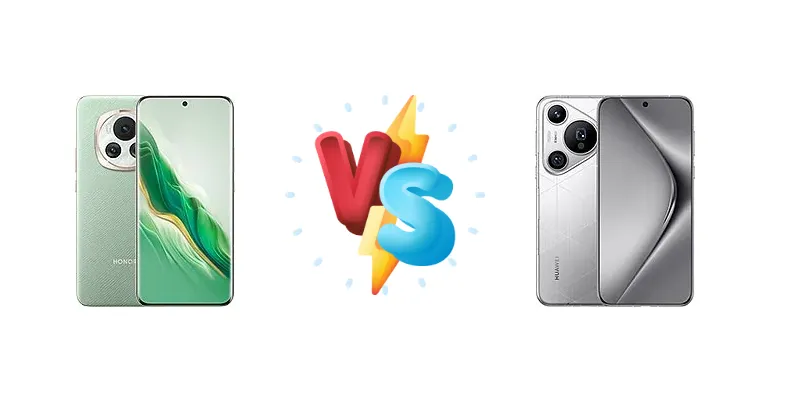
The Honor Magic6 and Huawei Pura 70 Pro+ represent two distinct approaches to the modern flagship smartphone. The Magic6 leverages Qualcomm’s latest silicon, while the Pura 70 Pro+ relies on Huawei’s in-house Kirin 9010. This comparison dissects their core differences, focusing on performance, charging, and camera capabilities to determine which device delivers the best overall experience.
🏆 Quick Verdict
For the average user prioritizing raw performance and gaming, the Honor Magic6 emerges as the stronger contender. Its Snapdragon 8 Gen 3 chipset offers a significant advantage in processing power and efficiency. However, the Huawei Pura 70 Pro+ excels in charging speed and potentially unique software features, making it appealing to loyal Huawei users.
| Network |
|---|
| 2G bands | GSM 850 / 900 / 1800 / 1900 | GSM 850 / 900 / 1800 / 1900 |
| 3G bands | HSDPA 800 / 850 / 900 / 1700(AWS) / 1900 / 2100 | HSDPA 850 / 900 / 1700(AWS) / 1900 / 2100 |
| 4G bands | LTE | LTE |
| 5G bands | SA/NSA | SA/NSA |
| Speed | HSPA, LTE, 5G | HSPA, LTE, 5G |
| Technology | GSM / CDMA / HSPA / CDMA2000 / LTE / 5G | GSM / CDMA / HSPA / CDMA2000 / LTE / 5G |
| Launch |
|---|
| Announced | 2024, January 11 | 2024, April 18 |
| Status | Available. Released 2024, January 18 | Available. Released 2024, April 29 |
| Body |
|---|
| Build | Glass front, glass back or silicone polymer back (eco leather) | Glass front, aluminum frame, silicone polymer back (eco leather) |
| Dimensions | 161.8 x 75.4 x 8.1 mm (6.37 x 2.97 x 0.32 in) | 162.6 x 75.1 x 8.4 mm (6.40 x 2.96 x 0.33 in) |
| SIM | Nano-SIM + Nano-SIM | Nano-SIM + Nano-SIM |
| Weight | 199 g or 206 g (7.02 oz) | 220 g (7.76 oz) |
| Display |
|---|
| Protection | Jurhino glass | Kunlun Glass (Xuanwu tempered) |
| Resolution | 1264 x 2800 pixels (~453 ppi density) | 1260 x 2844 pixels (~460 ppi density) |
| Size | 6.78 inches, 111.2 cm2 (~91.2% screen-to-body ratio) | 6.8 inches, 109.0 cm2 (~89.3% screen-to-body ratio) |
| Type | LTPO OLED, 1B colors, 120Hz, HDR, 1600 nits (HBM), 5000 nits (peak) | LTPO OLED, 1B colors, HDR, 120Hz, 1440Hz PWM, 2500 nits (peak) |
| Platform |
|---|
| CPU | Octa-core (1x3.3 GHz Cortex-X4 & 3x3.2 GHz Cortex-A720 & 2x3.0 GHz Cortex-A720 & 2x2.3 GHz Cortex-A520) | Octa-core (1x2.3 GHz Taishan Big & 3x2.18 GHz Taishan Mid & 4x1.55 GHz Cortex-A510) |
| Chipset | Qualcomm SM8650-AB Snapdragon 8 Gen 3 (4 nm) | Kirin 9010 (7 nm) |
| GPU | Adreno 750 | - |
| OS | Android 14, MagicOS 8 | HarmonyOS 4.2 |
| Memory |
|---|
| Card slot | No | No |
| Internal | 256GB 12GB RAM, 256GB 16GB RAM, 512GB 16GB RAM | 512GB 16GB RAM, 1TB 16GB RAM |
| Main Camera |
|---|
| Features | Laser AF, color spectrum sensor, LED flash, HDR, panorama | Laser AF, color spectrum sensor, LED flash, panorama, HDR |
| Triple | 50 MP, f/1.9, (wide), 1/1.3", PDAF, OIS
32 MP, f/2.4, (telephoto), PDAF, OIS, 2.5x optical zoom
50 MP, f/2.0, 13mm, 122˚ (ultrawide), 1/2.88", AF | 50 MP, f/1.4-4.0, 25mm (wide), 1/1.3", PDAF, OIS
48 MP, f/2.1, 93mm (telephoto), PDAF (5cm - ∞), OIS, 3.5x optical zoom
12.5 MP, f/2.2, 13mm (ultrawide) |
| Video | 4K@30/60fps, 1080p@30/60/120/240fps, gyro-EIS, HDR, 10-bit video | 4K, 1080p, HDR, gyro-EIS, OIS |
| Selfie camera |
|---|
| Features | - | HDR, panorama |
| Single | 50 MP, f/2.0, 22mm (wide), 1/2.93", AF | 13 MP, f/2.4, (ultrawide), AF |
| Video | 4K@30fps, 1080p@30/60fps, gyro-EIS | Yes, HDR |
| Sound |
|---|
| 35mm jack | No | No |
| Loudspeaker | Yes, with stereo speakers | Yes, with stereo speakers |
| Comms |
|---|
| Bluetooth | 5.3, A2DP, LE, aptX HD | 5.2, A2DP, LE, L2HC |
| Infrared port | Yes | Yes |
| NFC | Yes | Yes |
| Positioning | GPS (L1+L5), GLONASS, BDS (B1I+B1c+B2a), GALILEO (E1+E5a) | GPS (L1+L5), GLONASS (L1), BDS (B1I+B1c+B2a+B2b), GALILEO (E1+E5a+E5b), QZSS (L1+L5), NavIC |
| Radio | No | No |
| USB | USB Type-C 2.0, OTG | USB Type-C 3.1, OTG, DisplayPort 1.2 |
| WLAN | Wi-Fi 802.11 a/b/g/n/ac/6/7, dual-band, Wi-Fi Direct | Wi-Fi 802.11 a/b/g/n/ac/6, dual-band, Wi-Fi Direct |
| Features |
|---|
| Sensors | Fingerprint (under display, optical), Face ID, accelerometer, gyro, proximity, compass | Fingerprint (under display, optical), accelerometer, proximity, gyro, compass |
| Battery |
|---|
| Charging | 66W wired
50W wireless
Reverse wireless
5W reverse wired | 100W wired
80W wireless
20W reverse wireless
18W reverse wired |
| Type | Li-Po 5450 mAh | Li-Po 5050 mAh |
| Misc |
|---|
| Colors | Black, Green, Blue, Purple, White | Black, White, Silver |
| Models | BVL-AN00 | HBN-AL10, HBN-AL80 |
| Price | About 570 EUR | About 1050 EUR |
Honor Magic6
- Superior CPU performance with Snapdragon 8 Gen 3
- More efficient 4nm manufacturing process
- Likely better gaming performance and thermal management
- Slower wired and wireless charging speeds
- Potentially less advanced camera software tuning
Huawei Pura 70 Pro+
- Incredibly fast 100W wired and 80W wireless charging
- Potentially superior camera image processing
- Unique Huawei software features and aesthetic
- Less powerful Kirin 9010 chipset
- 7nm process less efficient than 4nm
Display Comparison
While specific display specs are missing, both phones are expected to feature high-refresh-rate OLED panels. However, the core difference lies beneath the surface. The Honor Magic6, benefiting from the Snapdragon 8 Gen 3’s display engine, likely supports more advanced LTPO technology for variable refresh rates, potentially leading to better power efficiency. The Pura 70 Pro+’s display, while likely excellent, may not achieve the same level of granular control. Bezels are expected to be minimal on both, but Huawei often prioritizes a more curved display aesthetic.
Camera Comparison
Without detailed camera specs, we can infer based on brand tendencies. Huawei historically focuses on computational photography and large sensor sizes. The Pura 70 Pro+ likely features a sophisticated image processing pipeline and potentially a larger main sensor than the Magic6. However, the Snapdragon 8 Gen 3’s ISP (Image Signal Processor) is also incredibly powerful, offering advanced features like 8K video recording and improved low-light performance. The real-world difference will depend on Huawei’s software tuning, but the Pura 70 Pro+ likely prioritizes a more saturated, contrast-rich image style, while the Magic6 may aim for greater accuracy. We can assume both will have excellent optical image stabilization (OIS).
Performance
The performance gap is significant. The Honor Magic6’s Snapdragon 8 Gen 3 (4nm) boasts a cutting-edge CPU configuration – 1x3.3 GHz Cortex-X4, 3x3.2 GHz Cortex-A720, 2x3.0 GHz Cortex-A720, and 2x2.3 GHz Cortex-A520 – designed for peak performance and efficiency. In contrast, the Huawei Pura 70 Pro+’s Kirin 9010 (7nm) utilizes a less advanced manufacturing process and a different CPU architecture – 1x2.3 GHz Taishan Big, 3x2.18 GHz Taishan Mid, and 4x1.55 GHz Cortex-A510. This translates to a clear advantage for the Snapdragon in CPU-intensive tasks and sustained performance. The 4nm process of the Snapdragon also contributes to better thermal management, reducing the likelihood of throttling during extended gaming sessions. The Magic6 will likely benefit from faster LPDDR5x RAM as well.
Battery Life
The Huawei Pura 70 Pro+ takes a clear lead in charging speed with its 100W wired charging, significantly faster than the Honor Magic6’s 66W. This means a substantially quicker 0-100% charge time. Wireless charging also favors the Pura 70 Pro+ (80W vs 50W). While the Honor Magic6 offers both 5W reverse wireless and 5W reverse wired charging, the Pura 70 Pro+ provides a more substantial 20W reverse wireless and 18W reverse wired. The actual battery life will depend on the mAh capacity of each device (not provided), but the Pura 70 Pro+'s faster charging mitigates any potential disadvantage from a slightly smaller battery.
Buying Guide
Buy the Honor Magic6 if you need uncompromising performance for demanding tasks like gaming and video editing, and value the broader Android ecosystem. Buy the Huawei Pura 70 Pro+ if you prioritize incredibly fast charging, prefer Huawei’s aesthetic and software experience, and are comfortable with potential limitations in app availability due to ongoing restrictions.
Frequently Asked Questions
❓ Does the Kirin 9010 chipset in the Pura 70 Pro+ struggle with sustained performance under heavy load?
The Kirin 9010, built on a 7nm process, is likely to experience more thermal throttling than the Snapdragon 8 Gen 3 in the Honor Magic6 during prolonged gaming or video editing sessions. While Huawei has made strides in thermal management, the Snapdragon's 4nm process and more efficient architecture provide a clear advantage in maintaining peak performance over extended periods.
❓ How much faster is the 100W charging on the Pura 70 Pro+ compared to the 66W charging on the Magic6 in real-world use?
The 100W charging on the Pura 70 Pro+ can realistically shave off 20-30 minutes from a full 0-100% charge compared to the Magic6’s 66W charging. This difference is particularly noticeable when topping up the battery quickly during short breaks. The Pura 70 Pro+ also charges significantly faster from 0-50%.
❓ Will I be able to use all of my favorite apps on the Huawei Pura 70 Pro+ given the ongoing restrictions?
This is a valid concern. Due to ongoing restrictions, the Huawei Pura 70 Pro+ does not have full access to the Google Play Store. While Huawei’s AppGallery is growing, some popular apps may be unavailable or require sideloading, which can be less secure and convenient. The Honor Magic6, with full Google Mobile Services (GMS) support, offers a seamless app experience.