
Honor Magic6 vs Google Pixel 8 Pro: Which Android Flagship Wins?
| Phones Images | |||||
|---|---|---|---|---|---|
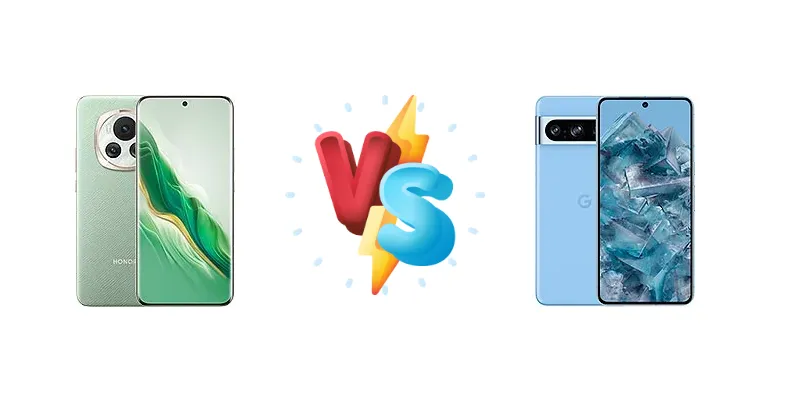
|
🏆 Quick Verdict
For users prioritizing peak performance and blazing-fast charging, the Honor Magic6 is the clear winner. However, the Google Pixel 8 Pro’s superior camera processing, longer software support, and refined user experience make it the better choice for photography enthusiasts and those deeply invested in the Google ecosystem.
| PHONES | ||
|---|---|---|
| Phone Names | Honor Magic6 | Google Pixel 8 Pro |
| Network | ||
|---|---|---|
| 2G bands | GSM 850 / 900 / 1800 / 1900 | GSM 850 / 900 / 1800 / 1900 |
| 3G bands | HSDPA 800 / 850 / 900 / 1700(AWS) / 1900 / 2100 | HSDPA 800 / 850 / 900 / 1700(AWS) / 1900 / 2100 |
| 4G bands | LTE | 1, 2, 3, 4, 5, 7, 8, 12, 13, 14, 17, 18, 19, 20, 25, 26, 28, 29, 30, 38, 39, 40, 41, 46, 48, 66, 71 - G1MNW |
| 5G bands | SA/NSA | 1, 2, 3, 5, 7, 8, 12, 20, 25, 26, 28, 29, 30, 38, 40, 41, 48, 66, 70, 71, 77, 78, 257, 258, 260, 261 SA/NSA/Sub6/mmWave - G1MNW |
| Speed | HSPA, LTE, 5G | HSPA, LTE, 5G |
| Technology | GSM / CDMA / HSPA / CDMA2000 / LTE / 5G | GSM / HSPA / LTE / 5G |
| Launch | ||
|---|---|---|
| Announced | 2024, January 11 | 2023, October 04 |
| Status | Available. Released 2024, January 18 | Available. Released 2023, October 12 |
| Body | ||
|---|---|---|
| Build | Glass front, glass back or silicone polymer back (eco leather) | Glass front (Gorilla Glass Victus 2), glass back (Gorilla Glass Victus 2), aluminum frame |
| Dimensions | 161.8 x 75.4 x 8.1 mm (6.37 x 2.97 x 0.32 in) | 162.6 x 76.5 x 8.8 mm (6.40 x 3.01 x 0.35 in) |
| SIM | Nano-SIM + Nano-SIM | Nano-SIM + eSIM |
| Weight | 199 g or 206 g (7.02 oz) | 213 g (7.51 oz) |
| Display | ||
|---|---|---|
| Protection | Jurhino glass | Corning Gorilla Glass Victus 2 |
| Resolution | 1264 x 2800 pixels (~453 ppi density) | 1344 x 2992 pixels, 20:9 ratio (~489 ppi density) |
| Size | 6.78 inches, 111.2 cm2 (~91.2% screen-to-body ratio) | 6.7 inches, 108.7 cm2 (~87.4% screen-to-body ratio) |
| Type | LTPO OLED, 1B colors, 120Hz, HDR, 1600 nits (HBM), 5000 nits (peak) | LTPO OLED, 120Hz, HDR10+, 1600 nits (HBM), 2400 nits (peak) |
| Platform | ||
|---|---|---|
| CPU | Octa-core (1x3.3 GHz Cortex-X4 & 3x3.2 GHz Cortex-A720 & 2x3.0 GHz Cortex-A720 & 2x2.3 GHz Cortex-A520) | Nona-core (1x3.0 GHz Cortex-X3 & 4x2.45 GHz Cortex-A715 & 4x2.15 GHz Cortex-A510) |
| Chipset | Qualcomm SM8650-AB Snapdragon 8 Gen 3 (4 nm) | Google Tensor G3 (4 nm) |
| GPU | Adreno 750 | Immortalis-G715s MC10 |
| OS | Android 14, MagicOS 8 | Android 14, upgradable to Android 16, up to 7 major Android upgrades |
| Memory | ||
|---|---|---|
| Card slot | No | No |
| Internal | 256GB 12GB RAM, 256GB 16GB RAM, 512GB 16GB RAM | 128GB 12GB RAM, 256GB 12GB RAM, 512GB 12GB RAM, 1TB 12GB RAM |
| Main Camera | ||
|---|---|---|
| Features | Laser AF, color spectrum sensor, LED flash, HDR, panorama | Multi-zone Laser AF, Dual-LED flash, Pixel Shift, Ultra-HDR, panorama, Best Take, Zoom Enhance |
| Triple | 50 MP, f/1.9, (wide), 1/1.3", PDAF, OIS 32 MP, f/2.4, (telephoto), PDAF, OIS, 2.5x optical zoom 50 MP, f/2.0, 13mm, 122˚ (ultrawide), 1/2.88", AF | 50 MP, f/1.7, 25mm (wide), 1/1.31", 1.2µm, dual pixel PDAF, OIS 48 MP, f/2.8, 113mm (periscope telephoto), 1/2.55", 0.7µm, dual pixel PDAF, OIS, 5x optical zoom 48 MP, f/2.0, 126˚ (ultrawide), 1/2.0", 0.8µm, dual pixel PDAF |
| Video | 4K@30/60fps, 1080p@30/60/120/240fps, gyro-EIS, HDR, 10-bit video | 4K@30/60fps, 1080p@24/30/60/120/240fps; gyro-EIS, OIS, 10-bit HDR |
| Selfie camera | ||
|---|---|---|
| Features | - | HDR, panorama |
| Single | 50 MP, f/2.0, 22mm (wide), 1/2.93", AF | 10.5 MP, f/2.2, 20mm (ultrawide), 1/3.1", 1.22µm, PDAF |
| Video | 4K@30fps, 1080p@30/60fps, gyro-EIS | 4K@24/30/60fps, 1080p@30/60fps |
| Sound | ||
|---|---|---|
| 35mm jack | No | No |
| Loudspeaker | Yes, with stereo speakers | Yes, with stereo speakers |
| Comms | ||
|---|---|---|
| Bluetooth | 5.3, A2DP, LE, aptX HD | 5.3, A2DP, LE, aptX HD |
| Infrared port | Yes | - |
| NFC | Yes | Yes |
| Positioning | GPS (L1+L5), GLONASS, BDS (B1I+B1c+B2a), GALILEO (E1+E5a) | GPS (L1+L5), GLONASS (G1), GALILEO (E1+E5a), QZSS (L1+L5) |
| Radio | No | No |
| USB | USB Type-C 2.0, OTG | USB Type-C 3.2 |
| WLAN | Wi-Fi 802.11 a/b/g/n/ac/6/7, dual-band, Wi-Fi Direct | Wi-Fi 802.11 a/b/g/n/ac/6e/7, tri-band, Wi-Fi Direct |
| Features | ||
|---|---|---|
| Sensors | Fingerprint (under display, optical), Face ID, accelerometer, gyro, proximity, compass | Fingerprint (under display, optical), accelerometer, gyro, proximity, compass, barometer, thermometer (skin temperature) |
| Battery | ||
|---|---|---|
| Charging | 66W wired 50W wireless Reverse wireless 5W reverse wired | 30W wired, PD3.0, PPS, 50% in 30 min 23W wireless Reverse wireless Bypass charging |
| Type | Li-Po 5450 mAh | Li-Ion 5050 mAh |
| Misc | ||
|---|---|---|
| Colors | Black, Green, Blue, Purple, White | Obsidian, Porcelain, Bay, Mint |
| Models | BVL-AN00 | GC3VE, G1MNW |
| Price | About 570 EUR | € 362.00 / $ 289.97 / £ 329.95 / ₹ 54,999 |
Honor Magic6
- Significantly faster charging speeds (66W wired, 50W wireless)
- Potentially superior CPU performance with Snapdragon 8 Gen 3
- Likely better gaming performance due to powerful chipset
- Camera performance may not match the Pixel 8 Pro’s computational photography
- Software update commitment may be shorter than Google’s
Google Pixel 8 Pro
- Exceptional camera quality and computational photography features
- Clean Android experience with guaranteed long-term software updates
- Excellent display brightness and color accuracy
- Slower charging speeds compared to the Honor Magic6
- Chipset performance may lag behind the Snapdragon 8 Gen 3 in demanding tasks
Display Comparison
The Google Pixel 8 Pro boasts a measured peak brightness of 1600 nits, ensuring excellent visibility even in direct sunlight. While the Magic6’s display specs aren’t provided, Honor typically employs high-quality OLED panels. The Pixel 8 Pro’s LTPO technology allows for a variable refresh rate, dynamically adjusting between 1Hz and 120Hz to conserve battery life – a feature likely present, but unconfirmed, on the Magic6. The Pixel 8 Pro’s color accuracy is renowned, crucial for content creators, and the Magic6 will need to match this to compete.
Camera Comparison
The Pixel 8 Pro is renowned for its computational photography prowess, leveraging Google’s advanced image processing algorithms. While specific sensor details for the Magic6 are missing, the Pixel 8 Pro’s camera system focuses on delivering consistently excellent results across various lighting conditions. The Pixel 8 Pro’s video capabilities are also exceptional, with features like Cinematic Blur. The Magic6 will need to offer a compelling camera experience to challenge the Pixel 8 Pro, potentially through larger sensor sizes or innovative image stabilization techniques. Ignoring the typical 2MP macro lens found on many phones, the focus should be on the main and ultrawide sensors.
Performance
The Honor Magic6’s Qualcomm Snapdragon 8 Gen 3 (4nm) is a powerhouse, featuring an octa-core configuration with a prime Cortex-X4 core clocked at 3.3 GHz. This contrasts with the Google Pixel 8 Pro’s Tensor G3 (4nm) nona-core CPU, which prioritizes AI and machine learning tasks over raw CPU horsepower. The Snapdragon 8 Gen 3’s architecture, with its newer Cortex-A720 cores, offers a performance advantage in CPU-intensive workloads. While the Tensor G3 excels in on-device AI processing, the Magic6 will likely demonstrate superior performance in graphically demanding games and applications. The Magic6’s LPDDR5x RAM (spec not confirmed, but highly probable) will further enhance its multitasking capabilities.
Battery Life
The Google Pixel 8 Pro achieves an impressive 11:14h of active use, and an endurance rating of 90 hours, indicating strong battery life. The Honor Magic6’s battery capacity is not specified, but its 66W wired charging and 50W wireless charging significantly outpace the Pixel 8 Pro’s 30W wired and 23W wireless charging. The Magic6 can reach 50% charge in approximately 30 minutes with its wired charging, while the Pixel 8 Pro takes a similar amount of time. The Magic6 also offers 5W reverse wired charging and reverse wireless charging, providing added convenience for charging accessories.
Buying Guide
Buy the Honor Magic6 if you need uncompromising processing power for demanding tasks like gaming or video editing, and if minimizing charging downtime is critical. Its 66W wired and 50W wireless charging are significantly faster than the Pixel 8 Pro’s offerings. Buy the Google Pixel 8 Pro if you prioritize camera quality, especially computational photography features like Magic Eraser and Best Take, and if you value a clean, consistently updated Android experience with guaranteed long-term support.