
Honor Magic6 Ultimate vs Xiaomi 14 Ultra: A Deep Dive into Snapdragon 8 Gen 3 Flagships
| Phones Images | |||||
|---|---|---|---|---|---|
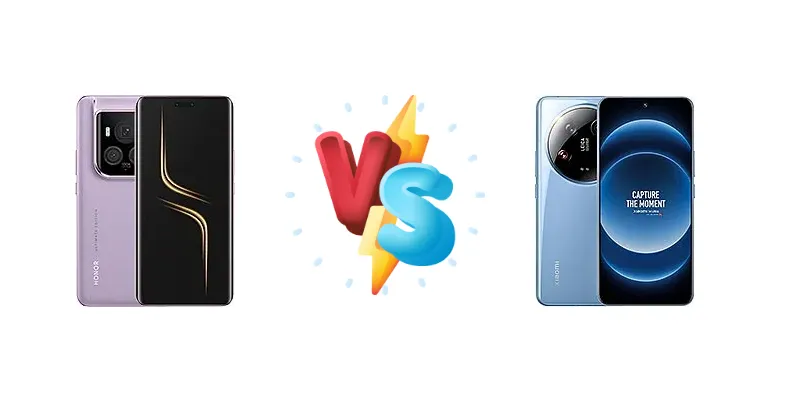
|
🏆 Quick Verdict
For the average user prioritizing rapid charging and a slightly brighter display, the Xiaomi 14 Ultra emerges as the winner. Its 90W wired and 80W wireless charging significantly outperform the Honor Magic6 Ultimate, and the measured 1281 nits peak brightness provides a more visible outdoor experience. However, the Honor Magic6 Ultimate remains a compelling option for those seeking a potentially more unique software experience.
| PHONES | ||
|---|---|---|
| Phone Names | Honor Magic6 Ultimate | Xiaomi 14 Ultra |
| Network | ||
|---|---|---|
| 2G bands | GSM 850 / 900 / 1800 / 1900 | GSM 850 / 900 / 1800 / 1900 |
| 3G bands | HSDPA 800 / 850 / 900 / 1700(AWS) / 1900 / 2100 | HSDPA 800 / 850 / 900 / 1700(AWS) / 1900 / 2100 |
| 4G bands | LTE | 1, 2, 3, 4, 5, 7, 8, 18, 19, 20, 26, 28, 38, 40, 41, 42, 48, 66 - International |
| 5G bands | SA/NSA | 1, 2, 3, 5, 7, 8, 20, 28, 38, 40, 41, 48, 66, 77, 78, 79 SA/NSA - International |
| Speed | HSPA, LTE, 5G | HSPA, LTE, 5G |
| Technology | GSM / CDMA / HSPA / CDMA2000 / LTE / 5G | GSM / CDMA / HSPA / EVDO / LTE / 5G |
| Launch | ||
|---|---|---|
| Announced | 2024, March 18 | 2024, February 22 |
| Status | Available. Released 2024, March 22 | Available. Released 2024, February 22 |
| Body | ||
|---|---|---|
| Build | Glass front, silicone polymer back (eco leather) | Glass front (Shield Glass), glass back or silicone polymer back (eco leather), titanium frame (grade 5) or aluminum alloy frame |
| Dimensions | 162.5 x 75.8 x 8.9 mm (6.40 x 2.98 x 0.35 in) | 161.4 x 75.3 x 9.2 mm (6.35 x 2.96 x 0.36 in) |
| SIM | Nano-SIM + Nano-SIM | Nano-SIM + Nano-SIM |
| Weight | 227 g (8.01 oz) | 219.8 / 224.4 / 229.5 g (7.76 oz) |
| Display | ||
|---|---|---|
| Protection | King Kong Rhinoceros | Xiaomi Shield Glass |
| Resolution | 1280 x 2800 pixels, 19.5:9 ratio (~453 ppi density) | 1440 x 3200 pixels, 20:9 ratio (~522 ppi density) |
| Size | 6.8 inches, 112.8 cm2 (~91.6% screen-to-body ratio) | 6.73 inches, 108.9 cm2 (~89.6% screen-to-body ratio) |
| Type | LTPO OLED, 1B colors, 120Hz, Dolby Vision, HDR, 1600 nits (HBM), 5000 nits (peak) | LTPO AMOLED, 68B colors, 120Hz, 1920Hz PWM, Dolby Vision, HDR10+, 1000 nits (typ), 3000 nits (peak) |
| Platform | ||
|---|---|---|
| CPU | Octa-core (1x3.3 GHz Cortex-X4 & 3x3.2 GHz Cortex-A720 & 2x3.0 GHz Cortex-A720 & 2x2.3 GHz Cortex-A520) | Octa-core (1x3.3 GHz Cortex-X4 & 3x3.2 GHz Cortex-A720 & 2x3.0 GHz Cortex-A720 & 2x2.3 GHz Cortex-A520) |
| Chipset | Qualcomm SM8650-AB Snapdragon 8 Gen 3 (4 nm) | Qualcomm SM8650-AB Snapdragon 8 Gen 3 (4 nm) |
| GPU | Adreno 750 | Adreno 750 |
| OS | Android 14, MagicOS 8 | Android 14, up to 4 major Android upgrades, HyperOS |
| Memory | ||
|---|---|---|
| Card slot | No | No |
| Internal | 512GB 16GB RAM, 1TB 16GB RAM | 256GB 12GB RAM, 512GB 16GB RAM, 1TB 16GB RAM |
| Main Camera | ||
|---|---|---|
| Features | Color spectrum sensor, LED flash, HDR, panorama | Laser AF, color spectrum sensor, Leica lenses, Dual-LED flash, HDR, panorama, 67mm filter ring holder (optional) |
| Quad | - | 50 MP, f/1.6-f/4.0, 23mm (wide), 1.0"-type, 1.6µm, dual pixel PDAF, OIS 50 MP, f/1.8, 75mm (telephoto), 1/2.51", 0.7µm, dual pixel PDAF (10cm - ∞), OIS, 3.2x optical zoom 50 MP, f/2.5, 120mm (periscope telephoto), 1/2.51", 0.7µm, dual pixel PDAF (30cm - ∞), OIS, 5x optical zoom 50 MP, f/1.8, 12mm, 122˚ (ultrawide), 1/2.51", 0.7µm, dual pixel PDAF TOF 3D, (depth) |
| Triple | 50 MP, f/1.4-2.0, 23mm (wide), 1/1.3", LiDAR AF, PDAF, OIS 180 MP, f/2.6, (periscope telephoto), 1/1.49", PDAF, OIS, 2.5x optical zoom 50 MP, f/2.0, 13mm, 122˚ (ultrawide), AF | - |
| Video | 4K@24/30/60fps, 1080p@30/60/120/240fps, gyro-EIS, OIS, HDR, 10-bit video | 8K@24/30fps, 4K@24/30/60/120fps, 1080p@30/60/120/240/480/960/1920fps, gyro-EIS, Dolby Vision HDR 10-bit rec. (4K@60fps, 1080p) |
| Selfie camera | ||
|---|---|---|
| Features | - | HDR, panorama |
| Single | 50 MP, f/2.0, (ultrawide), AF TOF 3D, (depth/biometrics sensor) | 32 MP, f/2.0, 22mm (wide), 1/3.14", 0.7µm |
| Video | 4K@30fps, 1080p@30/60fps, gyro-EIS | 4K@30/60fps, 1080p@30/60fps, gyro-EIS |
| Sound | ||
|---|---|---|
| 35mm jack | No | No |
| Loudspeaker | Yes, with stereo speakers | Yes, with stereo speakers |
| Comms | ||
|---|---|---|
| Bluetooth | 5.3, A2DP, LE, aptX HD | 5.4, A2DP, LE, aptX HD, aptX Adaptive, LHDC |
| Infrared port | Yes | Yes |
| NFC | Yes | Yes |
| Positioning | GPS (L1+L5), GLONASS, BDS (B1I+B1c+B2a), GALILEO (E1+E5a) | GPS (L1+L5), GLONASS (L1), BDS (B1I+B1c+B2a), GALILEO (E1+E5a), QZSS (L1+L5), NavIC (L5) |
| Radio | No | No |
| USB | USB Type-C 3.2, DisplayPort 1.2, OTG | USB Type-C 3.2 Gen 2, DisplayPort, OTG |
| WLAN | Wi-Fi 802.11 a/b/g/n/ac/6/7, dual-band, Wi-Fi Direct | Wi-Fi 802.11 a/b/g/n/ac/6e/7, tri-band, Wi-Fi Direct |
| Features | ||
|---|---|---|
| Sensors | Fingerprint (under display, optical), Face ID, accelerometer, gyro, proximity, compass | Fingerprint (under display, optical), accelerometer, proximity, gyro, compass, barometer |
| Battery | ||
|---|---|---|
| Charging | 80W wired 66W wireless Reverse wireless 5W reverse wired | 90W wired, PD3.0, QC4, 100% in 33 min 80W wireless, 100% in 46 min 10W reverse wireless |
| Type | Li-Po 5600 mAh | Market-dependent versions:· 5000 mAh (Global)· 5300 mAh (China only) |
| Misc | ||
|---|---|---|
| Colors | Black, Purple | Black, Blue, White, Titanium Gray |
| Models | BVL-AN20 | 24031PN0DC, 24030PN60G |
| Price | About 900 EUR | € 663.14 |
| SAR | - | 0.83 W/kg (head) 0.82 W/kg (body) |
| SAR EU | - | 1.00 W/kg (head) 1.00 W/kg (body) |
Honor Magic6 Ultimate
- Potentially unique software experience (Honor OS)
- 80W wired charging is still very fast
- 66W wireless charging is competitive
- Slower charging speeds compared to Xiaomi 14 Ultra
- Display brightness data unavailable, potentially lower than Xiaomi
Xiaomi 14 Ultra
- 90W wired charging for incredibly fast top-ups
- 80W wireless charging is class-leading
- 1281 nits peak brightness for excellent outdoor visibility
- Xiaomi’s MIUI can be resource intensive
- Potential for software bloatware
Display Comparison
The Xiaomi 14 Ultra boasts a measured peak brightness of 1281 nits, a significant advantage over the Honor Magic6 Ultimate (brightness data unavailable). This translates to superior visibility under direct sunlight. While both devices likely utilize LTPO display technology for adaptive refresh rates (based on flagship positioning), the Xiaomi’s higher peak brightness is a concrete advantage. Bezels are expected to be minimal on both, but detailed measurements are needed for a definitive comparison. Color accuracy is also likely to be excellent on both, given their flagship status, but independent testing is required to confirm.
Camera Comparison
While detailed camera specs are missing for the Honor Magic6 Ultimate, the Xiaomi 14 Ultra is known for its advanced camera system. The Xiaomi 14 Ultra’s image processing is likely to focus on natural color reproduction and detail preservation, a hallmark of Xiaomi’s flagship cameras. The absence of information regarding the Honor Magic6 Ultimate’s sensor sizes and OIS capabilities makes a direct comparison difficult. However, given the competitive landscape, it’s reasonable to expect a high-quality camera system, though potentially with a different image processing philosophy. We'll disregard any 2MP macro lenses on either device as they offer minimal practical benefit.
Performance
Both the Honor Magic6 Ultimate and the Xiaomi 14 Ultra are equipped with the Qualcomm SM8650-AB Snapdragon 8 Gen 3 (4 nm) chipset, featuring an identical CPU configuration: 1x3.3 GHz Cortex-X4, 3x3.2 GHz Cortex-A720, 2x3.0 GHz Cortex-A720, and 2x2.3 GHz Cortex-A520. This means raw processing power will be nearly indistinguishable between the two. Performance will largely depend on thermal management and software optimization. Both devices likely utilize LPDDR5x RAM, but the specific speed and configuration (e.g., 12GB vs 16GB) will influence multitasking capabilities. The 4nm fabrication process of the Snapdragon 8 Gen 3 contributes to improved thermal efficiency compared to previous generations, minimizing throttling during sustained workloads.
Battery Life
The Xiaomi 14 Ultra demonstrates a strong real-world battery performance, achieving 11:25h of active use. The Honor Magic6 Ultimate’s battery capacity is unknown, but the charging speeds provide a key differentiator. The Xiaomi 14 Ultra supports 90W wired charging (100% in 33 minutes) and 80W wireless charging (100% in 46 minutes), significantly faster than the Honor Magic6 Ultimate’s 80W wired and 66W wireless. The Xiaomi also offers 10W reverse wireless charging, while the Honor supports 5W reverse wired charging. The faster charging speeds of the Xiaomi 14 Ultra mitigate the impact of a potentially smaller battery capacity, offering a more convenient user experience.
Buying Guide
Buy the Honor Magic6 Ultimate if you prioritize a potentially more streamlined software experience and value a brand known for innovation. Buy the Xiaomi 14 Ultra if you demand the fastest possible charging speeds, a demonstrably brighter display for outdoor visibility, and a well-established camera system with a strong track record. Both phones deliver top-tier performance, but cater to slightly different user preferences.