
Honor Magic6 Ultimate vs Oppo Find X7 Ultra: A Deep Dive into Snapdragon 8 Gen 3 Flagships
| Phones Images | |||||
|---|---|---|---|---|---|
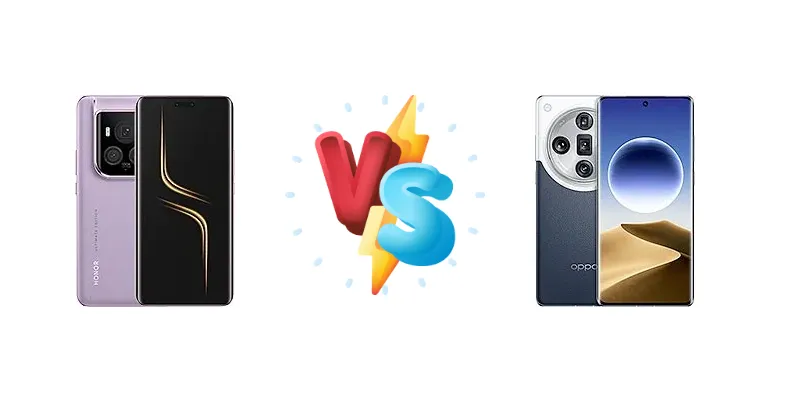
|
🏆 Quick Verdict
For the average user prioritizing rapid charging and extended battery life, the Oppo Find X7 Ultra emerges as the winner. Its 100W wired and 50W wireless charging significantly outperform the Honor Magic6 Ultimate's 80W and 66W respectively, translating to less time tethered to a wall outlet. While both offer identical processing power, the Find X7 Ultra’s battery performance gives it a practical edge.
| PHONES | ||
|---|---|---|
| Phone Names | Honor Magic6 Ultimate | Oppo Find X7 Ultra |
| Network | ||
|---|---|---|
| 2G bands | GSM 850 / 900 / 1800 / 1900 | GSM 850 / 900 / 1800 / 1900 |
| 3G bands | HSDPA 800 / 850 / 900 / 1700(AWS) / 1900 / 2100 | HSDPA 800 / 850 / 900 / 1700(AWS) / 1900 / 2100 |
| 4G bands | LTE | 1, 2, 3, 4, 5, 7, 8, 12, 17, 18, 19, 20, 26, 28, 34, 38, 39, 40, 41, 66 |
| 5G bands | SA/NSA | 1, 2, 3, 5, 7, 8, 20, 28, 38, 40, 41, 66, 77, 78, 79 SA/NSA |
| Speed | HSPA, LTE, 5G | HSPA, LTE, 5G |
| Technology | GSM / CDMA / HSPA / CDMA2000 / LTE / 5G | GSM / CDMA / HSPA / CDMA2000 / LTE / 5G |
| Launch | ||
|---|---|---|
| Announced | 2024, March 18 | 2024, January 08 |
| Status | Available. Released 2024, March 22 | Available. Released 2024, January 12 |
| Body | ||
|---|---|---|
| Build | Glass front, silicone polymer back (eco leather) | Glass front (Gorilla Glass Victus 2), glass back (Gorilla Glass) or eco leather back, aluminum frame |
| Dimensions | 162.5 x 75.8 x 8.9 mm (6.40 x 2.98 x 0.35 in) | 164.3 x 76.2 x 9.5 mm (6.47 x 3.00 x 0.37 in) |
| SIM | Nano-SIM + Nano-SIM | Nano-SIM + Nano-SIM |
| Weight | 227 g (8.01 oz) | 221 g (7.80 oz) |
| Display | ||
|---|---|---|
| Protection | King Kong Rhinoceros | Corning Gorilla Glass Victus 2 |
| Resolution | 1280 x 2800 pixels, 19.5:9 ratio (~453 ppi density) | 1440 x 3168 pixels (~510 ppi density) |
| Size | 6.8 inches, 112.8 cm2 (~91.6% screen-to-body ratio) | 6.82 inches, 113.0 cm2 (~90.3% screen-to-body ratio) |
| Type | LTPO OLED, 1B colors, 120Hz, Dolby Vision, HDR, 1600 nits (HBM), 5000 nits (peak) | LTPO AMOLED, 1B colors, 120Hz, Dolby Vision, HDR10+, 1600 nits (typ), 2600 nits (HBM), 4500 nits (peak) |
| Platform | ||
|---|---|---|
| CPU | Octa-core (1x3.3 GHz Cortex-X4 & 3x3.2 GHz Cortex-A720 & 2x3.0 GHz Cortex-A720 & 2x2.3 GHz Cortex-A520) | Octa-core (1x3.3 GHz Cortex-X4 & 3x3.2 GHz Cortex-A720 & 2x3.0 GHz Cortex-A720 & 2x2.3 GHz Cortex-A520) |
| Chipset | Qualcomm SM8650-AB Snapdragon 8 Gen 3 (4 nm) | Qualcomm SM8650-AB Snapdragon 8 Gen 3 (4 nm) |
| GPU | Adreno 750 | Adreno 750 |
| OS | Android 14, MagicOS 8 | Android 14, up to 4 major Android upgrades, ColorOS 14 |
| Memory | ||
|---|---|---|
| Card slot | No | No |
| Internal | 512GB 16GB RAM, 1TB 16GB RAM | 256GB 12GB RAM, 256GB 16GB RAM, 512GB 16GB RAM |
| Main Camera | ||
|---|---|---|
| Features | Color spectrum sensor, LED flash, HDR, panorama | Laser AF, color spectrum sensor, Hasselblad Color Calibration, LED flash, HDR, panorama |
| Quad | - | 50 MP, f/1.8, 23mm (wide), 1.0"-type, 1.6µm, dual pixel PDAF, OIS 50 MP, f/2.6, 65mm (periscope telephoto), 1/1.56", 1.0µm, 2.8x optical zoom, multi-directional PDAF (25cm - ∞), OIS 50 MP, f/4.3, 135mm (periscope telephoto), 1/2.51", 0.7µm, 6x optical zoom, dual pixel PDAF (35cm - ∞), OIS 50 MP, f/2.0, 14mm, 123˚ (ultrawide), 1/1.95", 1.0µm, PDAF |
| Triple | 50 MP, f/1.4-2.0, 23mm (wide), 1/1.3", LiDAR AF, PDAF, OIS 180 MP, f/2.6, (periscope telephoto), 1/1.49", PDAF, OIS, 2.5x optical zoom 50 MP, f/2.0, 13mm, 122˚ (ultrawide), AF | - |
| Video | 4K@24/30/60fps, 1080p@30/60/120/240fps, gyro-EIS, OIS, HDR, 10-bit video | 4K@30/60fps, 1080p@30/60/240fps; gyro-EIS; HDR, 10‑bit video, Dolby Vision |
| Selfie camera | ||
|---|---|---|
| Features | - | Panorama |
| Single | 50 MP, f/2.0, (ultrawide), AF TOF 3D, (depth/biometrics sensor) | 32 MP, f/2.4, 21mm (wide), 1/2.74", 0.8µm, PDAF |
| Video | 4K@30fps, 1080p@30/60fps, gyro-EIS | 4K@30/60fps, 1080p@30fps, gyro-EIS |
| Sound | ||
|---|---|---|
| 35mm jack | No | No |
| Loudspeaker | Yes, with stereo speakers | Yes, with stereo speakers |
| Comms | ||
|---|---|---|
| Bluetooth | 5.3, A2DP, LE, aptX HD | 5.4, A2DP, LE, aptX HD, LHDC |
| Infrared port | Yes | Yes |
| NFC | Yes | Yes |
| Positioning | GPS (L1+L5), GLONASS, BDS (B1I+B1c+B2a), GALILEO (E1+E5a) | GPS (L1+L5), BDS (B1I+B1c+B2a), GALILEO (E1+E5a), QZSS (L1+L5), GLONASS |
| Radio | No | No |
| USB | USB Type-C 3.2, DisplayPort 1.2, OTG | USB Type-C 3.2, OTG |
| WLAN | Wi-Fi 802.11 a/b/g/n/ac/6/7, dual-band, Wi-Fi Direct | Wi-Fi 802.11 a/b/g/n/ac/6e/7, dual-band, Wi-Fi Direct |
| Features | ||
|---|---|---|
| Sensors | Fingerprint (under display, optical), Face ID, accelerometer, gyro, proximity, compass | Fingerprint (under display, optical), accelerometer, gyro, proximity, compass |
| Battery | ||
|---|---|---|
| Charging | 80W wired 66W wireless Reverse wireless 5W reverse wired | 100W wired, PD, 50% in 10 min, 100% in 26 min 50W wireless 10W reverse wireless |
| Type | Li-Po 5600 mAh | 5000 mAh |
| Misc | ||
|---|---|---|
| Colors | Black, Purple | Black, Dark Blue, Light Brown |
| Models | BVL-AN20 | PHY110, PHY120 |
| Price | About 900 EUR | $ 546.64 |
Honor Magic6 Ultimate
- Potentially more affordable price point
- Reverse wired charging (5W)
- Snapdragon 8 Gen 3 performance
- Slower charging speeds (80W wired, 66W wireless)
- Unknown battery capacity and active use score
Oppo Find X7 Ultra
- Faster charging speeds (100W wired, 50W wireless)
- Longer battery life (12:47h active use)
- Higher peak display brightness (1165 nits)
- Likely higher price tag
- Reverse wireless charging at 10W is less versatile than wired
Display Comparison
While both devices are expected to feature high-quality displays, the Oppo Find X7 Ultra boasts a measured peak brightness of 1165 nits. This higher brightness translates to improved visibility in direct sunlight. Details regarding panel technology (LTPO, refresh rate) and color accuracy are currently unavailable for the Honor Magic6 Ultimate, but given the flagship positioning, both are likely to offer vibrant and accurate color reproduction. Bezels are expected to be minimal on both, contributing to an immersive viewing experience.
Camera Comparison
Detailed camera specifications beyond the main sensors are currently unavailable for both devices. However, the focus should be on sensor size, optical image stabilization (OIS), and lens apertures. Larger sensors generally capture more light, resulting in better low-light performance. OIS is critical for sharp images and stable videos. Image processing algorithms will also play a significant role in differentiating the camera experiences. The absence of information on secondary lenses (ultrawide, telephoto) makes a definitive camera comparison impossible at this time.
Performance
Both the Honor Magic6 Ultimate and Oppo Find X7 Ultra are equipped with the Qualcomm SM8650-AB Snapdragon 8 Gen 3 (4nm) chipset, featuring an identical CPU configuration: 1x3.3 GHz Cortex-X4, 3x3.2 GHz Cortex-A720, 2x3.0 GHz Cortex-A720, and 2x2.3 GHz Cortex-A520. This ensures comparable raw processing power for demanding tasks like gaming and video editing. However, thermal management will be crucial. The 4nm process node should contribute to improved efficiency, but the effectiveness of each manufacturer’s cooling solution will determine sustained performance under load. RAM specifications are currently unknown for the Honor Magic6 Ultimate, but both are expected to utilize LPDDR5x for fast memory access.
Battery Life
The Oppo Find X7 Ultra demonstrates a clear advantage in battery performance with an active use score of 12:47h. While the Honor Magic6 Ultimate’s battery capacity is unknown, the Oppo’s superior charging speeds – 100W wired (0-100% in 26 minutes) and 50W wireless – significantly reduce downtime. The Honor Magic6 Ultimate offers 80W wired and 66W wireless charging, which are still fast, but noticeably slower. The inclusion of reverse wireless and wired charging on both devices is a convenient feature for topping up accessories, but the Honor’s 5W reverse wired is less powerful than the Oppo’s 10W offering.
Buying Guide
Buy the Honor Magic6 Ultimate if you prioritize a potentially more competitive price point and value the convenience of reverse wired charging at 5W. Buy the Oppo Find X7 Ultra if you demand the fastest possible charging speeds, both wired and wirelessly, and benefit from the longer active use battery score of 12:47h, making it ideal for power users and travelers.