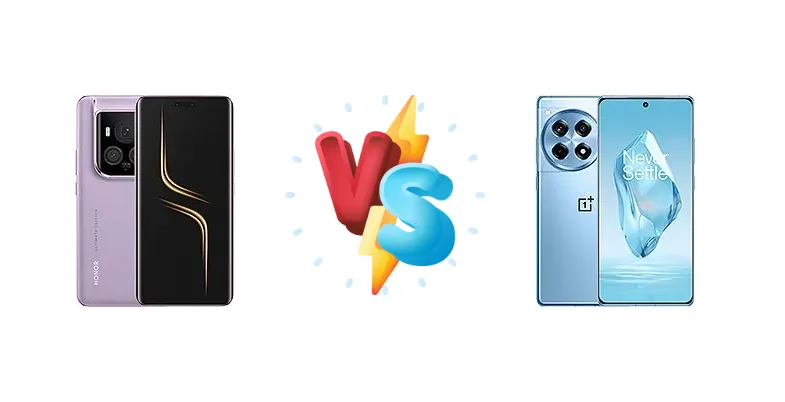
The Honor Magic6 Ultimate arrives as a new contender with Qualcomm’s latest Snapdragon 8 Gen 3, aiming for the top of the Android heap. However, the OnePlus 12R, powered by last year’s Snapdragon 8 Gen 2, continues to offer a compelling blend of performance and affordability. This comparison dissects the key differences to help you decide which phone best suits your needs.
🏆 Quick Verdict
For the average user prioritizing value, the OnePlus 12R emerges as the winner. Its 14:32 active use battery life and 100W charging are exceptional, and the Snapdragon 8 Gen 2 still delivers flagship-level performance. The Honor Magic6 Ultimate offers a performance edge with the Gen 3, but the price premium isn't justified for most.
| Network |
|---|
| 2G bands | GSM 850 / 900 / 1800 / 1900 | GSM 850 / 900 / 1800 / 1900 |
| 3G bands | HSDPA 800 / 850 / 900 / 1700(AWS) / 1900 / 2100 | HSDPA 850 / 900 / 1700(AWS) / 1900 / 2100 |
| 4G bands | LTE | 1, 2, 3, 4, 5, 7, 8, 12, 17, 18, 19, 20, 26, 28, 32, 38, 39, 40, 41, 66 |
| 5G bands | SA/NSA | 1, 2, 3, 5, 7, 8, 12, 20, 28, 38, 40, 41, 66, 77, 78 SA/NSA |
| Speed | HSPA, LTE, 5G | HSPA, LTE, 5G |
| Technology | GSM / CDMA / HSPA / CDMA2000 / LTE / 5G | GSM / CDMA / HSPA / LTE / 5G |
| Launch |
|---|
| Announced | 2024, March 18 | 2024, January 23 |
| Status | Available. Released 2024, March 22 | Available. Released 2024, February 06 |
| Body |
|---|
| Build | Glass front, silicone polymer back (eco leather) | Glass front (Gorilla Glass Victus 2), aluminum frame, glass back |
| Dimensions | 162.5 x 75.8 x 8.9 mm (6.40 x 2.98 x 0.35 in) | 163.3 x 75.3 x 8.8 mm (6.43 x 2.96 x 0.35 in) |
| SIM | Nano-SIM + Nano-SIM | · Nano-SIM + Nano-SIM + eSIM (max 2 at a time)· Nano-SIM + Nano-SIM |
| Weight | 227 g (8.01 oz) | 207 g (7.30 oz) |
| Display |
|---|
| Protection | King Kong Rhinoceros | Corning Gorilla Glass Victus 2 |
| Resolution | 1280 x 2800 pixels, 19.5:9 ratio (~453 ppi density) | 1264 x 2780 pixels (~450 ppi density) |
| Size | 6.8 inches, 112.8 cm2 (~91.6% screen-to-body ratio) | 6.78 inches, 111.7 cm2 (~90.9% screen-to-body ratio) |
| Type | LTPO OLED, 1B colors, 120Hz, Dolby Vision, HDR, 1600 nits (HBM), 5000 nits (peak) | LTPO4 AMOLED, 1B colors, 120Hz, HDR10+, Dolby Vision, 1600 nits (HBM), 4500 nits (peak) |
| Platform |
|---|
| CPU | Octa-core (1x3.3 GHz Cortex-X4 & 3x3.2 GHz Cortex-A720 & 2x3.0 GHz Cortex-A720 & 2x2.3 GHz Cortex-A520) | Octa-core (1x3.2 GHz Cortex-X3 & 2x2.8 GHz Cortex-A715 & 2x2.8 GHz Cortex-A710 & 3x2.0 GHz Cortex-A510) |
| Chipset | Qualcomm SM8650-AB Snapdragon 8 Gen 3 (4 nm) | Qualcomm SM8550-AB Snapdragon 8 Gen 2 (4 nm) |
| GPU | Adreno 750 | Adreno 740 |
| OS | Android 14, MagicOS 8 | Android 14, up to 3 major Android upgrades, OxygenOS 15 |
| Memory |
|---|
| Card slot | No | No |
| Internal | 512GB 16GB RAM, 1TB 16GB RAM | 128GB 8GB RAM, 256GB 8GB RAM, 256GB 12GB RAM, 256GB 16GB RAM |
| Main Camera |
|---|
| Features | Color spectrum sensor, LED flash, HDR, panorama | Laser AF, color spectrum sensor, LED flash, HDR, panorama |
| Triple | 50 MP, f/1.4-2.0, 23mm (wide), 1/1.3", LiDAR AF, PDAF, OIS
180 MP, f/2.6, (periscope telephoto), 1/1.49", PDAF, OIS, 2.5x optical zoom
50 MP, f/2.0, 13mm, 122˚ (ultrawide), AF | 50 MP, f/1.8, 24mm (wide), 1/1.56", 1.0µm, multi-directional PDAF, OIS
8 MP, f/2.2, 16mm, 112˚ (ultrawide), 1/4.0", 1.12µm
2 MP (macro) |
| Video | 4K@24/30/60fps, 1080p@30/60/120/240fps, gyro-EIS, OIS, HDR, 10-bit video | 4K@30/60fps, 1080p@30/60/120/240fps, gyro-EIS, OIS |
| Selfie camera |
|---|
| Features | - | HDR, panorama |
| Single | 50 MP, f/2.0, (ultrawide), AF
TOF 3D, (depth/biometrics sensor) | 16 MP, f/2.4, 26mm (wide), 1/3", 1.0µm |
| Video | 4K@30fps, 1080p@30/60fps, gyro-EIS | 1080p@30fps, gyro-EIS |
| Sound |
|---|
| 35mm jack | No | No |
| Loudspeaker | Yes, with stereo speakers | Yes, with stereo speakers |
| Comms |
|---|
| Bluetooth | 5.3, A2DP, LE, aptX HD | 5.3, A2DP, LE, aptX HD |
| Infrared port | Yes | Yes |
| NFC | Yes | Yes |
| Positioning | GPS (L1+L5), GLONASS, BDS (B1I+B1c+B2a), GALILEO (E1+E5a) | GPS, GALILEO, GLONASS, BDS, QZSS |
| Radio | No | No |
| USB | USB Type-C 3.2, DisplayPort 1.2, OTG | USB Type-C 2.0 |
| WLAN | Wi-Fi 802.11 a/b/g/n/ac/6/7, dual-band, Wi-Fi Direct | Wi-Fi 802.11 a/b/g/n/ac/6/7, dual-band |
| Features |
|---|
| Sensors | Fingerprint (under display, optical), Face ID, accelerometer, gyro, proximity, compass | Fingerprint (under display, optical), accelerometer, gyro, proximity, compass |
| Battery |
|---|
| Charging | 80W wired
66W wireless
Reverse wireless
5W reverse wired | 100W wired, 100% in 26 min |
| Type | Li-Po 5600 mAh | Li-Ion 5500 mAh |
| Misc |
|---|
| Colors | Black, Purple | Iron Gray, Cool Blue, Electric Violet, Sunset Dune |
| Models | BVL-AN20 | CPH2609, CPH2585, CPH2611 |
| Price | About 900 EUR | € 410.84 / $ 399.95 / £ 649.00 |
| SAR | - | 1.19 W/kg (head) 0.82 W/kg (body) |
Honor Magic6 Ultimate
- Latest Snapdragon 8 Gen 3 for top-tier performance
- Faster CPU clock speeds for demanding tasks
- Versatile charging options (wired, wireless, reverse)
- Likely higher price point
- Potential for increased thermal throttling under sustained load
OnePlus 12R
- Excellent battery life (14:32h active use)
- Ultra-fast 100W wired charging (26 min to 100%)
- More affordable price
- Older Snapdragon 8 Gen 2 chipset
- May not match the Magic6 Ultimate in peak performance
Display Comparison
The OnePlus 12R boasts a bright display, peaking at 1181 nits measured, ensuring excellent visibility even outdoors. While the Honor Magic6 Ultimate’s display specs aren’t provided, Honor typically employs high-quality panels. The 12R’s brightness is a concrete advantage, and its refresh rate (assumed to be 120Hz based on market positioning) will provide a smooth experience. Without knowing the Magic6 Ultimate’s panel technology (LTPO vs. standard OLED), it’s difficult to assess its power efficiency compared to the 12R.
Camera Comparison
Without detailed camera specifications for the Honor Magic6 Ultimate, a direct comparison is limited. However, the OnePlus 12R’s camera system is known for its reliable performance. The focus should be on the main sensor size and aperture. Larger sensors capture more light, resulting in better low-light performance. Image processing styles also differ; Honor typically leans towards vibrant, saturated colors, while OnePlus aims for a more natural look. The absence of details on the Magic6 Ultimate’s camera prevents a thorough assessment.
Performance
The Honor Magic6 Ultimate’s Snapdragon 8 Gen 3 (4nm) represents a significant leap over the OnePlus 12R’s Snapdragon 8 Gen 2 (4nm). The Gen 3 features a new CPU architecture with the Cortex-X4 prime core clocked at 3.3 GHz, compared to the 12R’s Cortex-X3 at 3.2 GHz. This translates to faster single-core performance and improved efficiency. The Gen 3 also benefits from architectural improvements in the Cortex-A720 cores, offering gains over the 12R’s A715/A710 configuration. However, the 12R’s 8 Gen 2 remains incredibly capable, and the difference in real-world usage will be noticeable primarily in demanding tasks like video editing or high-end gaming. Thermal management will be crucial; the 4nm process on both chips aids efficiency, but the Gen 3’s higher performance ceiling could lead to more heat generation.
Battery Life
The OnePlus 12R shines in battery life, achieving an impressive 14:32 hours of active use. This is a significant advantage over what we might expect from a phone prioritizing peak performance like the Magic6 Ultimate. The 12R’s 100W wired charging is incredibly fast, reaching 100% in just 26 minutes. The Honor Magic6 Ultimate offers 80W wired charging and 66W wireless charging, plus reverse wireless and wired charging, providing versatility, but the 12R’s faster wired charging is a key benefit for users who need to quickly top up their battery.
Buying Guide
Buy the Honor Magic6 Ultimate if you absolutely demand the fastest possible Android performance and are willing to pay a premium for the latest Snapdragon chipset. This phone is geared towards power users and mobile gamers who need every ounce of processing power. Buy the OnePlus 12R if you prioritize excellent battery life, fast charging, and a balanced overall experience at a significantly lower price point. It’s the ideal choice for everyday users and those who enjoy mobile gaming without breaking the bank.
Frequently Asked Questions
❓ Will the Snapdragon 8 Gen 2 in the OnePlus 12R struggle with demanding games like Genshin Impact?
No, the Snapdragon 8 Gen 2 is still a very capable chipset and can handle Genshin Impact and other demanding games at high settings. While it won't match the absolute peak frame rates of the Gen 3, the 12R provides a smooth and enjoyable gaming experience, especially considering its excellent thermal management.
❓ How does the 80W charging on the Honor Magic6 Ultimate compare to the 100W charging on the OnePlus 12R in real-world use?
While 80W is still fast, the OnePlus 12R’s 100W charging is noticeably quicker. The 12R can fully charge from 0-100% in just 26 minutes, whereas the Magic6 Ultimate will likely take closer to 35-40 minutes. This difference is significant for users who frequently need to quickly top up their battery.
❓ Does the Honor Magic6 Ultimate offer any unique software features or optimizations compared to OnePlus' OxygenOS?
Honor's MagicOS has been evolving, focusing on AI-powered features and a clean user interface. However, OnePlus' OxygenOS is widely praised for its smooth performance, customization options, and minimal bloatware. The preference between the two is largely subjective, but OxygenOS generally has a stronger reputation among Android enthusiasts.