
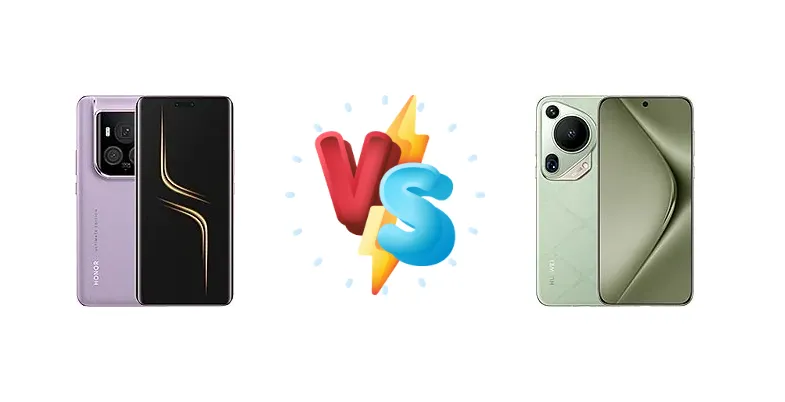
Honor Magic6 Ultimate vs. Huawei Pura 70 Ultra: A Head-to-Head Flagship Battle
| Phones Images | |||||
|---|---|---|---|---|---|
|
🏆 Quick Verdict
For the average user prioritizing raw performance and gaming, the Honor Magic6 Ultimate takes the lead thanks to the Snapdragon 8 Gen 3's superior processing power and thermal management. However, the Huawei Pura 70 Ultra offers a compelling package with faster charging and a potentially more refined camera experience, making it a strong contender for photography enthusiasts.
| PHONES | ||
|---|---|---|
| Phone Names | Honor Magic6 Ultimate | Huawei Pura 70 Ultra |
| Network | ||
|---|---|---|
| 2G bands | GSM 850 / 900 / 1800 / 1900 | GSM 850 / 900 / 1800 / 1900 |
| 3G bands | HSDPA 800 / 850 / 900 / 1700(AWS) / 1900 / 2100 | HSDPA 800 / 850 / 900 / 1700(AWS) / 1900 / 2100 |
| 4G bands | LTE | 1, 2, 3, 4, 5, 6, 7, 8, 9, 12, 17, 18, 19, 20, 26, 28, 34, 38, 39, 40, 41, 42 |
| 5G bands | SA/NSA | SA/NSA - China only |
| Speed | HSPA, LTE, 5G | HSPA, LTE, 5G |
| Technology | GSM / CDMA / HSPA / CDMA2000 / LTE / 5G | GSM / CDMA / HSPA / CDMA2000 / LTE / 5G |
| Launch | ||
|---|---|---|
| Announced | 2024, March 18 | 2024, April 18 |
| Status | Available. Released 2024, March 22 | Available. Released 2024, April 29 |
| Body | ||
|---|---|---|
| Build | Glass front, silicone polymer back (eco leather) | Glass front, aluminum frame, silicone polymer back (eco leather) |
| Dimensions | 162.5 x 75.8 x 8.9 mm (6.40 x 2.98 x 0.35 in) | 162.6 x 75.1 x 8.4 mm (6.40 x 2.96 x 0.33 in) |
| SIM | Nano-SIM + Nano-SIM | Nano-SIM + Nano-SIM |
| Weight | 227 g (8.01 oz) | 226 g (7.97 oz) |
| Display | ||
|---|---|---|
| Protection | King Kong Rhinoceros | Kunlun Glass (Basalt-tempered) |
| Resolution | 1280 x 2800 pixels, 19.5:9 ratio (~453 ppi density) | 1260 x 2844 pixels (~460 ppi density) |
| Size | 6.8 inches, 112.8 cm2 (~91.6% screen-to-body ratio) | 6.8 inches, 109.0 cm2 (~89.3% screen-to-body ratio) |
| Type | LTPO OLED, 1B colors, 120Hz, Dolby Vision, HDR, 1600 nits (HBM), 5000 nits (peak) | LTPO OLED, 1B colors, HDR, 120Hz, 1440Hz PWM, 2500 nits (peak) |
| Platform | ||
|---|---|---|
| CPU | Octa-core (1x3.3 GHz Cortex-X4 & 3x3.2 GHz Cortex-A720 & 2x3.0 GHz Cortex-A720 & 2x2.3 GHz Cortex-A520) | Octa-core (1x2.3 GHz Taishan Big & 3x2.18 GHz Taishan Mid & 4x1.55 GHz Cortex-A510) |
| Chipset | Qualcomm SM8650-AB Snapdragon 8 Gen 3 (4 nm) | Kirin 9010 (7 nm) |
| GPU | Adreno 750 | - |
| OS | Android 14, MagicOS 8 | EMUI 14.2 (International), HarmonyOS 4.2 (China) |
| Memory | ||
|---|---|---|
| Card slot | No | No |
| Internal | 512GB 16GB RAM, 1TB 16GB RAM | 512GB 12GB RAM, 512GB 16GB RAM, 1TB 16GB RAM |
| Main Camera | ||
|---|---|---|
| Features | Color spectrum sensor, LED flash, HDR, panorama | Laser AF, color spectrum sensor, LED flash, panorama, HDR |
| Triple | 50 MP, f/1.4-2.0, 23mm (wide), 1/1.3", LiDAR AF, PDAF, OIS 180 MP, f/2.6, (periscope telephoto), 1/1.49", PDAF, OIS, 2.5x optical zoom 50 MP, f/2.0, 13mm, 122˚ (ultrawide), AF | 50 MP, f/1.6-4.0, 23mm (wide), 1.0"-type, dual pixel PDAF, sensor-shift OIS, retractable lens 50 MP, f/2.1, 90mm (telephoto), PDAF (5cm - ∞), OIS, 3.5x optical zoom 40 MP, f/2.2, 13mm (ultrawide), AF |
| Video | 4K@24/30/60fps, 1080p@30/60/120/240fps, gyro-EIS, OIS, HDR, 10-bit video | 4K, 1080p, HDR, gyro-EIS, OIS |
| Selfie camera | ||
|---|---|---|
| Features | - | HDR, panorama |
| Single | 50 MP, f/2.0, (ultrawide), AF TOF 3D, (depth/biometrics sensor) | 13 MP, f/2.4, (ultrawide), AF |
| Video | 4K@30fps, 1080p@30/60fps, gyro-EIS | Yes, HDR |
| Sound | ||
|---|---|---|
| 35mm jack | No | No |
| Loudspeaker | Yes, with stereo speakers | Yes, with stereo speakers |
| Comms | ||
|---|---|---|
| Bluetooth | 5.3, A2DP, LE, aptX HD | 5.2, A2DP, LE, L2HC |
| Infrared port | Yes | Yes |
| NFC | Yes | Yes |
| Positioning | GPS (L1+L5), GLONASS, BDS (B1I+B1c+B2a), GALILEO (E1+E5a) | GPS (L1+L5), GLONASS (L1), BDS (B1I+B1c+B2a+B2b), GALILEO (E1+E5a+E5b), QZSS (L1+L5), NavIC |
| Radio | No | No |
| USB | USB Type-C 3.2, DisplayPort 1.2, OTG | USB Type-C 3.1, OTG, DisplayPort 1.2 |
| WLAN | Wi-Fi 802.11 a/b/g/n/ac/6/7, dual-band, Wi-Fi Direct | Wi-Fi 802.11 a/b/g/n/ac/6, dual-band, Wi-Fi Direct |
| Features | ||
|---|---|---|
| Sensors | Fingerprint (under display, optical), Face ID, accelerometer, gyro, proximity, compass | Fingerprint (under display, optical), accelerometer, proximity, gyro, compass |
| Battery | ||
|---|---|---|
| Charging | 80W wired 66W wireless Reverse wireless 5W reverse wired | 100W wired 80W wireless 20W reverse wireless 18W reverse wired |
| Type | Li-Po 5600 mAh | Li-Po 5200 mAh |
| Misc | ||
|---|---|---|
| Colors | Black, Purple | Black, White, Brown, Green |
| Models | BVL-AN20 | HBP-LX9, HBP-AL00 |
| Price | About 900 EUR | € 1,239.99 |
Honor Magic6 Ultimate
- Superior processing power with Snapdragon 8 Gen 3
- Potentially better thermal management
- Likely optimized for gaming
- Slower charging speeds (80W wired)
- Wireless charging slower than Pura 70 Ultra
- Battery life unknown
Huawei Pura 70 Ultra
- Faster 100W wired charging
- Excellent battery life (12:29h active use)
- Potentially superior camera image processing
- Less powerful Kirin 9010 chipset
- 7nm process less efficient than 4nm
- Reliance on Huawei’s ecosystem
Display Comparison
The Huawei Pura 70 Ultra boasts a measured peak brightness of 1231 nits, suggesting excellent outdoor visibility. While the Honor Magic6 Ultimate’s display specs aren’t provided, Honor typically employs high-quality panels. The Pura 70 Ultra’s brightness is a concrete advantage, especially in direct sunlight. Without knowing the panel technology (LTPO, refresh rate) of the Magic6 Ultimate, it’s difficult to assess its power efficiency compared to the Pura 70 Ultra. Bezels and color accuracy are unknown for both, requiring hands-on testing for a complete evaluation.
Camera Comparison
Without detailed camera specifications beyond the main sensors, a direct comparison is limited. However, the Pura 70 Ultra’s image processing is a key differentiator, known for its vibrant colors and AI-powered scene optimization. The larger sensor size (if present, data not provided) on either device would be a significant advantage in low-light photography. The absence of information regarding OIS and lens apertures prevents a thorough assessment of image quality. It's likely both phones will offer excellent camera performance, but Huawei’s software expertise could give the Pura 70 Ultra an edge in still photography.
Performance
The Honor Magic6 Ultimate’s Snapdragon 8 Gen 3 (4nm) is a clear advantage in raw processing power. Its octa-core configuration, featuring the Cortex-X4 prime core clocked at 3.3 GHz, promises significantly faster performance than the Huawei Pura 70 Ultra’s Kirin 9010 (7nm). The 7nm process of the Kirin 9010, while capable, is less efficient than the 4nm Snapdragon, potentially leading to more thermal throttling under sustained load. The Snapdragon’s architecture – with its mix of Cortex-A720 and A520 cores – is optimized for both performance and efficiency, benefiting gamers and power users. The Kirin 9010’s Taishan cores, while Huawei’s own design, haven’t historically matched the performance of Qualcomm’s Cortex counterparts.
Battery Life
The Huawei Pura 70 Ultra demonstrates a strong real-world battery performance, achieving 12 hours and 29 minutes of active use. The Honor Magic6 Ultimate’s battery capacity is unknown, but the Snapdragon 8 Gen 3’s efficiency could offset a potentially smaller battery. The Pura 70 Ultra’s 100W wired charging is significantly faster than the Magic6 Ultimate’s 80W, allowing for quicker top-ups. The Pura 70 Ultra also boasts 80W wireless charging, exceeding the Magic6 Ultimate’s 66W, and offers more reverse wireless charging power at 20W vs 5W. The 18W reverse wired charging on the Pura 70 Ultra is also a unique advantage.
Buying Guide
Buy the Honor Magic6 Ultimate if you need uncompromising performance for demanding tasks like gaming and video editing, and value the latest Qualcomm chipset. Buy the Huawei Pura 70 Ultra if you prioritize fast charging speeds, a potentially more polished camera system with Huawei’s image processing, and are comfortable with the Kirin ecosystem. The Pura 70 Ultra is also a better choice for users who heavily rely on wireless charging.