
Honor Magic6 Ultimate vs. Pro: A Detailed Comparison of Honor's Latest Flagships
| Phones Images | |||||
|---|---|---|---|---|---|
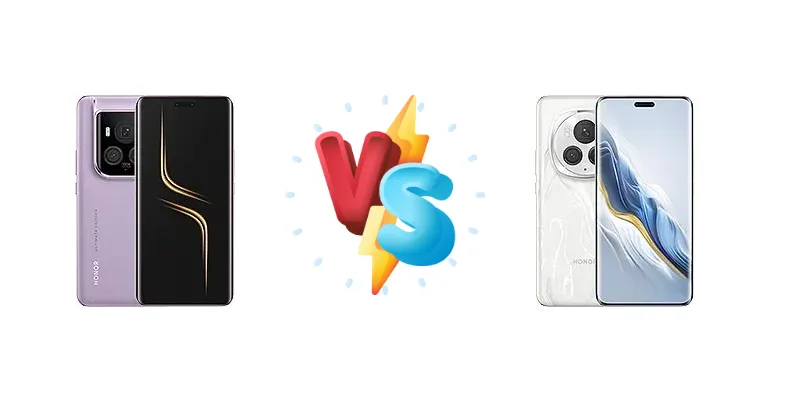
|
🏆 Quick Verdict
For most users, the Honor Magic6 Pro delivers an exceptional experience with its impressive 1578 nit display and solid 14:06h active use battery life. The Ultimate offers incremental improvements, but the price premium doesn't justify the upgrade unless you specifically need the potential for slightly better thermal performance or future-proofing.
| PHONES | ||
|---|---|---|
| Phone Names | Honor Magic6 Ultimate | Honor Magic6 Pro |
| Network | ||
|---|---|---|
| 2G bands | GSM 850 / 900 / 1800 / 1900 | GSM 850 / 900 / 1800 / 1900 |
| 3G bands | HSDPA 800 / 850 / 900 / 1700(AWS) / 1900 / 2100 | HSDPA 800 / 850 / 900 / 1700(AWS) / 1900 / 2100 |
| 4G bands | LTE | LTE |
| 5G bands | SA/NSA | SA/NSA |
| Speed | HSPA, LTE, 5G | HSPA, LTE, 5G |
| Technology | GSM / CDMA / HSPA / CDMA2000 / LTE / 5G | GSM / CDMA / HSPA / CDMA2000 / LTE / 5G |
| Launch | ||
|---|---|---|
| Announced | 2024, March 18 | 2024, January 11 |
| Status | Available. Released 2024, March 22 | Available. Released 2024, January 18 |
| Body | ||
|---|---|---|
| Build | Glass front, silicone polymer back (eco leather) | Glass front (NanoCrystal Shield), glass back or silicone polymer back (eco leather) |
| Dimensions | 162.5 x 75.8 x 8.9 mm (6.40 x 2.98 x 0.35 in) | 162.5 x 75.8 x 8.9 mm (6.40 x 2.98 x 0.35 in) |
| SIM | Nano-SIM + Nano-SIM | · Nano-SIM + eSIM· Nano-SIM + Nano-SIM |
| Weight | 227 g (8.01 oz) | 225 g or 229 g (7.94 oz) |
| Display | ||
|---|---|---|
| Protection | King Kong Rhinoceros | NanoCrystal Shield |
| Resolution | 1280 x 2800 pixels, 19.5:9 ratio (~453 ppi density) | 1280 x 2800 pixels, 19.5:9 ratio (~453 ppi density) |
| Size | 6.8 inches, 112.8 cm2 (~91.6% screen-to-body ratio) | 6.8 inches, 112.8 cm2 (~91.6% screen-to-body ratio) |
| Type | LTPO OLED, 1B colors, 120Hz, Dolby Vision, HDR, 1600 nits (HBM), 5000 nits (peak) | LTPO OLED, 1B colors, 120Hz, Dolby Vision, HDR, 1600 nits (HBM), 5000 nits (peak) |
| Platform | ||
|---|---|---|
| CPU | Octa-core (1x3.3 GHz Cortex-X4 & 3x3.2 GHz Cortex-A720 & 2x3.0 GHz Cortex-A720 & 2x2.3 GHz Cortex-A520) | Octa-core (1x3.3 GHz Cortex-X4 & 3x3.2 GHz Cortex-A720 & 2x3.0 GHz Cortex-A720 & 2x2.3 GHz Cortex-A520) |
| Chipset | Qualcomm SM8650-AB Snapdragon 8 Gen 3 (4 nm) | Qualcomm SM8650-AB Snapdragon 8 Gen 3 (4 nm) |
| GPU | Adreno 750 | Adreno 750 |
| OS | Android 14, MagicOS 8 | Android 14, up to 4 major Android upgrades, MagicOS 8 |
| Memory | ||
|---|---|---|
| Card slot | No | No |
| Internal | 512GB 16GB RAM, 1TB 16GB RAM | 256GB 12GB RAM, 256GB 16GB RAM, 512GB 12GB RAM, 512GB 16GB RAM, 1TB 16GB RAM |
| Main Camera | ||
|---|---|---|
| Features | Color spectrum sensor, LED flash, HDR, panorama | Laser AF, color spectrum sensor, LED flash, HDR, panorama |
| Triple | 50 MP, f/1.4-2.0, 23mm (wide), 1/1.3", LiDAR AF, PDAF, OIS 180 MP, f/2.6, (periscope telephoto), 1/1.49", PDAF, OIS, 2.5x optical zoom 50 MP, f/2.0, 13mm, 122˚ (ultrawide), AF | 50 MP, f/1.4-2.0, 23mm (wide), 1/1.3", 1.2µm, PDAF, OIS 180 MP, f/2.6, (periscope telephoto), 1/1.49", 0.56µm, PDAF, OIS, 2.5x optical zoom 50 MP, f/2.0, 13mm, 122˚ (ultrawide), 1/2.88", 0.61µm, AF |
| Video | 4K@24/30/60fps, 1080p@30/60/120/240fps, gyro-EIS, OIS, HDR, 10-bit video | 4K@24/30/60fps, 1080p@30/60/120/240fps, gyro-EIS, OIS, HDR, 10-bit video |
| Selfie camera | ||
|---|---|---|
| Single | 50 MP, f/2.0, (ultrawide), AF TOF 3D, (depth/biometrics sensor) | 50 MP, f/2.0, 22mm (wide), 1/2.93", 0.6µm, AF TOF 3D, (depth/biometrics sensor) |
| Video | 4K@30fps, 1080p@30/60fps, gyro-EIS | 4K@30fps, 1080p@30/60fps, gyro-EIS |
| Sound | ||
|---|---|---|
| 35mm jack | No | No |
| Loudspeaker | Yes, with stereo speakers | Yes, with stereo speakers |
| Comms | ||
|---|---|---|
| Bluetooth | 5.3, A2DP, LE, aptX HD | 5.3, A2DP, LE, aptX HD |
| Infrared port | Yes | Yes |
| NFC | Yes | Yes |
| Positioning | GPS (L1+L5), GLONASS, BDS (B1I+B1c+B2a), GALILEO (E1+E5a) | GPS (L1+L5), GLONASS, BDS (B1I+B1c+B2a), GALILEO (E1+E5a) |
| Radio | No | No |
| USB | USB Type-C 3.2, DisplayPort 1.2, OTG | USB Type-C 3.2, DisplayPort 1.2, OTG |
| WLAN | Wi-Fi 802.11 a/b/g/n/ac/6/7, dual-band, Wi-Fi Direct | Wi-Fi 802.11 a/b/g/n/ac/6/7, dual-band, Wi-Fi Direct |
| Features | ||
|---|---|---|
| Sensors | Fingerprint (under display, optical), Face ID, accelerometer, gyro, proximity, compass | Fingerprint (under display, optical), Face ID, accelerometer, gyro, proximity, compass |
| Battery | ||
|---|---|---|
| Charging | 80W wired 66W wireless Reverse wireless 5W reverse wired | 80W wired 66W wireless Reverse wireless 5W reverse wired |
| Type | Li-Po 5600 mAh | Si/C Li-Ion 5600 mAh |
| Misc | ||
|---|---|---|
| Colors | Black, Purple | Black, Green, Blue, Purple, White |
| Models | BVL-AN20 | BVL-AN16, BVL-N49 |
| Price | About 900 EUR | € 455.54 / $ 899.00 / £ 598.99 |
Honor Magic6 Ultimate
- Potential for superior thermal management
- Possible camera improvements over the Pro
- Future-proofed with potentially advanced cooling
- Higher price point
- Missing detailed specifications
- Diminishing returns for most users
Honor Magic6 Pro
- Excellent 1578 nit display brightness
- Impressive 14:06h active use battery life
- More affordable than the Ultimate
- May throttle slightly faster under sustained load
- Potentially less advanced camera system
- Lacks the 'Ultimate' branding appeal
Display Comparison
Both the Magic6 Pro and Ultimate utilize high-quality displays, but the Pro boasts a measured peak brightness of 1578 nits, suggesting a superior outdoor visibility experience. While the Ultimate's panel specifications aren't provided, the Pro's brightness is a significant advantage. Both likely employ LTPO technology for adaptive refresh rates, conserving battery life. The absence of detailed display specs for the Ultimate makes a direct comparison difficult, but the Pro's measured brightness is a clear win.
Camera Comparison
Detailed camera specifications are missing for both devices, making a comprehensive comparison challenging. However, the Ultimate's name suggests a more advanced camera system. Without sensor size, aperture, or OIS details, it's difficult to assess the image quality difference. We can assume both phones will offer excellent image processing capabilities, leveraging the Snapdragon 8 Gen 3's ISP. Ignoring the likely present but unimportant 2MP macro sensors, the key differentiator will be the main sensor and its associated optics.
Performance
Both devices are powered by the Qualcomm SM8650-AB Snapdragon 8 Gen 3 (4 nm) chipset, featuring an identical CPU configuration: 1x3.3 GHz Cortex-X4, 3x3.2 GHz Cortex-A720, 2x3.0 GHz Cortex-A720, and 2x2.3 GHz Cortex-A520. This means raw processing power will be nearly identical. However, the Ultimate *may* benefit from a more advanced cooling system, potentially allowing the Snapdragon 8 Gen 3 to sustain peak performance for longer durations during demanding tasks like prolonged gaming. The 4nm process node contributes to improved thermal efficiency in both devices, minimizing throttling compared to older generations.
Battery Life
The Magic6 Pro demonstrates impressive battery life with a 14:06h active use score. While the Ultimate's battery capacity isn't specified, both devices share the same charging capabilities: 80W wired, 66W wireless, and 5W reverse wired. The Pro's longer active use time suggests a more efficient combination of battery size and software optimization. The 80W wired charging ensures rapid replenishment, while 66W wireless charging provides convenient power-ups. The inclusion of reverse wireless and wired charging adds versatility for topping up accessories.
Buying Guide
Buy the Honor Magic6 Ultimate if you demand the absolute best in performance and are willing to pay a premium for potential future-proofing and the most robust thermal solution. Buy the Honor Magic6 Pro if you prioritize a stunning display, excellent battery life, and a more balanced overall package at a more reasonable price point. The Pro is ideal for everyday users, content consumers, and mobile gamers who don't require the absolute peak performance.