
Honor Magic6 RSR Porsche Design vs Xiaomi 14 Ultra: A Deep Dive into Battery, Display, and Performance
| Phones Images | |||||
|---|---|---|---|---|---|
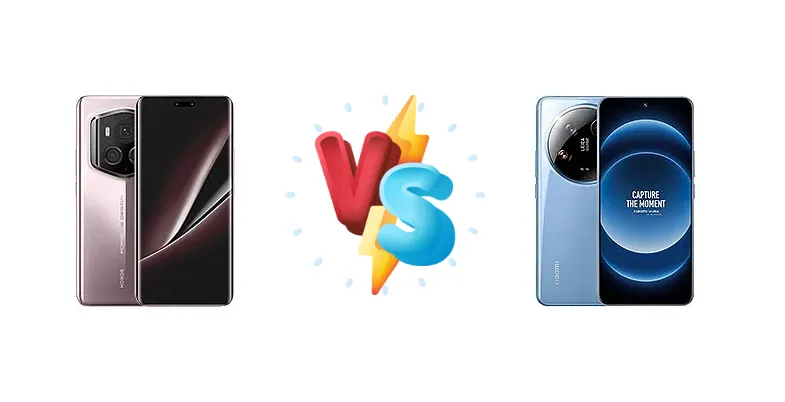
|
🏆 Quick Verdict
For the average user prioritizing all-day battery life and a brighter display, the Honor Magic6 RSR Porsche Design emerges as the winner. Its 14:14 active use score significantly surpasses the Xiaomi 14 Ultra’s 11:25, making it ideal for power users. However, the Xiaomi 14 Ultra’s faster wired charging is a compelling advantage for those who frequently need a quick top-up.
| PHONES | ||
|---|---|---|
| Phone Names | Honor Magic6 RSR Porsche Design | Xiaomi 14 Ultra |
| Network | ||
|---|---|---|
| 2G bands | GSM 850 / 900 / 1800 / 1900 | GSM 850 / 900 / 1800 / 1900 |
| 3G bands | HSDPA 800 / 850 / 900 / 1700(AWS) / 1900 / 2100 | HSDPA 800 / 850 / 900 / 1700(AWS) / 1900 / 2100 |
| 4G bands | LTE | 1, 2, 3, 4, 5, 7, 8, 18, 19, 20, 26, 28, 38, 40, 41, 42, 48, 66 - International |
| 5G bands | SA/NSA | 1, 2, 3, 5, 7, 8, 20, 28, 38, 40, 41, 48, 66, 77, 78, 79 SA/NSA - International |
| Speed | HSPA, LTE, 5G | HSPA, LTE, 5G |
| Technology | GSM / CDMA / HSPA / CDMA2000 / LTE / 5G | GSM / CDMA / HSPA / EVDO / LTE / 5G |
| Launch | ||
|---|---|---|
| Announced | 2024, March 18 | 2024, February 22 |
| Status | Available. Released 2024, March 22 | Available. Released 2024, February 22 |
| Body | ||
|---|---|---|
| Build | Glass front (NanoCrystal Shield), glass back (NanoCrystal Shield), titanium frame | Glass front (Shield Glass), glass back or silicone polymer back (eco leather), titanium frame (grade 5) or aluminum alloy frame |
| Dimensions | 162.5 x 75.8 x 8.9 mm (6.40 x 2.98 x 0.35 in) | 161.4 x 75.3 x 9.2 mm (6.35 x 2.96 x 0.36 in) |
| SIM | · Nano-SIM + eSIM· Nano-SIM + Nano-SIM | Nano-SIM + Nano-SIM |
| Weight | 237 g (8.36 oz) | 219.8 / 224.4 / 229.5 g (7.76 oz) |
| Display | ||
|---|---|---|
| Protection | NanoCrystal Shield | Xiaomi Shield Glass |
| Resolution | 1280 x 2800 pixels, 19.5:9 ratio (~453 ppi density) | 1440 x 3200 pixels, 20:9 ratio (~522 ppi density) |
| Size | 6.8 inches, 112.8 cm2 (~91.6% screen-to-body ratio) | 6.73 inches, 108.9 cm2 (~89.6% screen-to-body ratio) |
| Type | LTPO OLED, 1B colors, 120Hz, Dolby Vision, HDR, 1800 nits (HBM), 5000 nits (peak) | LTPO AMOLED, 68B colors, 120Hz, 1920Hz PWM, Dolby Vision, HDR10+, 1000 nits (typ), 3000 nits (peak) |
| Platform | ||
|---|---|---|
| CPU | Octa-core (1x3.3 GHz Cortex-X4 & 3x3.2 GHz Cortex-A720 & 2x3.0 GHz Cortex-A720 & 2x2.3 GHz Cortex-A520) | Octa-core (1x3.3 GHz Cortex-X4 & 3x3.2 GHz Cortex-A720 & 2x3.0 GHz Cortex-A720 & 2x2.3 GHz Cortex-A520) |
| Chipset | Qualcomm SM8650-AB Snapdragon 8 Gen 3 (4 nm) | Qualcomm SM8650-AB Snapdragon 8 Gen 3 (4 nm) |
| GPU | Adreno 750 | Adreno 750 |
| OS | Android 14, MagicOS 8 | Android 14, up to 4 major Android upgrades, HyperOS |
| Memory | ||
|---|---|---|
| Card slot | No | No |
| Internal | 1TB 24GB RAM | 256GB 12GB RAM, 512GB 16GB RAM, 1TB 16GB RAM |
| Main Camera | ||
|---|---|---|
| Features | Color spectrum sensor, LED flash, HDR, panorama | Laser AF, color spectrum sensor, Leica lenses, Dual-LED flash, HDR, panorama, 67mm filter ring holder (optional) |
| Quad | - | 50 MP, f/1.6-f/4.0, 23mm (wide), 1.0"-type, 1.6µm, dual pixel PDAF, OIS 50 MP, f/1.8, 75mm (telephoto), 1/2.51", 0.7µm, dual pixel PDAF (10cm - ∞), OIS, 3.2x optical zoom 50 MP, f/2.5, 120mm (periscope telephoto), 1/2.51", 0.7µm, dual pixel PDAF (30cm - ∞), OIS, 5x optical zoom 50 MP, f/1.8, 12mm, 122˚ (ultrawide), 1/2.51", 0.7µm, dual pixel PDAF TOF 3D, (depth) |
| Triple | 50 MP, f/1.4-2.0, 23mm (wide), 1/1.3", LiDAR AF, PDAF, OIS 180 MP, f/2.6, (periscope telephoto), 1/1.49", 0.56µm, PDAF, OIS, 2.5x optical zoom 50 MP, f/2.0, 13mm, 122˚ (ultrawide), 1/2.88", AF | - |
| Video | 4K@24/30/60fps, 1080p@30/60/120/240fps, gyro-EIS, OIS, HDR, 10-bit video | 8K@24/30fps, 4K@24/30/60/120fps, 1080p@30/60/120/240/480/960/1920fps, gyro-EIS, Dolby Vision HDR 10-bit rec. (4K@60fps, 1080p) |
| Selfie camera | ||
|---|---|---|
| Features | - | HDR, panorama |
| Single | 50 MP, f/2.0, 22mm (wide), 1/2.93", AF TOF 3D, (depth/biometrics sensor) | 32 MP, f/2.0, 22mm (wide), 1/3.14", 0.7µm |
| Video | 4K@30fps, 1080p@30/60fps, gyro-EIS | 4K@30/60fps, 1080p@30/60fps, gyro-EIS |
| Sound | ||
|---|---|---|
| 35mm jack | No | No |
| Loudspeaker | Yes, with stereo speakers | Yes, with stereo speakers |
| Comms | ||
|---|---|---|
| Bluetooth | 5.3, A2DP, LE, aptX HD | 5.4, A2DP, LE, aptX HD, aptX Adaptive, LHDC |
| Infrared port | Yes | Yes |
| NFC | Yes | Yes |
| Positioning | GPS (L1+L5), GLONASS, BDS (B1I+B1c+B2a), GALILEO (E1+E5a) | GPS (L1+L5), GLONASS (L1), BDS (B1I+B1c+B2a), GALILEO (E1+E5a), QZSS (L1+L5), NavIC (L5) |
| Radio | No | No |
| USB | USB Type-C 3.2, DisplayPort 1.2, OTG | USB Type-C 3.2 Gen 2, DisplayPort, OTG |
| WLAN | Wi-Fi 802.11 a/b/g/n/ac/6/7, dual-band, Wi-Fi Direct | Wi-Fi 802.11 a/b/g/n/ac/6e/7, tri-band, Wi-Fi Direct |
| Features | ||
|---|---|---|
| Sensors | Fingerprint (under display, optical), Face ID, accelerometer, gyro, proximity, compass | Fingerprint (under display, optical), accelerometer, proximity, gyro, compass, barometer |
| Battery | ||
|---|---|---|
| Charging | 80W wired 66W wireless Reverse wireless 5W reverse wired | 90W wired, PD3.0, QC4, 100% in 33 min 80W wireless, 100% in 46 min 10W reverse wireless |
| Type | Si/C Li-Ion 5600 mAh | Market-dependent versions:· 5000 mAh (Global)· 5300 mAh (China only) |
| Misc | ||
|---|---|---|
| Colors | Agate Grey, Frozen Berry | Black, Blue, White, Titanium Gray |
| Models | BVL-N59, BVL-AN20 | 24031PN0DC, 24030PN60G |
| Price | About 3020 EUR | € 663.14 |
| SAR | - | 0.83 W/kg (head) 0.82 W/kg (body) |
| SAR EU | - | 1.00 W/kg (head) 1.00 W/kg (body) |
Honor Magic6 RSR Porsche Design
- Significantly longer battery life (14:14h)
- Brighter display (1731 nits)
- Unique Porsche Design aesthetic
- Slower wired charging (80W)
- Camera system likely less versatile than Xiaomi
Xiaomi 14 Ultra
- Faster wired charging (90W, 33min to 100%)
- Potentially superior camera system
- Faster wireless charging (80W)
- Shorter battery life (11:25h)
- Dimmer display (1281 nits)
Display Comparison
The Honor Magic6 RSR Porsche Design boasts a significantly brighter display, reaching a measured 1731 nits compared to the Xiaomi 14 Ultra’s 1281 nits. This 450-nit difference translates to superior readability under direct sunlight. While both utilize OLED technology, the peak brightness advantage of the Honor is substantial. Both are expected to have LTPO panels for adaptive refresh rates, but the Honor’s higher brightness provides a clear advantage for outdoor users. The impact of PWM dimming rates, not provided in the data, would be a key differentiator for users sensitive to flicker.
Camera Comparison
The provided data doesn’t offer camera specifics, making a direct comparison impossible. However, Xiaomi’s Ultra series is renowned for its camera capabilities, often featuring large sensors and advanced image processing. The Honor Magic series has been steadily improving its camera performance, but Xiaomi typically holds an edge in this area. Without sensor size, aperture, or OIS details, we can only speculate that the Xiaomi 14 Ultra will likely offer a more comprehensive and versatile camera experience, particularly in low-light conditions. The absence of information on video recording capabilities further limits this comparison.
Performance
Both devices are powered by the Qualcomm SM8650-AB Snapdragon 8 Gen 3 (4 nm) chipset, featuring the same CPU configuration: 1x3.3 GHz Cortex-X4, 3x3.2 GHz Cortex-A720, 2x3.0 GHz Cortex-A720, and 2x2.3 GHz Cortex-A520. This means raw processing power will be nearly identical. Performance differences will likely stem from thermal management and RAM optimization. The lack of RAM specifications prevents a deeper analysis, but both are expected to utilize LPDDR5x. Sustained performance under heavy load will be the deciding factor, and independent thermal testing is crucial.
Battery Life
The Honor Magic6 RSR Porsche Design delivers a substantial battery life advantage, achieving 14:14 hours of active use compared to the Xiaomi 14 Ultra’s 11:25 hours. This nearly 3-hour difference is significant for users who heavily utilize their smartphones throughout the day. While the Xiaomi 14 Ultra compensates with faster charging – 90W wired (33 minutes to 100%) versus 80W on the Honor – the longer runtime of the Honor is a more impactful benefit for many. The Xiaomi also offers 80W wireless charging (46 minutes to 100%) compared to the Honor’s 66W, and both support reverse wireless charging, though at different wattages (10W vs 5W).
Buying Guide
Buy the Honor Magic6 RSR Porsche Design if you need exceptional battery life, a noticeably brighter display for outdoor visibility, and appreciate a unique, Porsche-inspired aesthetic. Buy the Xiaomi 14 Ultra if you prioritize the fastest possible wired charging speeds, a potentially more versatile camera system (pending full camera analysis), and are willing to trade some battery endurance for those features.