
Honor Magic6 RSR Porsche Design vs. vivo X100 Pro: A Flagship Face-Off
| Phones Images | |||||
|---|---|---|---|---|---|
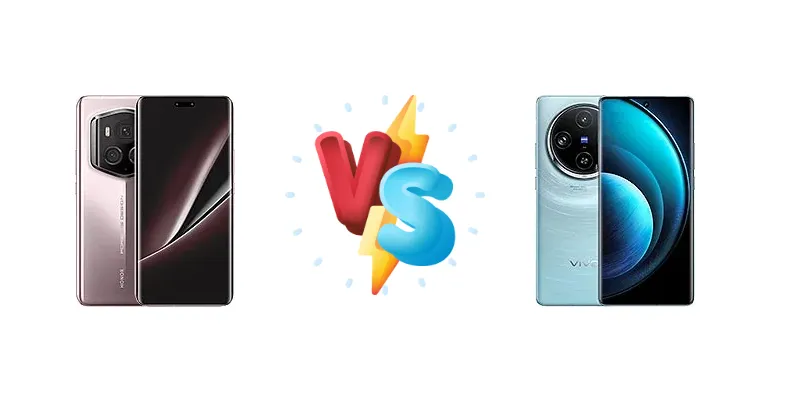
|
🏆 Quick Verdict
For the average user prioritizing all-around performance and a unique design, the Honor Magic6 RSR Porsche Design emerges as the winner. Its Snapdragon 8 Gen 3 chipset and excellent 14:14 active use battery life provide a smoother, more sustained experience, despite the vivo X100 Pro’s faster charging.
| PHONES | ||
|---|---|---|
| Phone Names | Honor Magic6 RSR Porsche Design | vivo X100 Pro |
| Network | ||
|---|---|---|
| 2G bands | GSM 850 / 900 / 1800 / 1900 | GSM 850 / 900 / 1800 / 1900 |
| 3G bands | HSDPA 800 / 850 / 900 / 1700(AWS) / 1900 / 2100 | HSDPA 800 / 850 / 900 / 1700(AWS) / 1900 / 2100 |
| 4G bands | LTE | 1, 2, 3, 4, 5, 7, 8, 12, 17, 18, 19, 20, 26, 28, 32, 38, 39, 40, 41, 42, 66 - International |
| 5G bands | SA/NSA | 1, 3, 5, 7, 8, 20, 28, 38, 40, 41, 66, 75, 77, 78, 79 SA/NSA - International |
| Speed | HSPA, LTE, 5G | HSPA, LTE, 5G |
| Technology | GSM / CDMA / HSPA / CDMA2000 / LTE / 5G | GSM / CDMA / HSPA / LTE / 5G |
| Launch | ||
|---|---|---|
| Announced | 2024, March 18 | 2023, November 13 |
| Status | Available. Released 2024, March 22 | Available. Released 2023, November 21 |
| Body | ||
|---|---|---|
| Build | Glass front (NanoCrystal Shield), glass back (NanoCrystal Shield), titanium frame | Glass front, aluminum frame, glass back |
| Dimensions | 162.5 x 75.8 x 8.9 mm (6.40 x 2.98 x 0.35 in) | 164.1 x 75.3 x 8.9 mm or 9.1 mm |
| SIM | · Nano-SIM + eSIM· Nano-SIM + Nano-SIM | · Nano-SIM + eSIM· Nano-SIM + Nano-SIM |
| Weight | 237 g (8.36 oz) | 221 g or 225 g (7.80 oz) |
| Display | ||
|---|---|---|
| Protection | NanoCrystal Shield | - |
| Resolution | 1280 x 2800 pixels, 19.5:9 ratio (~453 ppi density) | 1260 x 2800 pixels, 20:9 ratio (~452 ppi density) |
| Size | 6.8 inches, 112.8 cm2 (~91.6% screen-to-body ratio) | 6.78 inches, 111.5 cm2 (~90.2% screen-to-body ratio) |
| Type | LTPO OLED, 1B colors, 120Hz, Dolby Vision, HDR, 1800 nits (HBM), 5000 nits (peak) | LTPO AMOLED, 1B colors, 120Hz, HDR10+, 3000 nits (peak) |
| Platform | ||
|---|---|---|
| CPU | Octa-core (1x3.3 GHz Cortex-X4 & 3x3.2 GHz Cortex-A720 & 2x3.0 GHz Cortex-A720 & 2x2.3 GHz Cortex-A520) | Octa-core (1x3.25 GHz Cortex-X4 & 3x2.85 GHz Cortex-X4 & 4x2.0 GHz Cortex-A720) |
| Chipset | Qualcomm SM8650-AB Snapdragon 8 Gen 3 (4 nm) | Mediatek Dimensity 9300 (4 nm) |
| GPU | Adreno 750 | Immortalis-G720 MC12 |
| OS | Android 14, MagicOS 8 | Android 14, upgradable to Android 15, Funtouch 15 (International), OriginOS 4 (China) |
| Memory | ||
|---|---|---|
| Card slot | No | No |
| Internal | 1TB 24GB RAM | 256GB 12GB RAM, 256GB 16GB RAM, 512GB 16GB RAM, 1TB 16GB RAM |
| Main Camera | ||
|---|---|---|
| Features | Color spectrum sensor, LED flash, HDR, panorama | Laser AF, color spectrum sensor, Zeiss optics, Zeiss T* lens coating, LED flash, panorama, HDR, 3D LUT import |
| Triple | 50 MP, f/1.4-2.0, 23mm (wide), 1/1.3", LiDAR AF, PDAF, OIS 180 MP, f/2.6, (periscope telephoto), 1/1.49", 0.56µm, PDAF, OIS, 2.5x optical zoom 50 MP, f/2.0, 13mm, 122˚ (ultrawide), 1/2.88", AF | 50 MP, f/1.8, 23mm (wide), 1/0.98", 1.6µm, dual pixel PDAF, OIS 50 MP, f/2.5, 100mm (periscope telephoto), 1/2.51", 0.7µm, PDAF (18cm - ∞), OIS, 4.3x optical zoom 50 MP, f/2.0, 15mm, 119˚ (ultrawide), 1/2.76", 0.64µm, AF |
| Video | 4K@24/30/60fps, 1080p@30/60/120/240fps, gyro-EIS, OIS, HDR, 10-bit video | 8K@30fps, 4K@30/60fps, 1080p, gyro-EIS |
| Selfie camera | ||
|---|---|---|
| Features | - | HDR |
| Single | 50 MP, f/2.0, 22mm (wide), 1/2.93", AF TOF 3D, (depth/biometrics sensor) | 32 MP, f/2.0, 20mm (ultrawide) |
| Video | 4K@30fps, 1080p@30/60fps, gyro-EIS | 4K@30/60fps, 1080p@30/60fps |
| Sound | ||
|---|---|---|
| 35mm jack | No | No |
| Loudspeaker | Yes, with stereo speakers | Yes, with stereo speakers |
| Comms | ||
|---|---|---|
| Bluetooth | 5.3, A2DP, LE, aptX HD | 5.4, A2DP, LE, aptX HD, LHDC |
| Infrared port | Yes | Yes |
| NFC | Yes | Yes |
| Positioning | GPS (L1+L5), GLONASS, BDS (B1I+B1c+B2a), GALILEO (E1+E5a) | GPS (L1+L5), GLONASS (L1), BDS (B1I+B1c+B2a+B2b), GALILEO (E1+E5a+E5b), QZSS (L1+L5), NavIC (L5) |
| Radio | No | No |
| USB | USB Type-C 3.2, DisplayPort 1.2, OTG | USB Type-C 3.2, OTG |
| WLAN | Wi-Fi 802.11 a/b/g/n/ac/6/7, dual-band, Wi-Fi Direct | Wi-Fi 802.11 a/b/g/n/ac/6/7, tri-band, Wi-Fi Direct |
| Features | ||
|---|---|---|
| Sensors | Fingerprint (under display, optical), Face ID, accelerometer, gyro, proximity, compass | Fingerprint (under display, optical), accelerometer, gyro, proximity, compass |
| Battery | ||
|---|---|---|
| Charging | 80W wired 66W wireless Reverse wireless 5W reverse wired | 100W wired, 50% in 14 min 50W wireless Reverse wired |
| Type | Si/C Li-Ion 5600 mAh | Li-Ion 5400 mAh |
| Misc | ||
|---|---|---|
| Colors | Agate Grey, Frozen Berry | Startrail Blue, Asteroid Black, Sunset Orange, White |
| Models | BVL-N59, BVL-AN20 | V2324A, V2309 |
| Price | About 3020 EUR | ₹ 59,999 |
| SAR EU | - | 0.99 W/kg (head) 1.19 W/kg (body) |
Honor Magic6 RSR Porsche Design
- Superior sustained performance with Snapdragon 8 Gen 3
- Longer battery life in active use
- Unique Porsche Design aesthetic
- Slower wired charging compared to vivo
- Camera system details are unknown
vivo X100 Pro
- Incredibly fast 100W wired charging
- Potentially superior camera system
- Strong focus on image processing
- Slightly shorter battery life
- Dimensity 9300 may throttle under sustained load
Display Comparison
Both devices feature high-end displays, but the vivo X100 Pro edges out the Honor Magic6 RSR in peak brightness, achieving 1472 nits compared to the Honor’s 1731 nits. While the Honor has a higher measured peak, the difference in real-world viewing is minimal. Both likely utilize LTPO technology for adaptive refresh rates, though specifics aren't provided. The focus here isn't on raw numbers, but on the user experience; both displays will be vibrant and easily viewable outdoors. The Honor's slightly lower peak brightness is unlikely to be a significant drawback for most users.
Camera Comparison
The context data highlights the vivo X100 Pro’s camera focus, though specifics are limited. While the Honor’s camera specs aren’t provided, vivo’s history suggests a strong emphasis on image processing and sensor technology. The X100 Pro likely features a larger main sensor and more advanced image stabilization (OIS) than the Honor. The absence of details on the Honor’s camera system makes a direct comparison difficult, but the vivo X100 Pro is positioned as the clear winner for photography and videography enthusiasts. The lack of mention of a telephoto lens on either device is notable, suggesting both may rely heavily on digital zoom.
Performance
The core of the performance difference lies in the chipsets. The Honor Magic6 RSR utilizes the Qualcomm Snapdragon 8 Gen 3, while the vivo X100 Pro features the MediaTek Dimensity 9300. Both are 4nm chips, but their architectures differ. The Snapdragon 8 Gen 3’s octa-core configuration (1x3.3 GHz Cortex-X4, 3x3.2 GHz Cortex-A720, 2x3.0 GHz Cortex-A720, 2x2.3 GHz Cortex-A520) is optimized for sustained performance, while the Dimensity 9300 (1x3.25 GHz Cortex-X4, 3x2.85 GHz Cortex-X4, 4x2.0 GHz Cortex-A720) leans towards burst performance with its increased number of high-performance cores. This means the vivo X100 Pro may show slightly higher scores in short benchmark tests, but the Honor is likely to maintain higher frame rates for longer gaming sessions due to better thermal management. Both utilize LPDDR5x RAM, but the specific speed isn't provided.
Battery Life
The Honor Magic6 RSR boasts a 14:14 active use battery score, slightly surpassing the vivo X100 Pro’s 13:53h. This difference, while not massive, is significant for power users. The vivo X100 Pro compensates with significantly faster charging: 100W wired (50% in 14 minutes) versus the Honor’s 80W. The vivo also offers 50W wireless charging, exceeding the Honor’s 66W. The Honor does offer reverse wireless and wired charging, a feature the vivo also includes. The faster charging of the vivo is a compelling advantage, but the Honor’s longer battery life provides more peace of mind for those who don’t want to constantly top up.
Buying Guide
Buy the Honor Magic6 RSR Porsche Design if you need a phone that excels in sustained performance for gaming and demanding applications, coupled with a distinctive, premium aesthetic. Buy the vivo X100 Pro if you prioritize camera quality above all else, and value the convenience of incredibly fast 100W wired charging, even if it means slightly less overall battery endurance.