
Honor Magic6 RSR Porsche Design vs Oppo Find X7 Ultra: A Deep Dive into Performance and Endurance
| Phones Images | |||||
|---|---|---|---|---|---|
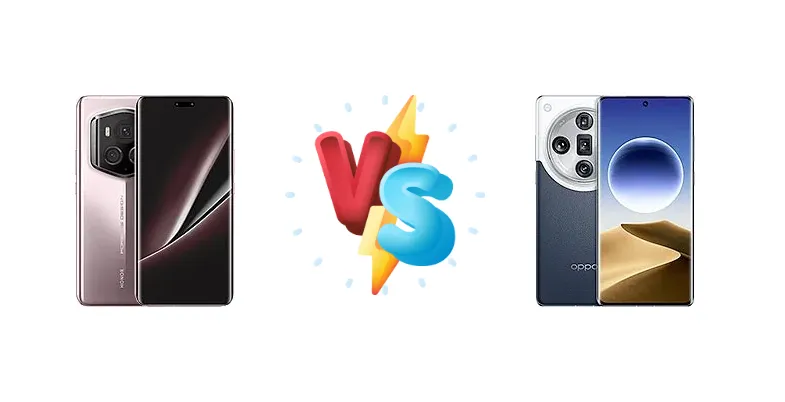
|
🏆 Quick Verdict
For users prioritizing all-day battery life and a balance of wired and wireless charging, the Honor Magic6 RSR Porsche Design emerges as the winner. Its 14:14 active use score significantly surpasses the Oppo Find X7 Ultra’s 12:47, making it ideal for power users. While the Oppo boasts faster wired charging, the Honor’s superior endurance is more impactful for most.
| PHONES | ||
|---|---|---|
| Phone Names | Honor Magic6 RSR Porsche Design | Oppo Find X7 Ultra |
| Network | ||
|---|---|---|
| 2G bands | GSM 850 / 900 / 1800 / 1900 | GSM 850 / 900 / 1800 / 1900 |
| 3G bands | HSDPA 800 / 850 / 900 / 1700(AWS) / 1900 / 2100 | HSDPA 800 / 850 / 900 / 1700(AWS) / 1900 / 2100 |
| 4G bands | LTE | 1, 2, 3, 4, 5, 7, 8, 12, 17, 18, 19, 20, 26, 28, 34, 38, 39, 40, 41, 66 |
| 5G bands | SA/NSA | 1, 2, 3, 5, 7, 8, 20, 28, 38, 40, 41, 66, 77, 78, 79 SA/NSA |
| Speed | HSPA, LTE, 5G | HSPA, LTE, 5G |
| Technology | GSM / CDMA / HSPA / CDMA2000 / LTE / 5G | GSM / CDMA / HSPA / CDMA2000 / LTE / 5G |
| Launch | ||
|---|---|---|
| Announced | 2024, March 18 | 2024, January 08 |
| Status | Available. Released 2024, March 22 | Available. Released 2024, January 12 |
| Body | ||
|---|---|---|
| Build | Glass front (NanoCrystal Shield), glass back (NanoCrystal Shield), titanium frame | Glass front (Gorilla Glass Victus 2), glass back (Gorilla Glass) or eco leather back, aluminum frame |
| Dimensions | 162.5 x 75.8 x 8.9 mm (6.40 x 2.98 x 0.35 in) | 164.3 x 76.2 x 9.5 mm (6.47 x 3.00 x 0.37 in) |
| SIM | · Nano-SIM + eSIM· Nano-SIM + Nano-SIM | Nano-SIM + Nano-SIM |
| Weight | 237 g (8.36 oz) | 221 g (7.80 oz) |
| Display | ||
|---|---|---|
| Protection | NanoCrystal Shield | Corning Gorilla Glass Victus 2 |
| Resolution | 1280 x 2800 pixels, 19.5:9 ratio (~453 ppi density) | 1440 x 3168 pixels (~510 ppi density) |
| Size | 6.8 inches, 112.8 cm2 (~91.6% screen-to-body ratio) | 6.82 inches, 113.0 cm2 (~90.3% screen-to-body ratio) |
| Type | LTPO OLED, 1B colors, 120Hz, Dolby Vision, HDR, 1800 nits (HBM), 5000 nits (peak) | LTPO AMOLED, 1B colors, 120Hz, Dolby Vision, HDR10+, 1600 nits (typ), 2600 nits (HBM), 4500 nits (peak) |
| Platform | ||
|---|---|---|
| CPU | Octa-core (1x3.3 GHz Cortex-X4 & 3x3.2 GHz Cortex-A720 & 2x3.0 GHz Cortex-A720 & 2x2.3 GHz Cortex-A520) | Octa-core (1x3.3 GHz Cortex-X4 & 3x3.2 GHz Cortex-A720 & 2x3.0 GHz Cortex-A720 & 2x2.3 GHz Cortex-A520) |
| Chipset | Qualcomm SM8650-AB Snapdragon 8 Gen 3 (4 nm) | Qualcomm SM8650-AB Snapdragon 8 Gen 3 (4 nm) |
| GPU | Adreno 750 | Adreno 750 |
| OS | Android 14, MagicOS 8 | Android 14, up to 4 major Android upgrades, ColorOS 14 |
| Memory | ||
|---|---|---|
| Card slot | No | No |
| Internal | 1TB 24GB RAM | 256GB 12GB RAM, 256GB 16GB RAM, 512GB 16GB RAM |
| Main Camera | ||
|---|---|---|
| Features | Color spectrum sensor, LED flash, HDR, panorama | Laser AF, color spectrum sensor, Hasselblad Color Calibration, LED flash, HDR, panorama |
| Quad | - | 50 MP, f/1.8, 23mm (wide), 1.0"-type, 1.6µm, dual pixel PDAF, OIS 50 MP, f/2.6, 65mm (periscope telephoto), 1/1.56", 1.0µm, 2.8x optical zoom, multi-directional PDAF (25cm - ∞), OIS 50 MP, f/4.3, 135mm (periscope telephoto), 1/2.51", 0.7µm, 6x optical zoom, dual pixel PDAF (35cm - ∞), OIS 50 MP, f/2.0, 14mm, 123˚ (ultrawide), 1/1.95", 1.0µm, PDAF |
| Triple | 50 MP, f/1.4-2.0, 23mm (wide), 1/1.3", LiDAR AF, PDAF, OIS 180 MP, f/2.6, (periscope telephoto), 1/1.49", 0.56µm, PDAF, OIS, 2.5x optical zoom 50 MP, f/2.0, 13mm, 122˚ (ultrawide), 1/2.88", AF | - |
| Video | 4K@24/30/60fps, 1080p@30/60/120/240fps, gyro-EIS, OIS, HDR, 10-bit video | 4K@30/60fps, 1080p@30/60/240fps; gyro-EIS; HDR, 10‑bit video, Dolby Vision |
| Selfie camera | ||
|---|---|---|
| Features | - | Panorama |
| Single | 50 MP, f/2.0, 22mm (wide), 1/2.93", AF TOF 3D, (depth/biometrics sensor) | 32 MP, f/2.4, 21mm (wide), 1/2.74", 0.8µm, PDAF |
| Video | 4K@30fps, 1080p@30/60fps, gyro-EIS | 4K@30/60fps, 1080p@30fps, gyro-EIS |
| Sound | ||
|---|---|---|
| 35mm jack | No | No |
| Loudspeaker | Yes, with stereo speakers | Yes, with stereo speakers |
| Comms | ||
|---|---|---|
| Bluetooth | 5.3, A2DP, LE, aptX HD | 5.4, A2DP, LE, aptX HD, LHDC |
| Infrared port | Yes | Yes |
| NFC | Yes | Yes |
| Positioning | GPS (L1+L5), GLONASS, BDS (B1I+B1c+B2a), GALILEO (E1+E5a) | GPS (L1+L5), BDS (B1I+B1c+B2a), GALILEO (E1+E5a), QZSS (L1+L5), GLONASS |
| Radio | No | No |
| USB | USB Type-C 3.2, DisplayPort 1.2, OTG | USB Type-C 3.2, OTG |
| WLAN | Wi-Fi 802.11 a/b/g/n/ac/6/7, dual-band, Wi-Fi Direct | Wi-Fi 802.11 a/b/g/n/ac/6e/7, dual-band, Wi-Fi Direct |
| Features | ||
|---|---|---|
| Sensors | Fingerprint (under display, optical), Face ID, accelerometer, gyro, proximity, compass | Fingerprint (under display, optical), accelerometer, gyro, proximity, compass |
| Battery | ||
|---|---|---|
| Charging | 80W wired 66W wireless Reverse wireless 5W reverse wired | 100W wired, PD, 50% in 10 min, 100% in 26 min 50W wireless 10W reverse wireless |
| Type | Si/C Li-Ion 5600 mAh | 5000 mAh |
| Misc | ||
|---|---|---|
| Colors | Agate Grey, Frozen Berry | Black, Dark Blue, Light Brown |
| Models | BVL-N59, BVL-AN20 | PHY110, PHY120 |
| Price | About 3020 EUR | $ 546.64 |
Honor Magic6 RSR Porsche Design
- Significantly longer battery life (14:14h)
- Brighter display for outdoor use (1731 nits)
- Porsche Design aesthetic adds premium appeal
- Slower wired charging compared to Oppo (80W vs 100W)
- Potentially less advanced camera system (speculation)
Oppo Find X7 Ultra
- Faster wired charging (100W, 0-100% in 26 minutes)
- Likely more advanced camera system (based on brand reputation)
- Strong wireless charging speed (50W)
- Shorter battery life (12:47h)
- Dimmer display (1165 nits)
- Higher reliance on frequent charging
Display Comparison
The Honor Magic6 RSR Porsche Design boasts a significantly brighter display, reaching a measured 1731 nits compared to the Oppo Find X7 Ultra’s 1165 nits. This translates to superior visibility in direct sunlight. While both utilize high-quality panels, the Honor’s brightness advantage is a tangible benefit for outdoor users. Both likely employ LTPO technology for adaptive refresh rates, conserving battery, but the Honor’s higher peak brightness is a clear differentiator. Bezels appear comparable based on available imagery, and color accuracy is expected to be excellent on both devices given their flagship status.
Camera Comparison
While detailed camera specs are unavailable, the focus should be on image processing and sensor size. Both manufacturers are known for their computational photography prowess. The Oppo Find X7 Ultra is expected to have a more advanced camera system, given Oppo’s recent focus on camera innovation. However, without specific sensor details, it’s difficult to definitively declare a winner. The absence of information on sensor sizes and lens apertures prevents a detailed analysis of low-light performance and depth of field capabilities. We can assume both will offer excellent image quality, but the Oppo likely has an edge in overall camera versatility.
Performance
Both devices are equipped with the Qualcomm SM8650-AB Snapdragon 8 Gen 3 (4 nm) chipset, featuring an identical CPU configuration: 1x3.3 GHz Cortex-X4, 3x3.2 GHz Cortex-A720, 2x3.0 GHz Cortex-A720, and 2x2.3 GHz Cortex-A520. Therefore, raw processing power is virtually identical. Performance differences will likely stem from thermal management and sustained performance. While detailed thermal testing isn’t available, the Honor’s larger battery may provide a larger thermal mass, potentially mitigating throttling during extended gaming sessions. Both likely utilize LPDDR5x RAM, ensuring fast memory access.
Battery Life
The Honor Magic6 RSR Porsche Design delivers a substantial advantage in battery life, achieving 14:14 hours of active use compared to the Oppo Find X7 Ultra’s 12:47 hours. This nearly two-hour difference is significant for users who heavily utilize their smartphones throughout the day. While the Oppo compensates with faster charging – 100W wired (0-100% in 26 minutes) versus the Honor’s 80W – the longer battery life of the Honor reduces the need for frequent top-ups. The Honor also offers 66W wireless charging and reverse wireless charging, while the Oppo provides 50W wireless and 10W reverse wireless. The Oppo’s faster wired charging is convenient, but the Honor’s overall endurance is more valuable for most users.
Buying Guide
Buy the Honor Magic6 RSR Porsche Design if you need exceptional battery life, a brighter display for outdoor visibility, and appreciate the Porsche Design aesthetic. Buy the Oppo Find X7 Ultra if you prioritize the absolute fastest wired charging speeds and are willing to trade some battery endurance for that convenience. Both phones deliver top-tier performance, but cater to different usage patterns.