
Honor Magic6 RSR Porsche Design vs OnePlus 12R: A Deep Dive into Performance and Battery Life
| Phones Images | |||||
|---|---|---|---|---|---|
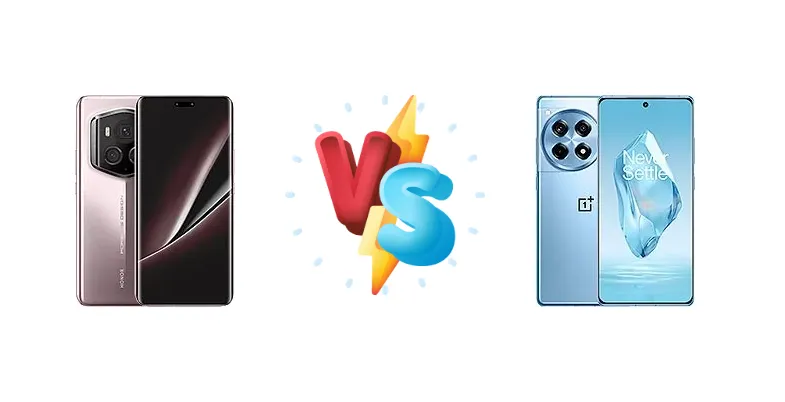
|
🏆 Quick Verdict
For the average user prioritizing all-day battery life and rapid charging, the OnePlus 12R emerges as the winner. Its 14:32h active use score and 100W charging significantly outperform the Honor Magic6 RSR Porsche Design, despite the latter’s more powerful processor. However, power users demanding the absolute best performance will find the Magic6 RSR’s Snapdragon 8 Gen 3 a worthwhile investment.
| PHONES | ||
|---|---|---|
| Phone Names | Honor Magic6 RSR Porsche Design | OnePlus 12R |
| Network | ||
|---|---|---|
| 2G bands | GSM 850 / 900 / 1800 / 1900 | GSM 850 / 900 / 1800 / 1900 |
| 3G bands | HSDPA 800 / 850 / 900 / 1700(AWS) / 1900 / 2100 | HSDPA 850 / 900 / 1700(AWS) / 1900 / 2100 |
| 4G bands | LTE | 1, 2, 3, 4, 5, 7, 8, 12, 17, 18, 19, 20, 26, 28, 32, 38, 39, 40, 41, 66 |
| 5G bands | SA/NSA | 1, 2, 3, 5, 7, 8, 12, 20, 28, 38, 40, 41, 66, 77, 78 SA/NSA |
| Speed | HSPA, LTE, 5G | HSPA, LTE, 5G |
| Technology | GSM / CDMA / HSPA / CDMA2000 / LTE / 5G | GSM / CDMA / HSPA / LTE / 5G |
| Launch | ||
|---|---|---|
| Announced | 2024, March 18 | 2024, January 23 |
| Status | Available. Released 2024, March 22 | Available. Released 2024, February 06 |
| Body | ||
|---|---|---|
| Build | Glass front (NanoCrystal Shield), glass back (NanoCrystal Shield), titanium frame | Glass front (Gorilla Glass Victus 2), aluminum frame, glass back |
| Dimensions | 162.5 x 75.8 x 8.9 mm (6.40 x 2.98 x 0.35 in) | 163.3 x 75.3 x 8.8 mm (6.43 x 2.96 x 0.35 in) |
| SIM | · Nano-SIM + eSIM· Nano-SIM + Nano-SIM | · Nano-SIM + Nano-SIM + eSIM (max 2 at a time)· Nano-SIM + Nano-SIM |
| Weight | 237 g (8.36 oz) | 207 g (7.30 oz) |
| Display | ||
|---|---|---|
| Protection | NanoCrystal Shield | Corning Gorilla Glass Victus 2 |
| Resolution | 1280 x 2800 pixels, 19.5:9 ratio (~453 ppi density) | 1264 x 2780 pixels (~450 ppi density) |
| Size | 6.8 inches, 112.8 cm2 (~91.6% screen-to-body ratio) | 6.78 inches, 111.7 cm2 (~90.9% screen-to-body ratio) |
| Type | LTPO OLED, 1B colors, 120Hz, Dolby Vision, HDR, 1800 nits (HBM), 5000 nits (peak) | LTPO4 AMOLED, 1B colors, 120Hz, HDR10+, Dolby Vision, 1600 nits (HBM), 4500 nits (peak) |
| Platform | ||
|---|---|---|
| CPU | Octa-core (1x3.3 GHz Cortex-X4 & 3x3.2 GHz Cortex-A720 & 2x3.0 GHz Cortex-A720 & 2x2.3 GHz Cortex-A520) | Octa-core (1x3.2 GHz Cortex-X3 & 2x2.8 GHz Cortex-A715 & 2x2.8 GHz Cortex-A710 & 3x2.0 GHz Cortex-A510) |
| Chipset | Qualcomm SM8650-AB Snapdragon 8 Gen 3 (4 nm) | Qualcomm SM8550-AB Snapdragon 8 Gen 2 (4 nm) |
| GPU | Adreno 750 | Adreno 740 |
| OS | Android 14, MagicOS 8 | Android 14, up to 3 major Android upgrades, OxygenOS 15 |
| Memory | ||
|---|---|---|
| Card slot | No | No |
| Internal | 1TB 24GB RAM | 128GB 8GB RAM, 256GB 8GB RAM, 256GB 12GB RAM, 256GB 16GB RAM |
| Main Camera | ||
|---|---|---|
| Features | Color spectrum sensor, LED flash, HDR, panorama | Laser AF, color spectrum sensor, LED flash, HDR, panorama |
| Triple | 50 MP, f/1.4-2.0, 23mm (wide), 1/1.3", LiDAR AF, PDAF, OIS 180 MP, f/2.6, (periscope telephoto), 1/1.49", 0.56µm, PDAF, OIS, 2.5x optical zoom 50 MP, f/2.0, 13mm, 122˚ (ultrawide), 1/2.88", AF | 50 MP, f/1.8, 24mm (wide), 1/1.56", 1.0µm, multi-directional PDAF, OIS 8 MP, f/2.2, 16mm, 112˚ (ultrawide), 1/4.0", 1.12µm 2 MP (macro) |
| Video | 4K@24/30/60fps, 1080p@30/60/120/240fps, gyro-EIS, OIS, HDR, 10-bit video | 4K@30/60fps, 1080p@30/60/120/240fps, gyro-EIS, OIS |
| Selfie camera | ||
|---|---|---|
| Features | - | HDR, panorama |
| Single | 50 MP, f/2.0, 22mm (wide), 1/2.93", AF TOF 3D, (depth/biometrics sensor) | 16 MP, f/2.4, 26mm (wide), 1/3", 1.0µm |
| Video | 4K@30fps, 1080p@30/60fps, gyro-EIS | 1080p@30fps, gyro-EIS |
| Sound | ||
|---|---|---|
| 35mm jack | No | No |
| Loudspeaker | Yes, with stereo speakers | Yes, with stereo speakers |
| Comms | ||
|---|---|---|
| Bluetooth | 5.3, A2DP, LE, aptX HD | 5.3, A2DP, LE, aptX HD |
| Infrared port | Yes | Yes |
| NFC | Yes | Yes |
| Positioning | GPS (L1+L5), GLONASS, BDS (B1I+B1c+B2a), GALILEO (E1+E5a) | GPS, GALILEO, GLONASS, BDS, QZSS |
| Radio | No | No |
| USB | USB Type-C 3.2, DisplayPort 1.2, OTG | USB Type-C 2.0 |
| WLAN | Wi-Fi 802.11 a/b/g/n/ac/6/7, dual-band, Wi-Fi Direct | Wi-Fi 802.11 a/b/g/n/ac/6/7, dual-band |
| Features | ||
|---|---|---|
| Sensors | Fingerprint (under display, optical), Face ID, accelerometer, gyro, proximity, compass | Fingerprint (under display, optical), accelerometer, gyro, proximity, compass |
| Battery | ||
|---|---|---|
| Charging | 80W wired 66W wireless Reverse wireless 5W reverse wired | 100W wired, 100% in 26 min |
| Type | Si/C Li-Ion 5600 mAh | Li-Ion 5500 mAh |
| Misc | ||
|---|---|---|
| Colors | Agate Grey, Frozen Berry | Iron Gray, Cool Blue, Electric Violet, Sunset Dune |
| Models | BVL-N59, BVL-AN20 | CPH2609, CPH2585, CPH2611 |
| Price | About 3020 EUR | € 410.84 / $ 399.95 / £ 649.00 |
| SAR | - | 1.19 W/kg (head) 0.82 W/kg (body) |
Honor Magic6 RSR Porsche Design
- Latest Snapdragon 8 Gen 3 processor for top-tier performance
- Significantly brighter display for excellent outdoor visibility
- 66W wireless charging and reverse charging capabilities
- Slightly shorter battery life compared to the OnePlus 12R
- Slower wired charging speed (80W vs 100W)
OnePlus 12R
- Exceptional battery life (14:32h active use)
- Ultra-fast 100W wired charging (0-100% in 26 minutes)
- Excellent value for money
- Less powerful Snapdragon 8 Gen 2 processor
- Lower peak display brightness
Display Comparison
The Honor Magic6 RSR Porsche Design boasts a significantly brighter display, reaching a measured 1731 nits compared to the OnePlus 12R’s 1181 nits. This translates to superior visibility in direct sunlight. While both displays likely utilize OLED technology (though not explicitly stated), the higher peak brightness of the Honor gives it a clear advantage for outdoor use. The absence of refresh rate data for both devices makes a direct comparison of smoothness impossible, but both are expected to offer at least 120Hz panels given their positioning. The Honor’s brightness advantage will be particularly noticeable when viewing HDR content.
Camera Comparison
Without detailed camera specifications, a direct comparison is limited. However, the Honor Magic6 RSR Porsche Design’s positioning suggests a more sophisticated camera system, potentially with larger sensors and more advanced image processing. The OnePlus 12R, while likely offering a competent camera experience, is expected to prioritize value over cutting-edge camera technology. The absence of information regarding OIS or lens apertures prevents a deeper analysis. It’s reasonable to assume both phones will offer a versatile set of shooting modes, but the Honor is likely to excel in low-light performance and detail capture.
Performance
The core difference lies in the chipsets: the Honor Magic6 RSR Porsche Design features the Qualcomm SM8650-AB Snapdragon 8 Gen 3 (4nm), while the OnePlus 12R utilizes the SM8550-AB Snapdragon 8 Gen 2 (4nm). The Snapdragon 8 Gen 3’s Cortex-X4 prime core, clocked at 3.3 GHz, represents a substantial architectural upgrade over the 8 Gen 2’s Cortex-X3 (3.2 GHz). This, combined with improved GPU performance, will result in noticeably faster application loading times and smoother frame rates in graphically intensive games. However, the 8 Gen 2 in the OnePlus 12R remains a highly capable chip, and the difference in real-world usage may not be dramatic for all users. The OnePlus 12R’s LPDDR5x RAM is expected to be comparable to the Honor’s, minimizing memory-related bottlenecks.
Battery Life
The OnePlus 12R takes a clear lead in battery endurance, achieving 14:32h of active use compared to the Honor Magic6 RSR Porsche Design’s 14:14h. While the difference is relatively small, it’s significant for users who heavily rely on their phones throughout the day. Furthermore, the OnePlus 12R’s 100W wired charging, capable of a full charge in just 26 minutes, is substantially faster than the Honor’s 80W wired charging. The Honor does offer 66W wireless charging and reverse wireless/wired charging, providing added convenience, but the speed advantage of the OnePlus 12R’s wired charging is undeniable.
Buying Guide
Buy the Honor Magic6 RSR Porsche Design if you need uncompromising processing power for demanding tasks like video editing, high-end gaming, or consistently running multiple intensive applications. Buy the OnePlus 12R if you prioritize exceptional battery life, incredibly fast charging, and a smooth, responsive experience for everyday use and moderate gaming, all at a more accessible price point.