
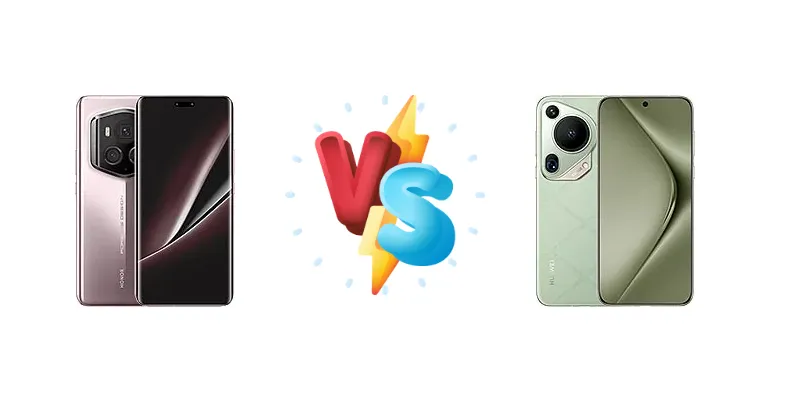
Honor Magic6 RSR Porsche Design vs. Huawei Pura 70 Ultra: A Deep Dive Comparison
| Phones Images | |||||
|---|---|---|---|---|---|
|
🏆 Quick Verdict
For the average user prioritizing sustained performance and a brighter display, the Honor Magic6 RSR Porsche Design emerges as the winner. Its Snapdragon 8 Gen 3 chipset and 1731 nits peak brightness provide a smoother, more visible experience, especially in demanding tasks and outdoor environments. However, the Pura 70 Ultra’s faster charging and unique aesthetic appeal will resonate with specific users.
| PHONES | ||
|---|---|---|
| Phone Names | Honor Magic6 RSR Porsche Design | Huawei Pura 70 Ultra |
| Network | ||
|---|---|---|
| 2G bands | GSM 850 / 900 / 1800 / 1900 | GSM 850 / 900 / 1800 / 1900 |
| 3G bands | HSDPA 800 / 850 / 900 / 1700(AWS) / 1900 / 2100 | HSDPA 800 / 850 / 900 / 1700(AWS) / 1900 / 2100 |
| 4G bands | LTE | 1, 2, 3, 4, 5, 6, 7, 8, 9, 12, 17, 18, 19, 20, 26, 28, 34, 38, 39, 40, 41, 42 |
| 5G bands | SA/NSA | SA/NSA - China only |
| Speed | HSPA, LTE, 5G | HSPA, LTE, 5G |
| Technology | GSM / CDMA / HSPA / CDMA2000 / LTE / 5G | GSM / CDMA / HSPA / CDMA2000 / LTE / 5G |
| Launch | ||
|---|---|---|
| Announced | 2024, March 18 | 2024, April 18 |
| Status | Available. Released 2024, March 22 | Available. Released 2024, April 29 |
| Body | ||
|---|---|---|
| Build | Glass front (NanoCrystal Shield), glass back (NanoCrystal Shield), titanium frame | Glass front, aluminum frame, silicone polymer back (eco leather) |
| Dimensions | 162.5 x 75.8 x 8.9 mm (6.40 x 2.98 x 0.35 in) | 162.6 x 75.1 x 8.4 mm (6.40 x 2.96 x 0.33 in) |
| SIM | · Nano-SIM + eSIM· Nano-SIM + Nano-SIM | Nano-SIM + Nano-SIM |
| Weight | 237 g (8.36 oz) | 226 g (7.97 oz) |
| Display | ||
|---|---|---|
| Protection | NanoCrystal Shield | Kunlun Glass (Basalt-tempered) |
| Resolution | 1280 x 2800 pixels, 19.5:9 ratio (~453 ppi density) | 1260 x 2844 pixels (~460 ppi density) |
| Size | 6.8 inches, 112.8 cm2 (~91.6% screen-to-body ratio) | 6.8 inches, 109.0 cm2 (~89.3% screen-to-body ratio) |
| Type | LTPO OLED, 1B colors, 120Hz, Dolby Vision, HDR, 1800 nits (HBM), 5000 nits (peak) | LTPO OLED, 1B colors, HDR, 120Hz, 1440Hz PWM, 2500 nits (peak) |
| Platform | ||
|---|---|---|
| CPU | Octa-core (1x3.3 GHz Cortex-X4 & 3x3.2 GHz Cortex-A720 & 2x3.0 GHz Cortex-A720 & 2x2.3 GHz Cortex-A520) | Octa-core (1x2.3 GHz Taishan Big & 3x2.18 GHz Taishan Mid & 4x1.55 GHz Cortex-A510) |
| Chipset | Qualcomm SM8650-AB Snapdragon 8 Gen 3 (4 nm) | Kirin 9010 (7 nm) |
| GPU | Adreno 750 | - |
| OS | Android 14, MagicOS 8 | EMUI 14.2 (International), HarmonyOS 4.2 (China) |
| Memory | ||
|---|---|---|
| Card slot | No | No |
| Internal | 1TB 24GB RAM | 512GB 12GB RAM, 512GB 16GB RAM, 1TB 16GB RAM |
| Main Camera | ||
|---|---|---|
| Features | Color spectrum sensor, LED flash, HDR, panorama | Laser AF, color spectrum sensor, LED flash, panorama, HDR |
| Triple | 50 MP, f/1.4-2.0, 23mm (wide), 1/1.3", LiDAR AF, PDAF, OIS 180 MP, f/2.6, (periscope telephoto), 1/1.49", 0.56µm, PDAF, OIS, 2.5x optical zoom 50 MP, f/2.0, 13mm, 122˚ (ultrawide), 1/2.88", AF | 50 MP, f/1.6-4.0, 23mm (wide), 1.0"-type, dual pixel PDAF, sensor-shift OIS, retractable lens 50 MP, f/2.1, 90mm (telephoto), PDAF (5cm - ∞), OIS, 3.5x optical zoom 40 MP, f/2.2, 13mm (ultrawide), AF |
| Video | 4K@24/30/60fps, 1080p@30/60/120/240fps, gyro-EIS, OIS, HDR, 10-bit video | 4K, 1080p, HDR, gyro-EIS, OIS |
| Selfie camera | ||
|---|---|---|
| Features | - | HDR, panorama |
| Single | 50 MP, f/2.0, 22mm (wide), 1/2.93", AF TOF 3D, (depth/biometrics sensor) | 13 MP, f/2.4, (ultrawide), AF |
| Video | 4K@30fps, 1080p@30/60fps, gyro-EIS | Yes, HDR |
| Sound | ||
|---|---|---|
| 35mm jack | No | No |
| Loudspeaker | Yes, with stereo speakers | Yes, with stereo speakers |
| Comms | ||
|---|---|---|
| Bluetooth | 5.3, A2DP, LE, aptX HD | 5.2, A2DP, LE, L2HC |
| Infrared port | Yes | Yes |
| NFC | Yes | Yes |
| Positioning | GPS (L1+L5), GLONASS, BDS (B1I+B1c+B2a), GALILEO (E1+E5a) | GPS (L1+L5), GLONASS (L1), BDS (B1I+B1c+B2a+B2b), GALILEO (E1+E5a+E5b), QZSS (L1+L5), NavIC |
| Radio | No | No |
| USB | USB Type-C 3.2, DisplayPort 1.2, OTG | USB Type-C 3.1, OTG, DisplayPort 1.2 |
| WLAN | Wi-Fi 802.11 a/b/g/n/ac/6/7, dual-band, Wi-Fi Direct | Wi-Fi 802.11 a/b/g/n/ac/6, dual-band, Wi-Fi Direct |
| Features | ||
|---|---|---|
| Sensors | Fingerprint (under display, optical), Face ID, accelerometer, gyro, proximity, compass | Fingerprint (under display, optical), accelerometer, proximity, gyro, compass |
| Battery | ||
|---|---|---|
| Charging | 80W wired 66W wireless Reverse wireless 5W reverse wired | 100W wired 80W wireless 20W reverse wireless 18W reverse wired |
| Type | Si/C Li-Ion 5600 mAh | Li-Po 5200 mAh |
| Misc | ||
|---|---|---|
| Colors | Agate Grey, Frozen Berry | Black, White, Brown, Green |
| Models | BVL-N59, BVL-AN20 | HBP-LX9, HBP-AL00 |
| Price | About 3020 EUR | € 1,239.99 |
Honor Magic6 RSR Porsche Design
- Superior performance with Snapdragon 8 Gen 3
- Brighter display for better outdoor visibility
- Longer battery life in active use
- Slower wired charging compared to Pura 70 Ultra
- Potentially less distinctive design
Huawei Pura 70 Ultra
- Ultra-fast 100W wired charging
- Unique and luxurious design aesthetic
- Strong camera capabilities (based on branding)
- Less powerful Kirin 9010 chipset
- Shorter battery life in active use
Display Comparison
The Honor Magic6 RSR Porsche Design boasts a significantly brighter display, reaching a measured 1731 nits compared to the Pura 70 Ultra’s 1231 nits. This 400-nit difference translates to superior visibility under direct sunlight, a crucial advantage for outdoor users. While both likely employ OLED panels, the Honor’s higher peak brightness suggests a more advanced panel technology or more aggressive calibration. We expect both to feature high refresh rates, but the Honor’s brightness advantage is a clear win for usability. The impact of PWM dimming rates, not provided, would be a key consideration for users sensitive to flicker.
Camera Comparison
Without detailed camera specs, a direct comparison is limited. However, the market positioning suggests both phones will feature advanced camera systems. The Pura 70 Ultra’s ‘Ultra’ designation hints at a larger sensor and more sophisticated optics. Huawei has historically excelled in computational photography, leveraging its image processing algorithms to produce vibrant and detailed images. The Honor, benefiting from Qualcomm’s ISP, will likely focus on a more natural color profile and faster processing speeds. The absence of information regarding sensor sizes and OIS implementation makes a definitive judgment impossible, but the Pura 70 Ultra’s branding suggests a stronger emphasis on camera capabilities.
Performance
The core of the performance difference lies in the chipsets. The Honor Magic6 RSR Porsche Design utilizes the Qualcomm Snapdragon 8 Gen 3 (4nm), a proven powerhouse known for its raw processing power and efficient thermal management. In contrast, the Huawei Pura 70 Ultra relies on the Kirin 9010 (7nm). The 4nm fabrication process of the Snapdragon offers inherent advantages in power efficiency, potentially leading to less throttling during extended gaming sessions. The Snapdragon’s CPU configuration – a Cortex-X4 prime core alongside A720 and A520 cores – is optimized for both peak performance and sustained workloads, while the Kirin’s Taishan architecture, while capable, is less widely benchmarked and may not match the Snapdragon’s overall efficiency. The Snapdragon’s Adreno GPU is also expected to outperform the Kirin’s integrated GPU.
Battery Life
The Honor Magic6 RSR Porsche Design achieves an active use score of 14:14h, exceeding the Huawei Pura 70 Ultra’s 12:29h. This suggests better overall battery efficiency, likely attributable to the Snapdragon 8 Gen 3’s 4nm process. However, the Pura 70 Ultra compensates with significantly faster charging: 100W wired versus 80W on the Honor. This translates to quicker top-ups, potentially mitigating the slightly smaller battery life. The Pura 70 Ultra also offers 80W wireless charging, matching the Honor’s wireless speed, and superior reverse wireless charging at 20W compared to the Honor’s 5W. The faster charging speeds of the Pura 70 Ultra are a significant advantage for users who frequently need to quickly replenish their battery.
Buying Guide
Buy the Honor Magic6 RSR Porsche Design if you need uncompromising performance for gaming and multitasking, a display that excels in bright sunlight, and a more globally accessible software experience. Buy the Huawei Pura 70 Ultra if you prefer a distinctive, luxurious design, prioritize the absolute fastest wired charging speeds, and are comfortable with Huawei’s ecosystem and software approach.