
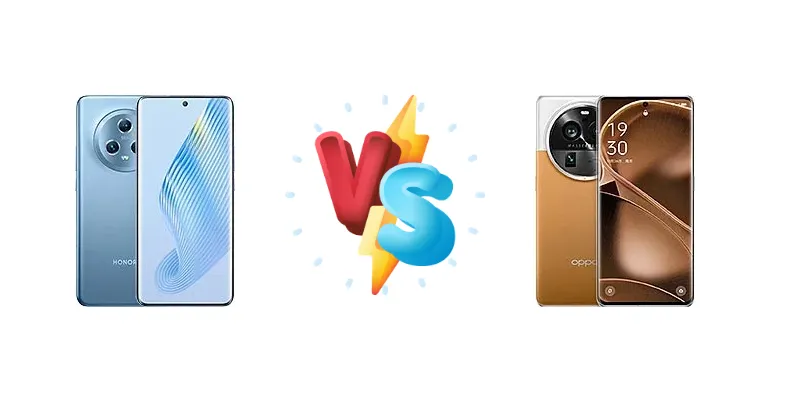
Honor Magic5 vs Oppo Find X6 Pro: A Deep Dive into Flagship Features
| Phones Images | |||||
|---|---|---|---|---|---|
|
🏆 Quick Verdict
For most users, the Oppo Find X6 Pro emerges as the superior choice. Its significantly faster 100W wired and 50W wireless charging, coupled with a brighter display, provide a more convenient and visually immersive experience. While the Honor Magic5 is a strong contender, the charging advantage of the Oppo is a compelling differentiator.
| PHONES | ||
|---|---|---|
| Phone Names | Honor Magic5 | Oppo Find X6 Pro |
| Network | ||
|---|---|---|
| 2G bands | GSM 850 / 900 / 1800 / 1900 | GSM 850 / 900 / 1800 / 1900 |
| 3G bands | HSDPA 800 / 850 / 900 / 1700(AWS) / 1900 / 2100 | HSDPA 800 / 850 / 900 / 1700(AWS) / 1900 / 2100 |
| 4G bands | 1, 2, 3, 4, 5, 7, 8, 12, 17, 18, 19, 20, 26, 28, 34, 38, 39, 40, 41 - China | 1, 2, 3, 4, 5, 7, 8, 12, 17, 18, 19, 20, 26, 28, 34, 38, 39, 40, 41, 66 |
| 5G bands | 1, 3, 5, 8, 28, 38, 41, 77, 78 SA/NSA - China | 1, 3, 5, 7, 8, 20, 28, 38, 40, 41, 66, 77, 78, 79 SA/NSA |
| Speed | HSPA, LTE, 5G | HSPA, LTE, 5G |
| Technology | GSM / CDMA / HSPA / EVDO / LTE / 5G | GSM / CDMA / HSPA / CDMA2000 / LTE / 5G |
| CDMA2000 1xEV-DO | CDMA2000 1x | |
| Launch | ||
|---|---|---|
| Announced | 2023, February 27 | 2023, March 21 |
| Status | Available. Released 2023, March 31 | Available. Released 2023, March 24 |
| Body | ||
|---|---|---|
| Build | Glass front, glass back or eco leather back | Glass front (Gorilla Glass Victus 2), glass back (Gorilla Glass 5) or eco leather back, aluminum frame |
| Dimensions | 161.4 x 75.5 x 7.8 mm (6.35 x 2.97 x 0.31 in) | 164.8 x 76.2 x 9.1 mm or 9.5 mm |
| SIM | · Nano-SIM· Nano-SIM + Nano-SIM | Nano-SIM + Nano-SIM |
| Weight | 191 g (6.74 oz) | 216 g or 218 g (7.62 oz) |
| - | IP68 dust/water resistant (up to 1.5m for 30 min) | |
| Display | ||
|---|---|---|
| Protection | - | Corning Gorilla Glass Victus 2 |
| Resolution | 1224 x 2688 pixels (~439 ppi density) | 1440 x 3168 pixels (~510 ppi density) |
| Size | 6.73 inches, 110.2 cm2 (~90.4% screen-to-body ratio) | 6.82 inches, 113.0 cm2 (~90.0% screen-to-body ratio) |
| Type | OLED, 1B colors, 120Hz, HDR10+, 1600 nits (peak) | LTPO3 AMOLED, 1B colors, 120Hz, Dolby Vision, HDR10+, 800 nits (typ), 1500 nits (HBM), 2500 nits (peak) |
| Platform | ||
|---|---|---|
| CPU | Octa-core (1x3.2 GHz Cortex-X3 & 2x2.8 GHz Cortex-A715 & 2x2.8 GHz Cortex-A710 & 3x2.0 GHz Cortex-A510) | Octa-core (1x3.2 GHz Cortex-X3 & 2x2.8 GHz Cortex-A715 & 2x2.8 GHz Cortex-A710 & 3x2.0 GHz Cortex-A510) |
| Chipset | Qualcomm SM8550-AB Snapdragon 8 Gen 2 (4 nm) | Qualcomm SM8550-AB Snapdragon 8 Gen 2 (4 nm) |
| GPU | Adreno 740 | Adreno 740 |
| OS | Android 13, MagicOS 7.1 | Android 13, up to 4 major Android upgrades, ColorOS 14 |
| Memory | ||
|---|---|---|
| Card slot | No | No |
| Internal | 256GB 8GB RAM, 256GB 12GB RAM, 256GB 16GB RAM, 512GB 16GB RAM | 256GB 12GB RAM, 256GB 16GB RAM, 512GB 16GB RAM |
| UFS | UFS 4.0 | |
| Main Camera | ||
|---|---|---|
| Features | Color spectrum sensor, LED flash, HDR, panorama | Laser AF, color spectrum sensor, Hasselblad Color Calibration, LED flash, HDR, panorama |
| Single | 12 MP, f/2.4, 100˚ (ultrawide), 1.22µm | - |
| Triple | 54 MP, f/1.9, (wide), 1/1.49", PDAF 32 MP, f/2.4, (telephoto), PDAF, OIS, 2.5x optical zoom 50 MP, f/2.0, 13mm, 122˚ (ultrawide), 1/2.5", AF | 50 MP, f/1.8, 23mm (wide), 1.0"-type, 1.6µm, dual pixel PDAF, OIS 50 MP, f/2.6, 65mm (periscope telephoto), 1/1.56", 1.0µm, 2.8x optical zoom, multi-directional PDAF, OIS 50 MP, f/2.2, 15mm, 110˚ (ultrawide), 1/1.56", 1.0µm, multi-directional PDAF |
| Video | 4K@30/60fps, 1080p@30/60fps, gyro-EIS, HDR10, 10-bit video | 4K@30/60fps, 1080p@30/60/240fps; gyro-EIS; HDR, 10‑bit video, Dolby Vision |
| Selfie camera | ||
|---|---|---|
| Features | HDR | Panorama |
| Single | 12 MP, f/2.4, 100˚ (ultrawide), 1.22µm | 32 MP, f/2.4, 21mm (wide), 1/2.74", 0.8µm, PDAF |
| Video | 4K@30fps, 1080p@30/60fps | 4K@30fps, gyro-EIS |
| Sound | ||
|---|---|---|
| 3.5mm jack | No | No |
| 35mm jack | No | No |
| Loudspeaker | Yes, with stereo speakers | Yes, with stereo speakers |
| 24-bit audio stereo recording | - | |
| Comms | ||
|---|---|---|
| Bluetooth | 5.2, A2DP, LE, aptX HD | 5.3, A2DP, LE, aptX HD |
| Infrared port | Yes | Yes |
| NFC | Yes | Yes |
| Positioning | GPS (L1+L5), GLONASS (L1), BDS (B1I+B1c+B2a), GALILEO (E1+E5a) | GPS (L1+L5), GLONASS (G1), BDS (B1I+B1c+B2a), GALILEO (E1+E5a), QZSS (L1+L5) |
| Radio | No | No |
| USB | USB Type-C 2.0, OTG | USB Type-C 3.1, OTG |
| WLAN | Wi-Fi 802.11 a/b/g/n/ac/6/7, dual-band, Wi-Fi Direct | Wi-Fi 802.11 a/b/g/n/ac/6e/7, tri-band, Wi-Fi Direct |
| Features | ||
|---|---|---|
| Sensors | Fingerprint (under display, optical), accelerometer, gyro, proximity, compass | Fingerprint (under display, optical), accelerometer, gyro, proximity, compass |
| Battery | ||
|---|---|---|
| Charging | 66W wired 5W reverse wired | 100W wired, PD, 45% in 10 min, 100% in 30 min 50W wireless, 50% in 22 min, 100% in 51 min 10W reverse wireless |
| Type | Li-Po 5100 mAh | Li-Po 5000 mAh |
| Misc | ||
|---|---|---|
| Colors | Black, Glacier Blue, Green, Purple, Orange | Black, Green, Brown |
| Models | PGT-AN00, PGT-N09 | PGEM110, PGEM10 |
| Price | About 900 EUR | About 820 EUR |
| Tests | ||
|---|---|---|
| Battery life | - | Endurance rating 114h |
| Camera | - | Photo / Video |
| Display | - | Contrast ratio: Infinite (nominal) |
| Loudspeaker | - | -25.1 LUFS (Very good) |
| Performance | - | AnTuTu: 1294797 (v9) GeekBench: 4791 (v5.1), 5226 (v6) GFXBench: 60fps (ES 3.1 onscreen) |
Honor Magic5
- Potentially more affordable price point
- Balanced feature set
- 5W reverse wired charging
- Significantly slower charging speeds (66W wired)
- Display likely less bright than Oppo
- Camera details are currently unknown
Oppo Find X6 Pro
- Ultra-fast 100W wired charging
- 50W wireless charging
- Brighter display (1318 nits)
- Likely superior camera system
- Potentially higher price
- May run slightly warmer under sustained load
- Larger size and weight (likely)
Display Comparison
The Oppo Find X6 Pro boasts a notably brighter display, reaching a measured peak of 1318 nits, compared to an unspecified peak brightness for the Honor Magic5. This translates to superior visibility under direct sunlight. Both devices likely utilize LTPO technology for adaptive refresh rates, conserving battery life. While the Honor Magic5’s display quality is undoubtedly high, the Oppo’s higher peak brightness provides a tangible advantage for outdoor users and content consumers. Contrast ratio is infinite (nominal) on the Oppo, suggesting excellent black levels.
Camera Comparison
Both phones are advertised as having exceptional photo and video capabilities, but detailed sensor information is lacking for the Honor Magic5. The Oppo Find X6 Pro is expected to feature a sophisticated camera system, likely with a large main sensor and advanced image processing algorithms. Without specific details on the Honor Magic5’s camera hardware, it’s difficult to make a direct comparison. The Oppo’s focus on photo/video suggests a strong emphasis on computational photography and image quality. The absence of details on the Honor Magic5’s camera system makes it difficult to assess its capabilities relative to the Oppo.
Performance
Both the Honor Magic5 and Oppo Find X6 Pro are equipped with the Qualcomm SM8550-AB Snapdragon 8 Gen 2 (4nm) chipset, featuring an identical CPU configuration: 1x3.2 GHz Cortex-X3, 2x2.8 GHz Cortex-A715, 2x2.8 GHz Cortex-A710, and 3x2.0 GHz Cortex-A510. Performance will be virtually indistinguishable in most tasks. The 4nm process node ensures excellent thermal efficiency, minimizing throttling during sustained workloads like gaming. However, Oppo’s cooling solution (details unspecified) may offer a slight edge in maintaining peak performance for extended periods. RAM configurations are not specified, but both are expected to utilize LPDDR5x for fast memory access.
Battery Life
The Oppo Find X6 Pro’s charging capabilities are a clear standout. Its 100W wired charging can replenish the battery to 100% in just 30 minutes, with a 45% charge achievable in 10 minutes. It also supports 50W wireless charging, reaching 100% in 51 minutes. The Honor Magic5, with its 66W wired charging, is significantly slower. Both phones have an endurance rating of 114 hours, suggesting similar battery life despite the different charging speeds. The Oppo’s faster charging is a significant convenience factor, especially for users who frequently need to top up their battery quickly. The 10W reverse wireless charging on the Honor Magic5 and 10W reverse wireless on the Oppo are useful for charging accessories.
Buying Guide
Buy the Honor Magic5 if you prioritize a more balanced package and potentially a slightly lower price point. It's ideal for users who don't demand the absolute fastest charging speeds and appreciate a refined, all-around experience. Buy the Oppo Find X6 Pro if you are a power user who values rapid charging – both wired and wireless – and a display that excels in bright outdoor conditions. This phone is geared towards those who demand the best in convenience and visual fidelity.