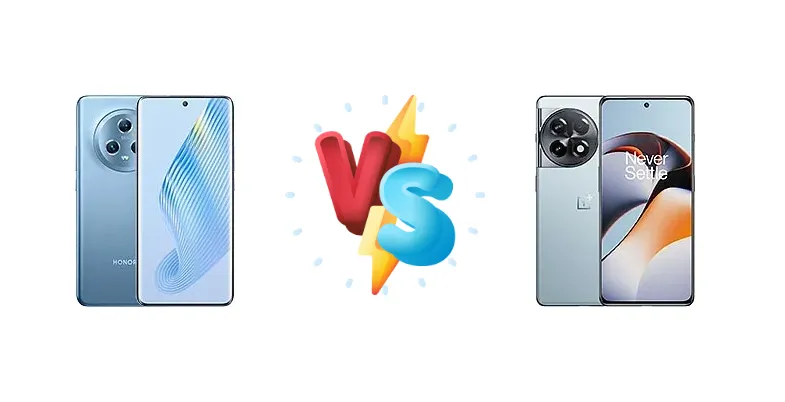
The Honor Magic5 and OnePlus 11R represent compelling options in a crowded flagship market. The Magic5 arrives with the latest Snapdragon 8 Gen 2, while the 11R leverages the proven Snapdragon 8+ Gen 1. This comparison dissects the key differences, focusing on performance, charging speeds, and overall user experience to determine which device delivers the most bang for your buck.
🏆 Quick Verdict
For users prioritizing raw processing power and future-proofing, the Honor Magic5 is the clear winner thanks to its Snapdragon 8 Gen 2. However, the OnePlus 11R’s significantly faster 100W charging and competitive price make it an excellent choice for those who value convenience and affordability.
| Network |
|---|
| 2G bands | GSM 850 / 900 / 1800 / 1900 | GSM 850 / 900 / 1800 / 1900 |
| 3G bands | HSDPA 800 / 850 / 900 / 1700(AWS) / 1900 / 2100 | HSDPA 850 / 900 / 1700(AWS) / 2100 |
| 4G bands | 1, 2, 3, 4, 5, 7, 8, 12, 17, 18, 19, 20, 26, 28, 34, 38, 39, 40, 41 - China | 1, 3, 4, 5, 8, 28, 34, 38, 39, 40, 41 |
| 5G bands | 1, 3, 5, 8, 28, 38, 41, 77, 78 SA/NSA - China | 1, 3, 5, 8, 28, 40, 41, 77, 78 SA/NSA |
| Speed | HSPA, LTE, 5G | HSPA, LTE (3CA), 5G |
| Technology | GSM / CDMA / HSPA / EVDO / LTE / 5G | GSM / CDMA / HSPA / LTE / 5G |
| | CDMA2000 1xEV-DO | CDMA 800 |
| Launch |
|---|
| Announced | 2023, February 27 | 2023, February 07 |
| Status | Available. Released 2023, March 31 | Available. Released 2023, February 21 |
| Body |
|---|
| Build | Glass front, glass back or eco leather back | Glass front, glass back (Gorilla Glass 5), plastic frame |
| Dimensions | 161.4 x 75.5 x 7.8 mm (6.35 x 2.97 x 0.31 in) | 163.4 x 74.3 x 8.7 mm (6.43 x 2.93 x 0.34 in) |
| SIM | · Nano-SIM· Nano-SIM + Nano-SIM | Nano-SIM + Nano-SIM |
| Weight | 191 g (6.74 oz) | 204 g (7.20 oz) |
| Display |
|---|
| Resolution | 1224 x 2688 pixels (~439 ppi density) | 1240 x 2772 pixels, 20:9 ratio (~451 ppi density) |
| Size | 6.73 inches, 110.2 cm2 (~90.4% screen-to-body ratio) | 6.74 inches, 109.2 cm2 (~90.0% screen-to-body ratio) |
| Type | OLED, 1B colors, 120Hz, HDR10+, 1600 nits (peak) | Fluid AMOLED, 1B colors, 120Hz, HDR10+, 1450 nits (peak) |
| Platform |
|---|
| CPU | Octa-core (1x3.2 GHz Cortex-X3 & 2x2.8 GHz Cortex-A715 & 2x2.8 GHz Cortex-A710 & 3x2.0 GHz Cortex-A510) | Octa-core (1x3.0 GHz Cortex-X2 & 3x2.5 GHz Cortex-A710 & 4x1.80 GHz Cortex-A510) |
| Chipset | Qualcomm SM8550-AB Snapdragon 8 Gen 2 (4 nm) | Qualcomm SM8475 Snapdragon 8+ Gen 1 (4 nm) |
| GPU | Adreno 740 | Adreno 730 |
| OS | Android 13, MagicOS 7.1 | Android 13, upgradable to Android 15, OxygenOS 15 |
| Memory |
|---|
| Card slot | No | No |
| Internal | 256GB 8GB RAM, 256GB 12GB RAM, 256GB 16GB RAM, 512GB 16GB RAM | 128GB 8GB RAM, 256GB 16GB RAM, 512GB 18GB RAM |
| | UFS | UFS 3.1 |
| Main Camera |
|---|
| Features | Color spectrum sensor, LED flash, HDR, panorama | Color spectrum sensor, LED flash, HDR, panorama |
| Single | 12 MP, f/2.4, 100˚ (ultrawide), 1.22µm | 16 MP, f/2.4, 24mm (wide), 1/3.09", 1.0µm |
| Triple | 54 MP, f/1.9, (wide), 1/1.49", PDAF
32 MP, f/2.4, (telephoto), PDAF, OIS, 2.5x optical zoom
50 MP, f/2.0, 13mm, 122˚ (ultrawide), 1/2.5", AF | 50 MP, f/1.8, 24mm (wide), 1/1.56", 1.0µm, multi-directional PDAF, OIS
8 MP, f/2.2, 120˚ (ultrawide), 1/4.0", 1.12µm
2 MP (macro) |
| Video | 4K@30/60fps, 1080p@30/60fps, gyro-EIS, HDR10, 10-bit video | 4K@30/60fps, 1080p@30/60/240fps, gyro-EIS |
| Selfie camera |
|---|
| Features | HDR | HDR |
| Single | 12 MP, f/2.4, 100˚ (ultrawide), 1.22µm | 16 MP, f/2.4, 24mm (wide), 1/3.09", 1.0µm |
| Video | 4K@30fps, 1080p@30/60fps | 1080p@30fps |
| Sound |
|---|
| 3.5mm jack | No | No |
| 35mm jack | No | No |
| Loudspeaker | Yes, with stereo speakers | Yes, with stereo speakers |
| | 24-bit audio stereo recording | 24-bit/192kHz audio |
| Comms |
|---|
| Bluetooth | 5.2, A2DP, LE, aptX HD | 5.3, A2DP, LE, aptX HD |
| Infrared port | Yes | Yes |
| NFC | Yes | Yes |
| Positioning | GPS (L1+L5), GLONASS (L1), BDS (B1I+B1c+B2a), GALILEO (E1+E5a) | GPS (L1+L5), GLONASS (G1), BDS (B1I+B1c+B2a), GALILEO (E1+E5a), QZSS (L1+L5) |
| Radio | No | No |
| USB | USB Type-C 2.0, OTG | USB Type-C 2.0 |
| WLAN | Wi-Fi 802.11 a/b/g/n/ac/6/7, dual-band, Wi-Fi Direct | Wi-Fi 802.11 a/b/g/n/ac/6, dual-band |
| Features |
|---|
| Sensors | Fingerprint (under display, optical), accelerometer, gyro, proximity, compass | Fingerprint (under display, optical), accelerometer, gyro, proximity, compass |
| Battery |
|---|
| Charging | 66W wired
5W reverse wired | 100W wired |
| Type | Li-Po 5100 mAh | Li-Po 5000 mAh |
| Misc |
|---|
| Colors | Black, Glacier Blue, Green, Purple, Orange | Galactic Silver, Sonic Black, Solar Red |
| Models | PGT-AN00, PGT-N09 | CPH2487 |
| Price | About 900 EUR | About 600 EUR |
| SAR | - | 1.16 W/kg (head) 0.61 W/kg (body) |
Honor Magic5
- Superior processing power with Snapdragon 8 Gen 2
- More efficient CPU architecture for sustained performance
- Potentially better camera image processing
- 5W Reverse Wireless Charging
- Slower 66W charging compared to the 11R
- Likely higher price point
OnePlus 11R
- Blazing-fast 100W wired charging
- Competitive price point
- Excellent performance for most users
- Proven Snapdragon 8+ Gen 1 platform
- Less powerful CPU and GPU than the Magic5
- May exhibit more thermal throttling under heavy load
Display Comparison
While both devices likely feature high-quality AMOLED panels (data not provided), the core difference lies in the processing power driving them. The Honor Magic5’s Snapdragon 8 Gen 2 will contribute to smoother animations and faster response times, particularly noticeable in graphically intensive applications. The absence of LTPO information for either device makes it difficult to assess power efficiency gains from variable refresh rates. Bezels and color accuracy are assumed to be comparable within the flagship segment, but detailed testing would be required to confirm.
Camera Comparison
Without detailed camera specifications, a direct comparison is limited. However, the flagship positioning of the Magic5 suggests a more sophisticated camera system. The Snapdragon 8 Gen 2’s improved ISP (Image Signal Processor) will deliver superior image processing capabilities, including better noise reduction, dynamic range, and detail preservation. While the 11R’s camera will be capable, the Magic5 is likely to excel in low-light photography and video recording. The absence of information regarding sensor sizes and OIS makes a definitive statement impossible, but the Magic5’s higher-tier chipset suggests a more advanced imaging experience.
Performance
The Honor Magic5’s Snapdragon 8 Gen 2 (4nm) represents a significant leap over the OnePlus 11R’s Snapdragon 8+ Gen 1 (4nm). The Gen 2 features a redesigned CPU architecture with a Cortex-X3 prime core clocked at 3.2 GHz, compared to the 11R’s Cortex-X2 at 3.0 GHz. This translates to approximately 10-15% faster single-core performance. The Gen 2 also boasts improvements in GPU performance and AI processing. While the 11R’s 8+ Gen 1 remains a potent chip, the Magic5 will exhibit less thermal throttling under sustained load, maintaining higher clock speeds for longer periods. The Magic5’s CPU configuration (1+2+2+3) is also more balanced than the 11R’s (1+3+4), potentially improving multi-tasking efficiency.
Battery Life
The OnePlus 11R’s 100W wired charging is a game-changer, allowing for a full charge in approximately 25-30 minutes. The Honor Magic5’s 66W charging, while still fast, is significantly slower. This difference is crucial for users who frequently need to top up their battery quickly. While battery capacity isn’t specified, the faster charging of the 11R effectively mitigates any potential disadvantage from a slightly smaller battery. The 5W reverse wired charging on the Magic5 is a niche feature, useful for charging accessories but unlikely to be a primary selling point.
Buying Guide
Buy the Honor Magic5 if you demand the absolute best performance for demanding tasks like video editing, high-end gaming, and consistently smooth multitasking. Buy the OnePlus 11R if you prioritize incredibly fast charging, a slightly more aggressive price point, and still require excellent performance for everyday use and most gaming scenarios.
Frequently Asked Questions
❓ Will the OnePlus 11R overheat during extended gaming sessions?
The Snapdragon 8+ Gen 1 is known to generate heat under sustained load. While OnePlus implements cooling solutions, the 11R may experience some thermal throttling during prolonged gaming. However, it's unlikely to reach critical temperatures and will still provide a playable experience, albeit with slightly reduced performance.
❓ Is the 66W charging on the Honor Magic5 slow compared to other flagships?
While 66W is fast, it's slower than the 100W offered by the OnePlus 11R and some other competitors. A full charge will take approximately 40-50 minutes. This is a trade-off for potentially better thermal management and battery longevity.
❓ Does the Snapdragon 8 Gen 2 in the Honor Magic5 offer a noticeable performance difference in everyday tasks?
For basic tasks like browsing, social media, and email, the difference between the Snapdragon 8 Gen 2 and 8+ Gen 1 will be minimal. However, the Gen 2’s superior processing power will be more apparent in demanding applications like video editing, graphic-intensive games, and multitasking with numerous apps open.
❓ What kind of gaming performance can I expect from the OnePlus 11R?
The OnePlus 11R is capable of running most mobile games at high settings with smooth frame rates. While it may not match the absolute peak performance of the Magic5, it provides an excellent gaming experience for the vast majority of mobile titles.