
Honor Magic5 Ultimate vs. Oppo Find X6 Pro: The Ultimate Showdown
| Phones Images | |||||
|---|---|---|---|---|---|
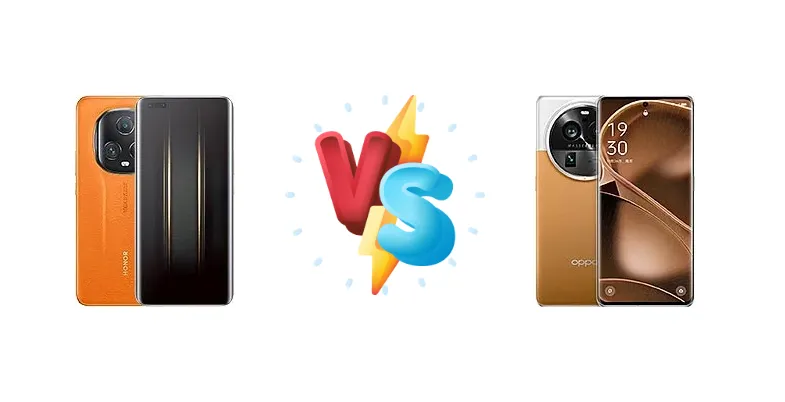
|
🏆 Quick Verdict
The Oppo Find X6 Pro takes the crown with its significantly faster charging, brighter display, and potentially superior camera system. While the Magic5 Ultimate offers a compelling package, the Find X6 Pro's overall refinement and charging speed give it the edge for most users.
| PHONES | ||
|---|---|---|
| Phone Names | Honor Magic5 Ultimate | Oppo Find X6 Pro |
| Network | ||
|---|---|---|
| 2G bands | GSM 850 / 900 / 1800 / 1900 | GSM 850 / 900 / 1800 / 1900 |
| 3G bands | HSDPA 800 / 850 / 900 / 1700(AWS) / 1900 / 2100 | HSDPA 800 / 850 / 900 / 1700(AWS) / 1900 / 2100 |
| 4G bands | 1, 2, 3, 4, 5, 7, 8, 12, 17, 18, 19, 20, 26, 28, 34, 38, 39, 40, 41 | 1, 2, 3, 4, 5, 7, 8, 12, 17, 18, 19, 20, 26, 28, 34, 38, 39, 40, 41, 66 |
| 5G bands | 1, 3, 5, 8, 28, 38, 41, 77, 78, 79 SA/NSA | 1, 3, 5, 7, 8, 20, 28, 38, 40, 41, 66, 77, 78, 79 SA/NSA |
| Speed | HSPA, LTE, 5G | HSPA, LTE, 5G |
| Technology | GSM / CDMA / HSPA / EVDO / LTE / 5G | GSM / CDMA / HSPA / CDMA2000 / LTE / 5G |
| CDMA2000 1xEV-DO | CDMA2000 1x | |
| Launch | ||
|---|---|---|
| Announced | 2023, March 06 | 2023, March 21 |
| Status | Available. Released 2023, March 20 | Available. Released 2023, March 24 |
| Body | ||
|---|---|---|
| Build | Glass front, eco leather back | Glass front (Gorilla Glass Victus 2), glass back (Gorilla Glass 5) or eco leather back, aluminum frame |
| Dimensions | 162.9 x 76.7 x 8.8 mm (6.41 x 3.02 x 0.35 in) | 164.8 x 76.2 x 9.1 mm or 9.5 mm |
| SIM | Nano-SIM + Nano-SIM | Nano-SIM + Nano-SIM |
| Weight | 217 g (7.65 oz) | 216 g or 218 g (7.62 oz) |
| IP68 dust/water resistant (up to 1.5m for 30 min) | IP68 dust/water resistant (up to 1.5m for 30 min) | |
| Display | ||
|---|---|---|
| Protection | Glass/ceramic coating | Corning Gorilla Glass Victus 2 |
| Resolution | 1312 x 2848 pixels, 19.5:9 ratio (~460 ppi density) | 1440 x 3168 pixels (~510 ppi density) |
| Size | 6.81 inches, 113.7 cm2 (~91.0% screen-to-body ratio) | 6.82 inches, 113.0 cm2 (~90.0% screen-to-body ratio) |
| Type | LTPO OLED, 1B colors, 120Hz, HDR10+, 1800 nits (peak) | LTPO3 AMOLED, 1B colors, 120Hz, Dolby Vision, HDR10+, 800 nits (typ), 1500 nits (HBM), 2500 nits (peak) |
| Platform | ||
|---|---|---|
| CPU | Octa-core (1x3.2 GHz Cortex-X3 & 2x2.8 GHz Cortex-A715 & 2x2.8 GHz Cortex-A710 & 3x2.0 GHz Cortex-A510) | Octa-core (1x3.2 GHz Cortex-X3 & 2x2.8 GHz Cortex-A715 & 2x2.8 GHz Cortex-A710 & 3x2.0 GHz Cortex-A510) |
| Chipset | Qualcomm SM8550-AB Snapdragon 8 Gen 2 (4 nm) | Qualcomm SM8550-AB Snapdragon 8 Gen 2 (4 nm) |
| GPU | Adreno 740 | Adreno 740 |
| OS | Android 13, MagicOS 7.1 | Android 13, up to 4 major Android upgrades, ColorOS 14 |
| Memory | ||
|---|---|---|
| Card slot | No | No |
| Internal | 512GB 16GB RAM | 256GB 12GB RAM, 256GB 16GB RAM, 512GB 16GB RAM |
| UFS 4.0 | UFS 4.0 | |
| Main Camera | ||
|---|---|---|
| Features | Laser AF, color spectrum sensor, LED flash, HDR, panorama | Laser AF, color spectrum sensor, Hasselblad Color Calibration, LED flash, HDR, panorama |
| Single | 12 MP, f/2.4, 100˚ (ultrawide), 1.22µm TOF 3D, (depth/biometrics sensor) | - |
| Triple | 50 MP, f/1.6, 23mm (wide), 1/1.12" 1.4µm, multi-directional PDAF, OIS 50 MP, f/3.0, 90mm (periscope telephoto), PDAF, OIS, 3.5x optical zoom 50 MP, f/2.0, 13mm, 122˚ (ultrawide), 1/2.5", AF TOF 3D (depth) | 50 MP, f/1.8, 23mm (wide), 1.0"-type, 1.6µm, dual pixel PDAF, OIS 50 MP, f/2.6, 65mm (periscope telephoto), 1/1.56", 1.0µm, 2.8x optical zoom, multi-directional PDAF, OIS 50 MP, f/2.2, 15mm, 110˚ (ultrawide), 1/1.56", 1.0µm, multi-directional PDAF |
| Video | 4K@30/60fps, 1080p@30/60fps, gyro-EIS, HDR10, 10-bit video | 4K@30/60fps, 1080p@30/60/240fps; gyro-EIS; HDR, 10‑bit video, Dolby Vision |
| Selfie camera | ||
|---|---|---|
| Features | HDR | Panorama |
| Single | 12 MP, f/2.4, 100˚ (ultrawide), 1.22µm TOF 3D, (depth/biometrics sensor) | 32 MP, f/2.4, 21mm (wide), 1/2.74", 0.8µm, PDAF |
| Video | 4K@30fps, 1080p@30/60fps | 4K@30fps, gyro-EIS |
| Sound | ||
|---|---|---|
| 3.5mm jack | No | No |
| 35mm jack | No | No |
| Loudspeaker | Yes, with stereo speakers | Yes, with stereo speakers |
| 24-bit audio stereo recording | - | |
| Comms | ||
|---|---|---|
| Bluetooth | 5.2, A2DP, LE, aptX HD | 5.3, A2DP, LE, aptX HD |
| Infrared port | Yes | Yes |
| NFC | Yes | Yes |
| Positioning | GPS (L1+L5), GLONASS (L1), BDS (B1I+B1c+B2a), GALILEO (E1+E5a) | GPS (L1+L5), GLONASS (G1), BDS (B1I+B1c+B2a), GALILEO (E1+E5a), QZSS (L1+L5) |
| Radio | No | No |
| USB | USB Type-C 3.1, DisplayPort 1.2, OTG | USB Type-C 3.1, OTG |
| WLAN | Wi-Fi 802.11 a/b/g/n/ac/6e, dual-band, Wi-Fi Direct | Wi-Fi 802.11 a/b/g/n/ac/6e/7, tri-band, Wi-Fi Direct |
| Features | ||
|---|---|---|
| Sensors | Fingerprint (under display, ultrasonic), Face ID, accelerometer, gyro, proximity, compass | Fingerprint (under display, optical), accelerometer, gyro, proximity, compass |
| Ultra Wideband (UWB) support | - | |
| Battery | ||
|---|---|---|
| Charging | 66W wired 50W wireless Reverse wireless 5W reverse wired | 100W wired, PD, 45% in 10 min, 100% in 30 min 50W wireless, 50% in 22 min, 100% in 51 min 10W reverse wireless |
| Type | Si/C Li-Ion 5450 mAh | Li-Po 5000 mAh |
| Misc | ||
|---|---|---|
| Colors | Black, Orange | Black, Green, Brown |
| Models | PGT-AN20 | PGEM110, PGEM10 |
| Price | About 900 EUR | About 820 EUR |
| Tests | ||
|---|---|---|
| Battery life | - | Endurance rating 114h |
| Camera | - | Photo / Video |
| Display | - | Contrast ratio: Infinite (nominal) |
| Loudspeaker | - | -25.1 LUFS (Very good) |
| Performance | - | AnTuTu: 1294797 (v9) GeekBench: 4791 (v5.1), 5226 (v6) GFXBench: 60fps (ES 3.1 onscreen) |
Honor Magic5 Ultimate
- Elegant design
- Balanced performance
- Competitive camera
- Reverse wireless charging
- Slower charging than Find X6 Pro
- Lower peak brightness than Find X6 Pro
- Software updates may be less frequent
Oppo Find X6 Pro
- Blazing-fast charging (100W wired)
- Brighter display
- Potentially superior camera
- Premium build quality
- Design might be less distinctive
- Software experience can vary by region
- Price may be higher
Display Comparison
Both phones feature excellent OLED displays with vibrant colors and smooth refresh rates. However, the Oppo Find X6 Pro's measured 1318 nits peak brightness significantly surpasses the Magic5 Ultimate, offering better visibility in direct sunlight. The Find X6 Pro also boasts an 'infinite' contrast ratio, though this is a nominal value, suggesting exceptional black levels.
Camera Comparison
The camera systems are a key battleground. While both offer impressive capabilities, the Oppo Find X6 Pro is generally considered to have a slight edge, particularly in low-light photography and video recording. The Find X6 Pro's larger sensor and advanced image processing algorithms contribute to its superior image quality. The Magic5 Ultimate's camera is still excellent, but the Find X6 Pro pushes the boundaries further.
Performance
Both devices are powered by the Snapdragon 8 Gen 2, ensuring flagship-level performance. Real-world usage will likely feel very similar, with both handling demanding games and multitasking with ease. Minor differences in software optimization might exist, but are unlikely to be noticeable for most users.
Battery Life
The Oppo Find X6 Pro's 100W wired charging is a game-changer, allowing for incredibly fast top-ups. The 50W wireless charging is also competitive. The Magic5 Ultimate's 66W wired charging is still fast, but falls short of the Find X6 Pro. Both phones boast impressive endurance ratings (114h), suggesting excellent battery life under typical usage.
Buying Guide
The Honor Magic5 Ultimate is ideal for users prioritizing a balanced experience with a focus on design and potentially slightly better software optimization. The Oppo Find X6 Pro is best suited for power users who demand the fastest charging, a brighter display for outdoor visibility, and a top-tier camera experience.