
Honor Magic5 Pro vs Huawei Mate 50 Pro: The Ultimate Showdown
| Phones Images | |||||
|---|---|---|---|---|---|
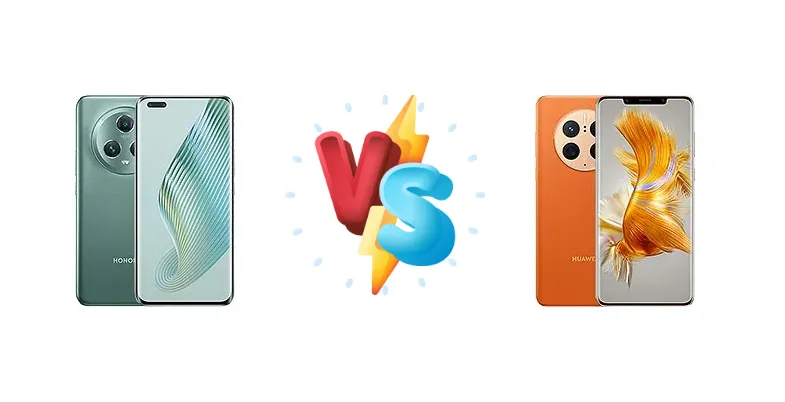
|
🏆 Quick Verdict
The Honor Magic5 Pro edges out the Mate 50 Pro thanks to its brighter display, superior performance with the Snapdragon 8 Gen 2, and slightly better battery life. However, the Mate 50 Pro’s camera system and unique design might appeal to some users. Ultimately, it depends on your priorities.
| PHONES | ||
|---|---|---|
| Phone Names | Honor Magic5 Pro | Huawei Mate 50 Pro |
| Network | ||
|---|---|---|
| 2G bands | GSM 850 / 900 / 1800 / 1900 | GSM 850 / 900 / 1800 / 1900 |
| 3G bands | HSDPA 800 / 850 / 900 / 1700(AWS) / 1900 / 2100 | HSDPA 800 / 850 / 900 / 1700(AWS) / 1900 / 2100 |
| 4G bands | 1, 2, 3, 4, 5, 7, 8, 12, 17, 18, 19, 20, 26, 28, 34, 38, 39, 40, 41 - China | 1, 2, 3, 4, 5, 7, 8, 12, 13, 17, 18, 19, 20, 26, 28, 32, 34, 38, 39, 40, 41, 66 - International |
| 5G bands | 1, 3, 5, 8, 28, 38, 41, 77, 78, 79 SA/NSA - China | - |
| Speed | HSPA, LTE, 5G | HSPA, LTE |
| Technology | GSM / CDMA / HSPA / EVDO / LTE / 5G | GSM / CDMA / HSPA / CDMA2000 / LTE |
| CDMA2000 1xEV-DO | 1, 2, 3, 4, 5, 7, 8, 12, 17, 18, 19, 20, 26, 28, 34, 38, 39, 40, 41 - China | |
| Launch | ||
|---|---|---|
| Announced | 2023, February 27 | 2022, September 06 |
| Status | Available. Released 2023, March 31 | Available. Released 2022, September 28 |
| Body | ||
|---|---|---|
| Build | Glass front, glass back or eco leather back | - |
| Dimensions | 162.9 x 76.7 x 8.8 mm (6.41 x 3.02 x 0.35 in) | 162.1 x 75.5 x 8.5 mm (6.38 x 2.97 x 0.33 in) |
| SIM | · Nano-SIM + eSIM· Nano-SIM + Nano-SIM + eSIM (max 2 at a time) | · Nano-SIM· Nano-SIM + Nano-SIM |
| Weight | 219 g (7.72 oz) | 205 g / 209 g (7.23 oz) |
| IP68 dust/water resistant (up to 1.5m for 30 min) | IP68 dust/water resistant (up to 6m for 30 min) | |
| Display | ||
|---|---|---|
| Protection | - | Huawei Kunlun Glass |
| Resolution | 1312 x 2848 pixels, 19.5:9 ratio (~460 ppi density) | 1212 x 2616 pixels, 19.5:9 ratio (~428 ppi density) |
| Size | 6.81 inches, 113.7 cm2 (~91.0% screen-to-body ratio) | 6.74 inches, 111.8 cm2 (~91.3% screen-to-body ratio) |
| Type | LTPO OLED, 1B colors, 120Hz, HDR10+, 1800 nits (peak) | OLED, 1B colors, 120Hz |
| Platform | ||
|---|---|---|
| CPU | Octa-core (1x3.2 GHz Cortex-X3 & 2x2.8 GHz Cortex-A715 & 2x2.8 GHz Cortex-A710 & 3x2.0 GHz Cortex-A510) | Octa-core (1x3.19 GHz Cortex-X2 & 3x2.75 GHz Cortex-A710 & 4x2.0 GHz Cortex-A510) |
| Chipset | Qualcomm SM8550-AB Snapdragon 8 Gen 2 (4 nm) | Qualcomm SM8475 Snapdragon 8+ Gen 1 4G (4 nm) |
| GPU | Adreno 740 | Adreno 730 |
| OS | Android 13, upgradable to Android 14, MagicOS 8 | EMUI 13 (International), HarmonyOS 3.0 (China) |
| Memory | ||
|---|---|---|
| Card slot | No | Nano Memory (uses shared SIM slot) |
| Internal | 256GB 8GB RAM, 256GB 12GB RAM, 512GB 12GB RAM, 512GB 16GB RAM | 256GB 8GB RAM, 512GB 8GB RAM |
| UFS 4.0 | UFS 3.1 | |
| Main Camera | ||
|---|---|---|
| Features | Laser AF, color spectrum sensor, LED flash, HDR, panorama | Laser AF, color spectrum sensor, LED flash, panorama, HDR |
| Single | 12 MP, f/2.4, 100˚ (ultrawide), 1.22µm TOF 3D, (depth/biometrics sensor) | 13 MP, f/2.4, 18mm (ultrawide) TOF 3D, (depth/biometrics sensor) |
| Triple | 50 MP, f/1.6, 23mm (wide), 1/1.12" 1.4µm, multi-directional PDAF, OIS 50 MP, f/3.0, 90mm (periscope telephoto), PDAF, OIS, 3.5x optical zoom 50 MP, f/2.0, 13mm, 122˚ (ultrawide), 1/2.76", AF TOF 3D (depth) | 50 MP, f/1.4-f/4.0, 24mm (wide), PDAF, OIS 64 MP, f/3.5, 90mm (periscope telephoto), PDAF, OIS, 3.5x optical zoom 13 MP, f/2.2, 13mm, 120˚ (ultrawide), PDAF |
| Video | 4K@30/60fps, 1080p@30/60fps, gyro-EIS, HDR10, 10-bit video | 4K@30/60fps, 1080p@30/60/120/240/480fps, 720p@960fps, 720p@3840fps, HDR, gyro-EIS |
| Selfie camera | ||
|---|---|---|
| Features | HDR | HDR, panorama |
| Single | 12 MP, f/2.4, 100˚ (ultrawide), 1.22µm TOF 3D, (depth/biometrics sensor) | 13 MP, f/2.4, 18mm (ultrawide) TOF 3D, (depth/biometrics sensor) |
| Video | 4K@30fps, 1080p@30/60fps | 4K@30/60fps, 1080p@30/60/240fps |
| Sound | ||
|---|---|---|
| 3.5mm jack | No | No |
| 35mm jack | No | No |
| Loudspeaker | Yes, with stereo speakers | Yes, with stereo speakers |
| 24-bit audio stereo recording | 32-bit/384kHz audio | |
| Comms | ||
|---|---|---|
| Bluetooth | 5.2, A2DP, LE, aptX HD | 5.2, A2DP, LE |
| Infrared port | Yes | Yes |
| NFC | Yes | Yes |
| Positioning | GPS (L1+L5), GLONASS (L1), BDS (B1I+B1c+B2a), GALILEO (E1+E5a) | GPS (L1+L5), GLONASS (L1), BDS (B1I+B1c+B2a), GALILEO (E1+E5a), QZSS (L1+L5), NavIC (L5) |
| Radio | No | No |
| USB | USB Type-C 3.1, DisplayPort 1.2, OTG | USB Type-C 3.1, OTG, Display Port 1.2 |
| WLAN | Wi-Fi 802.11 a/b/g/n/ac/6, dual-band, Wi-Fi Direct | Wi-Fi 802.11 a/b/g/n/ac/6, dual-band, Wi-Fi Direct |
| Features | ||
|---|---|---|
| Sensors | Fingerprint (under display, optical), Face ID, accelerometer, gyro, proximity, compass | Face ID, fingerprint (under display, optical), accelerometer, gyro, proximity, barometer, compass |
| - | BDS Satellite Message (sending only) | |
| Battery | ||
|---|---|---|
| Charging | 66W wired 50W wireless Reverse wireless 5W reverse wired | 66W wired 50W wireless 5W reverse wireless |
| Type | Market-dependent versions:· Li-Po 5100 mAh (Global)· Si/C Li-Ion 5450 mAh (China only) | Li-Po 4700 mAh |
| Misc | ||
|---|---|---|
| Colors | Black, Meadow Green, Blue, Purple, Orange | Black, Silver, Purple, Orange |
| Models | PGT-AN10, PGT-N19 | DCO-AL00, DCO-LX9 |
| Price | £ 799.99 / € 407.79 | About 900 EUR |
| Tests | ||
|---|---|---|
| Battery life | Endurance rating 109h | Endurance rating 104h |
| Camera | Photo / Video | Photo / Video |
| Display | Contrast ratio: Infinite (nominal) | Contrast ratio: Infinite (nominal) |
| Loudspeaker | -24.6 LUFS (Very good) | -24.8 LUFS (Very good) |
| Performance | GeekBench: 4378 (v5.1), 5096 (v6) | AnTuTu: 979921 (v9) GeekBench: 3839 (v5.1) GFXBench: 68fps (ES 3.1 onscreen) |
Honor Magic5 Pro
- Brighter Display
- Superior Performance (Snapdragon 8 Gen 2)
- Slightly Better Battery Life
- Versatile Camera System
- Design might be less distinctive
- Software experience can vary by region
Huawei Mate 50 Pro
- Excellent Camera Image Processing (XMAGE)
- Distinctive Design
- Strong Build Quality
- Good Battery Life
- Slightly Dimmer Display
- Older Chipset (Snapdragon 8+ Gen 1)
- Potential Software Limitations (Huawei Ecosystem)
- 4G only
Display Comparison
The Honor Magic5 Pro takes a clear lead in the display department. Its peak brightness of 1227 nits significantly outshines the Mate 50 Pro's 946 nits, making it much easier to view content outdoors. Both offer excellent contrast ratios (infinite nominal), and vibrant colors, but the Magic5 Pro's brightness advantage is noticeable.
Camera Comparison
Both phones feature excellent camera systems, but they approach photography differently. The Mate 50 Pro is known for its impressive image processing and color science, often producing vibrant and detailed photos. The Magic5 Pro offers a versatile camera setup with a focus on detail and dynamic range. The Mate 50 Pro's XMAGE image processing is a key differentiator. Real-world testing is needed to definitively declare a winner, but both are top contenders.
Performance
The Honor Magic5 Pro's Snapdragon 8 Gen 2 chipset provides a noticeable performance boost over the Mate 50 Pro's Snapdragon 8+ Gen 1. The Gen 2 offers improved CPU and GPU performance, resulting in smoother multitasking, faster app loading times, and better gaming experiences. While the 8+ Gen 1 is still a capable chip, the Magic5 Pro has the edge.
Battery Life
The Honor Magic5 Pro demonstrates slightly better battery endurance. Its active use score of 12:06 hours is a bit higher than the Mate 50 Pro's 10:36 hours. Both phones support 66W wired and 50W wireless charging, ensuring relatively quick top-ups.
Buying Guide
The Honor Magic5 Pro is ideal for users who prioritize raw performance, a vibrant display, and long battery life. The Huawei Mate 50 Pro is a great choice for those who value camera quality, a distinctive design, and are comfortable with Huawei's ecosystem and potential software limitations (due to US sanctions).