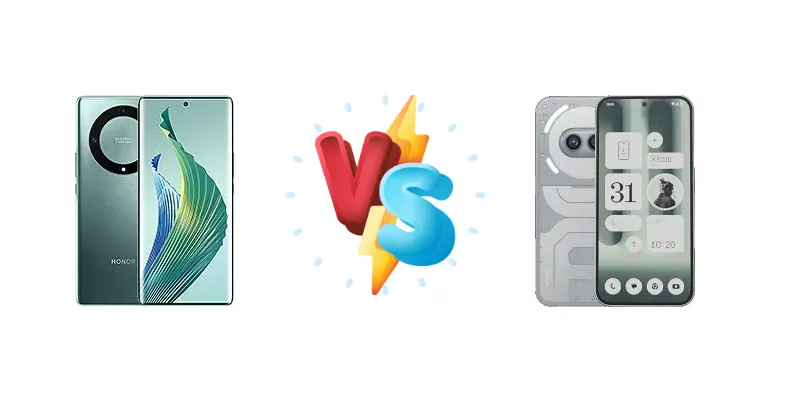
The mid-range smartphone market is fiercely competitive, and the Nothing Phone (2a) Plus and Honor Magic5 Lite represent compelling options for budget-conscious buyers. The Magic5 Lite prioritizes endurance and affordability, while the Nothing Phone (2a) Plus aims to deliver a more refined experience with a focus on performance and faster charging. This comparison dives deep into the specifications and real-world implications of each device to determine which one best suits your needs.
🏆 Quick Verdict
For the average user prioritizing performance and faster charging, the Nothing Phone (2a) Plus is the clear winner. Its Mediatek Dimensity 7350 Pro chipset offers a significant performance uplift over the Honor Magic5 Lite’s Snapdragon 695, and the 50W charging dramatically reduces downtime. However, the Honor Magic5 Lite’s exceptional battery endurance remains a strong advantage for those who value longevity above all else.
| Network |
|---|
| 2G bands | GSM 850 / 900 / 1800 / 1900 | GSM 850 / 900 / 1800 / 1900 |
| 3G bands | HSDPA 850 / 900 / 1900 / 2100 | HSDPA 800 / 850 / 900 / 1700(AWS) / 1900 / 2100 |
| 4G bands | LTE | 1, 3, 4, 5, 7, 8, 18, 19, 20, 26, 28, 38, 39, 40, 41, 42, 66 |
| 5G bands | SA/NSA | 1, 3, 5, 7, 8, 20, 28, 38, 40, 41, 66, 77, 78 SA/NSA |
| Speed | HSPA, LTE, 5G | HSPA, LTE, 5G |
| Technology | GSM / HSPA / LTE / 5G | GSM / HSPA / LTE / 5G |
| Launch |
|---|
| Announced | 2023, February 15 | 2024, July 31 |
| Status | Available. Released 2023, February 20 | Available. Released 2024, August 03 |
| Body |
|---|
| Build | Glass front, plastic frame, plastic back | Glass front (Gorilla Glass 5), plastic frame, plastic back |
| Dimensions | 161.6 x 73.9 x 7.9 mm (6.36 x 2.91 x 0.31 in) | 161.7 x 76.3 x 8.5 mm (6.37 x 3.00 x 0.33 in) |
| SIM | Nano-SIM + Nano-SIM | Nano-SIM + Nano-SIM |
| Weight | 175 g (6.17 oz) | 190 g (6.70 oz) |
| Display |
|---|
| Protection | Scratch/drop-resistant glass | Corning Gorilla Glass 5 |
| Resolution | 1080 x 2400 pixels, 20:9 ratio (~395 ppi density) | 1080 x 2412 pixels, 20:9 ratio (~395 ppi density) |
| Size | 6.67 inches, 107.4 cm2 (~89.9% screen-to-body ratio) | 6.7 inches, 107.5 cm2 (~87.1% screen-to-body ratio) |
| Type | AMOLED, 1B colors, 120Hz, 800 nits (HBM) | AMOLED, 1B colors, 120Hz, 2160Hz PWM, HDR10+, 700 nits (typ), 1100 nits (HBM), 1300 nits (peak) |
| Platform |
|---|
| CPU | Octa-core (2x2.2 GHz Kryo 660 Gold & 6x1.7 GHz Kryo 660 Silver) | Octa-core (2x3.0 GHz Cortex-A715 & 6x 2.0 GHz Cortex-A510) |
| Chipset | Qualcomm SM6375 Snapdragon 695 5G (6 nm) | Mediatek Dimensity 7350 Pro (4 nm) |
| GPU | Adreno 619 | Mali-G610 MC4 |
| OS | Android 12, upgradable to Android 13, MagicOS 7.1 | Android 14, up to 3 major Android upgrades, Nothing OS 3.0 |
| Memory |
|---|
| Card slot | No | No |
| Internal | 128GB 6GB RAM, 256GB 6GB RAM, 256GB 8GB RAM | 256GB 8GB RAM, 256GB 12GB RAM |
| Main Camera |
|---|
| Dual | 64 MP, f/1.8, (wide), PDAF
5 MP, f/2.2, (ultrawide)
2 MP (macro) | 50 MP, f/1.9, 24mm (wide), 1/1.57", 1.0µm, PDAF, OIS
50 MP, f/2.2, 114˚ (ultrawide), 1/2.76", 0.64µm |
| Features | LED flash, panorama, HDR | LED flash, panorama, HDR |
| Single | 16 MP, f/2.5, (wide) | - |
| Video | 1080p@30fps | 4K@30fps, 1080p@60/120fps, gyro-EIS |
| Selfie camera |
|---|
| Features | - | HDR |
| Single | 16 MP, f/2.5, (wide) | 50 MP, f/2.2, (wide), 1/2.76" |
| Video | 1080p@30fps | 4K@30fps |
| Sound |
|---|
| 3.5mm jack | No | - |
| 35mm jack | No | No |
| Loudspeaker | Yes | Yes, with stereo speakers |
| Comms |
|---|
| Bluetooth | 5.1, A2DP, LE | 5.3, A2DP, LE |
| Infrared port | Yes | - |
| NFC | Yes | Yes, 360˚ |
| Positioning | GPS, GLONASS, GALILEO, BDS | GPS, GALILEO, GLONASS, BDS, QZSS |
| Radio | No | No |
| USB | USB Type-C 2.0, OTG | USB Type-C 2.0, OTG |
| WLAN | Wi-Fi 802.11 a/b/g/n/ac, dual-band, Wi-Fi Direct | Wi-Fi 802.11 a/b/g/n/ac/6, dual-band, Wi-Fi Direct |
| Features |
|---|
| Sensors | Fingerprint (under display, optical), accelerometer, gyro, proximity, compass | Fingerprint (under display, optical), accelerometer, gyro, proximity, compass |
| Battery |
|---|
| Charging | 40W wired | 50W wired, 50% in 21 min, 100% in 56 min |
| Type | Li-Po 5100 mAh | 5000 mAh |
| Misc |
|---|
| Colors | Midnight Black, Emerald Green, Titanium Silver | Black, Grey |
| Models | RMO-NX1, RMO-NX3 | A142P |
| Price | About 190 EUR | € 269.90 / ₹ 22,599 |
| Tests |
|---|
| Battery life |
Endurance rating 111h
| - |
| Camera |
Photo / Video | - |
| Display |
Contrast ratio: Infinite (nominal) | - |
| Loudspeaker |
-31.4 LUFS (Below average)
| - |
| Performance |
AnTuTu: 387250 (v9)
GeekBench: 1912 (v5.1)
GFXBench: 18fps (ES 3.1 onscreen) | - |
Honor Magic5 Lite
- Exceptional battery endurance (111h rating)
- More affordable price point
- Reliable performance for basic tasks
- Less powerful processor
- Slower charging speeds
- Potentially limited gaming performance
Nothing Phone (2a) Plus
- Significantly faster processor (Dimensity 7350 Pro)
- Faster charging (50W)
- Brighter display for better outdoor visibility
- Shorter battery life compared to Honor Magic5 Lite
- Potentially higher price
- May require more frequent charging
Display Comparison
The Nothing Phone (2a) Plus boasts a brighter display, reaching a measured peak brightness of 1097 nits, compared to the Honor Magic5 Lite’s 864 nits. This translates to better visibility outdoors under direct sunlight. While both displays have an infinite (nominal) contrast ratio, the Nothing Phone (2a) Plus’s higher brightness provides a more vibrant and engaging viewing experience. The panel technology isn’t specified for either, but the brightness difference is a key differentiator. Bezels are likely comparable given the price points, and color accuracy is assumed to be standard for this segment without further testing data.
Camera Comparison
Both phones are listed as having Photo/Video capabilities, but detailed camera specifications are lacking. Without sensor size or aperture information, it’s difficult to make a definitive judgment. However, the Nothing Phone (2a) Plus’s more powerful processor likely enables more sophisticated image processing algorithms, potentially leading to better dynamic range and low-light performance. The absence of details suggests neither phone will excel in photography, and users shouldn’t expect flagship-level image quality. We can assume both will include standard features like HDR and portrait modes.
Performance
The core difference between these two phones lies in their chipsets. The Nothing Phone (2a) Plus utilizes the Mediatek Dimensity 7350 Pro, built on a more efficient 4nm process, featuring an octa-core configuration with 2x3.0 GHz Cortex-A715 cores and 6x2.0 GHz Cortex-A510 cores. This is a substantial upgrade over the Honor Magic5 Lite’s Qualcomm Snapdragon 695 5G (6nm), which has an octa-core setup of 2x2.2 GHz Kryo 660 Gold and 6x1.7 GHz Kryo 660 Silver cores. The 4nm node of the Dimensity 7350 Pro offers superior power efficiency and thermal performance, resulting in less throttling during sustained workloads. This means the Nothing Phone (2a) Plus will handle demanding games and applications with greater ease and consistency.
Battery Life
The Honor Magic5 Lite claims an impressive endurance rating of 111 hours, suggesting exceptional battery life. However, this is based on a standardized test and doesn’t reflect real-world usage. The Nothing Phone (2a) Plus, with an active use score of 16:34 hours, offers a more realistic measure of battery performance. While the Magic5 Lite’s endurance rating is higher, the Nothing Phone (2a) Plus compensates with significantly faster charging – 50W wired, reaching 50% in 21 minutes and 100% in 56 minutes. The Honor Magic5 Lite’s 40W charging is slower, requiring more time to fully replenish the battery. The trade-off is endurance versus convenience.
Buying Guide
Buy the Honor Magic5 Lite if you need a phone that can reliably last through two full days of moderate use and prioritize affordability. It’s ideal for users who don’t heavily game or run demanding applications. Buy the Nothing Phone (2a) Plus if you prefer a smoother, more responsive experience, faster charging speeds, and a more modern design, even if it means sacrificing some battery life. This phone is better suited for users who frequently multitask, play games, or capture a lot of photos and videos.
Frequently Asked Questions
❓ Does the Mediatek Dimensity 7350 Pro in the Nothing Phone (2a) Plus get hot during extended gaming sessions?
The Dimensity 7350 Pro is built on a 4nm process, which generally results in better thermal efficiency compared to the 6nm Snapdragon 695 in the Honor Magic5 Lite. While some heat generation is inevitable during gaming, the Nothing Phone (2a) Plus is less likely to experience significant throttling, allowing for more sustained performance. However, prolonged, intensive gaming will still lead to some temperature increase.
❓ How does the 50W charging on the Nothing Phone (2a) Plus compare to the 40W charging on the Honor Magic5 Lite in terms of real-world use?
The Nothing Phone (2a) Plus’s 50W charging is noticeably faster. It can reach 50% charge in just 21 minutes and a full charge in 56 minutes. The Honor Magic5 Lite’s 40W charging will take considerably longer to achieve the same results. This difference is significant for users who need to quickly top up their battery before leaving the house or during short breaks.
❓ Is the difference in performance between the Snapdragon 695 and Dimensity 7350 Pro noticeable for everyday tasks like browsing and social media?
While both processors can handle everyday tasks, the Dimensity 7350 Pro in the Nothing Phone (2a) Plus provides a smoother and more responsive experience. App loading times will be faster, multitasking will be more fluid, and animations will appear more seamless. The Snapdragon 695 in the Honor Magic5 Lite is adequate for basic use, but it may exhibit occasional lag or stuttering when handling multiple apps simultaneously.